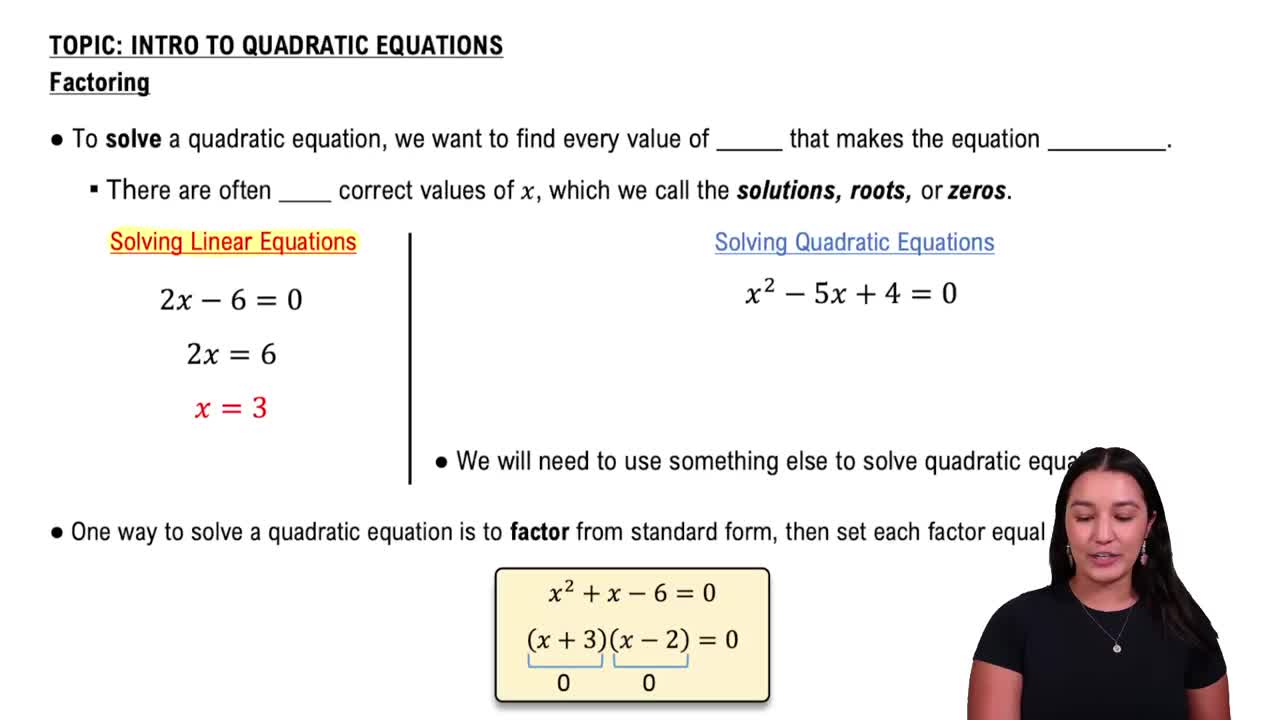
Solve each factor equal to zero: \(x - 6 = 0\) gives \(x = 6\), and \(x + 1 = 0\) gives \(x = -1\). These values are excluded from the domain.
Verified video answer for a similar problem:
This video solution was recommended by our tutors as helpful for the problem above
Video duration:
5m
Play a video:
0 Comments
Key Concepts
Here are the essential concepts you must grasp in order to answer the question correctly.
Rational Expressions
A rational expression is a fraction where both the numerator and denominator are polynomials. Understanding rational expressions involves knowing how to simplify, evaluate, and find restrictions on the variable to avoid division by zero.
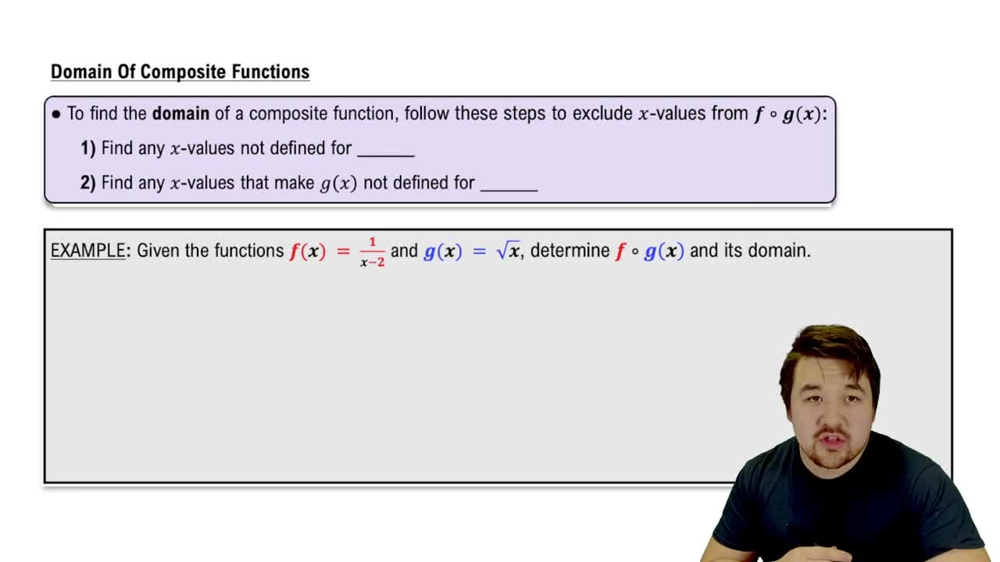
The domain of a function is the set of all possible input values (x-values) for which the function is defined. For rational expressions, the domain excludes values that make the denominator zero, as division by zero is undefined.
Factoring quadratics involves rewriting a quadratic polynomial as a product of two binomials. This skill is essential to identify values that make the denominator zero by setting each factor equal to zero and solving for x.

 5:07 minutes
 Verified step by step guidance
 02:58
02:58