Use set notation, and list all the elements of each set. {17, 22, 27, .. , 47}
Verified step by step guidance
1
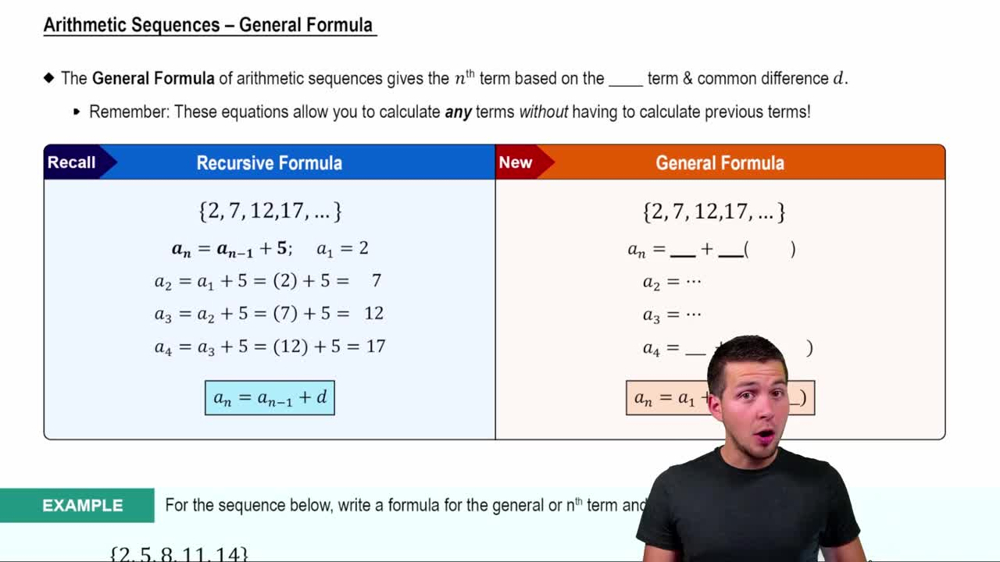
Identify the pattern in the given set: {17, 22, 27, .. , 47}. Notice that the numbers increase by 5 each time, so this is an arithmetic sequence with the first term \(a_1 = 17\) and common difference \(d = 5\).
To list all elements, start from 17 and keep adding 5 until you reach or pass 47. The terms are: \$17, 22, 27, 32, 37, 42, 47$.
Express the set in set notation by listing all these elements explicitly: \(\{17, 22, 27, 32, 37, 42, 47\}\).
Alternatively, you can describe the set using a formula for the \(n\)-th term of an arithmetic sequence: \(a_n = a_1 + (n-1)d\) where \(a_n \leq 47\).
Determine the number of terms by solving \(17 + (n-1) \times 5 = 47\) to find the largest \(n\) that fits, confirming the number of elements in the set.
Verified video answer for a similar problem:
This video solution was recommended by our tutors as helpful for the problem above
Video duration:
1m
Play a video:
0 Comments
Key Concepts
Here are the essential concepts you must grasp in order to answer the question correctly.
Set Notation
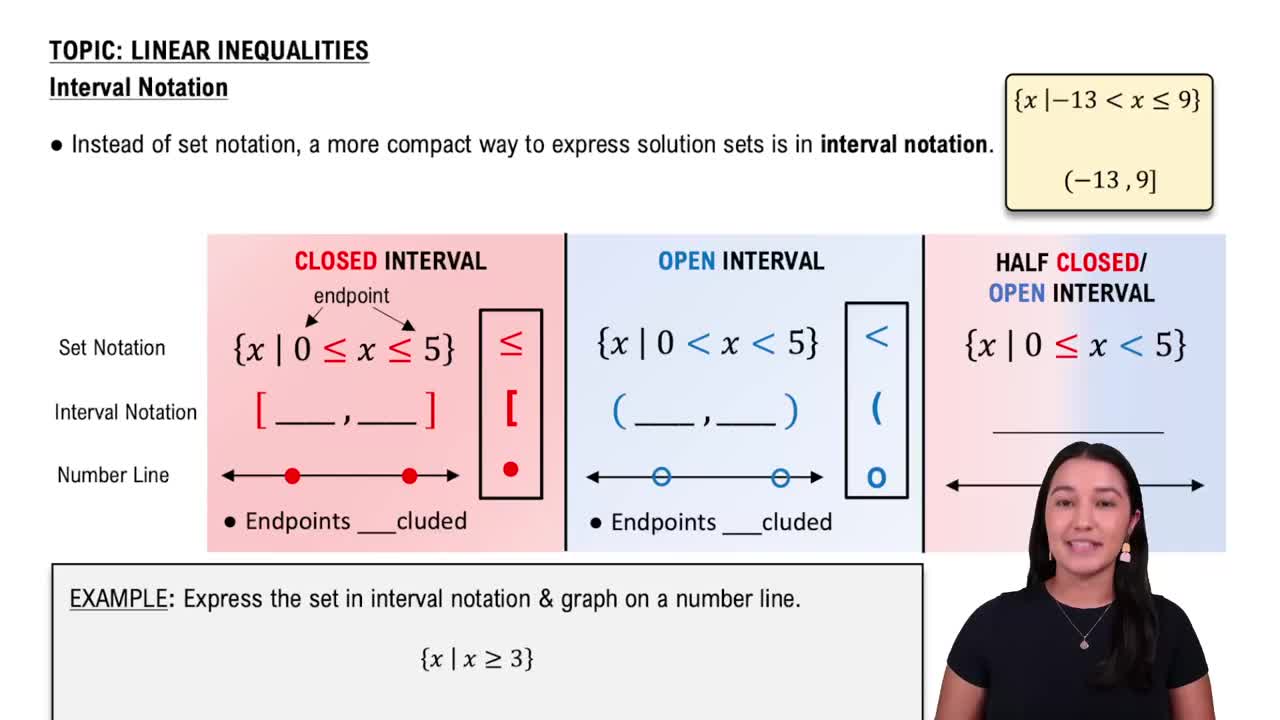
Set notation is a way to describe a collection of distinct objects, called elements, using curly braces {}. Elements can be listed explicitly or described by a rule. For example, {1, 2, 3} lists elements, while {x | x is an integer between 1 and 3} uses a rule.
An arithmetic sequence is a list of numbers with a constant difference between consecutive terms. In the given set {17, 22, 27, ..., 47}, the difference is 5. Understanding this helps to find all elements by adding the common difference repeatedly until reaching the last term.
Listing elements means explicitly writing out all members of a set. For sequences, this involves starting from the first term and adding the common difference until the last term is included. This clarifies the set's contents and ensures no elements are missed.

 1:43 minutes
 Verified step by step guidance
 05:18
05:18