Use set notation, and list all the elements of each set. {1, 1/2, 1/4, ...., 1/32} .
Verified step by step guidance
1
Identify the pattern in the given set: the elements are fractions starting from 1 and each subsequent element is half of the previous one.
Express the elements as powers of \( \frac{1}{2} \). The first element is \( 1 = \left( \frac{1}{2} \right)^0 \), the second is \( \frac{1}{2} = \left( \frac{1}{2} \right)^1 \), the third is \( \frac{1}{4} = \left( \frac{1}{2} \right)^2 \), and so on.
Determine the exponent for the last element \( \frac{1}{32} \). Since \( \frac{1}{32} = \left( \frac{1}{2} \right)^5 \), the exponents go from 0 to 5.
Write the set in set-builder notation as \( \left\{ x \mid x = \left( \frac{1}{2} \right)^n, n \in \mathbb{Z}, 0 \leq n \leq 5 \right\} \).
List all the elements explicitly: \( \left\{ 1, \frac{1}{2}, \frac{1}{4}, \frac{1}{8}, \frac{1}{16}, \frac{1}{32} \right\} \).
Verified video answer for a similar problem:
This video solution was recommended by our tutors as helpful for the problem above
Video duration:
2m
Play a video:
0 Comments
Key Concepts
Here are the essential concepts you must grasp in order to answer the question correctly.
Set Notation
Set notation is a way to describe a collection of distinct objects, called elements, using curly braces {}. Elements are listed or described by a rule. For example, {1, 2, 3} lists elements explicitly, while {x | x is a positive integer less than 4} uses a rule.
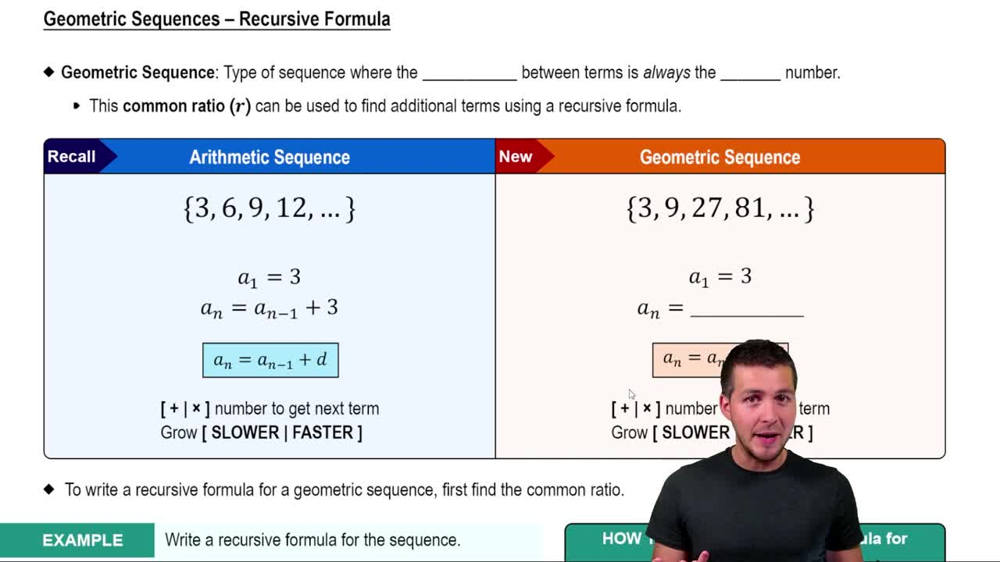
A geometric sequence is a list of numbers where each term is found by multiplying the previous term by a constant ratio. In this problem, the terms 1, 1/2, 1/4, ..., 1/32 form a geometric sequence with ratio 1/2.
Listing elements of a set means writing out all individual members explicitly. For finite sets, this involves enumerating each element separated by commas within braces. Here, the set includes all terms from 1 down to 1/32 in the given sequence.

 2:46 minutes
 Verified step by step guidance
 05:18
05:18