Use a graphing calculator to find the coordinates of the turning points of the graph of each polynomial function in the given domain interval. Give answers to the nearest hundredth. ƒ(x)=2x3-5x2-x+1; [1.4, 2]
Verified step by step guidance
1
Understand that turning points of a polynomial function occur where the derivative equals zero, as these points correspond to local maxima or minima on the graph.
Find the first derivative of the function \( f(x) = 2x^3 - 5x^2 - x + 1 \). Use the power rule for differentiation: \( f'(x) = 6x^2 - 10x - 1 \).
Use the graphing calculator to graph the derivative function \( f'(x) = 6x^2 - 10x - 1 \) over the domain interval \([1.4, 2]\) and find the values of \( x \) where \( f'(x) = 0 \). These \( x \)-values are the candidates for turning points within the interval.
For each \( x \)-value found, substitute it back into the original function \( f(x) = 2x^3 - 5x^2 - x + 1 \) to find the corresponding \( y \)-coordinate of the turning point.
Round the coordinates \( (x, f(x)) \) of each turning point to the nearest hundredth as required.
Verified video answer for a similar problem:
This video solution was recommended by our tutors as helpful for the problem above
Video duration:
2m
Play a video:
0 Comments
Key Concepts
Here are the essential concepts you must grasp in order to answer the question correctly.
Turning Points of a Polynomial Function
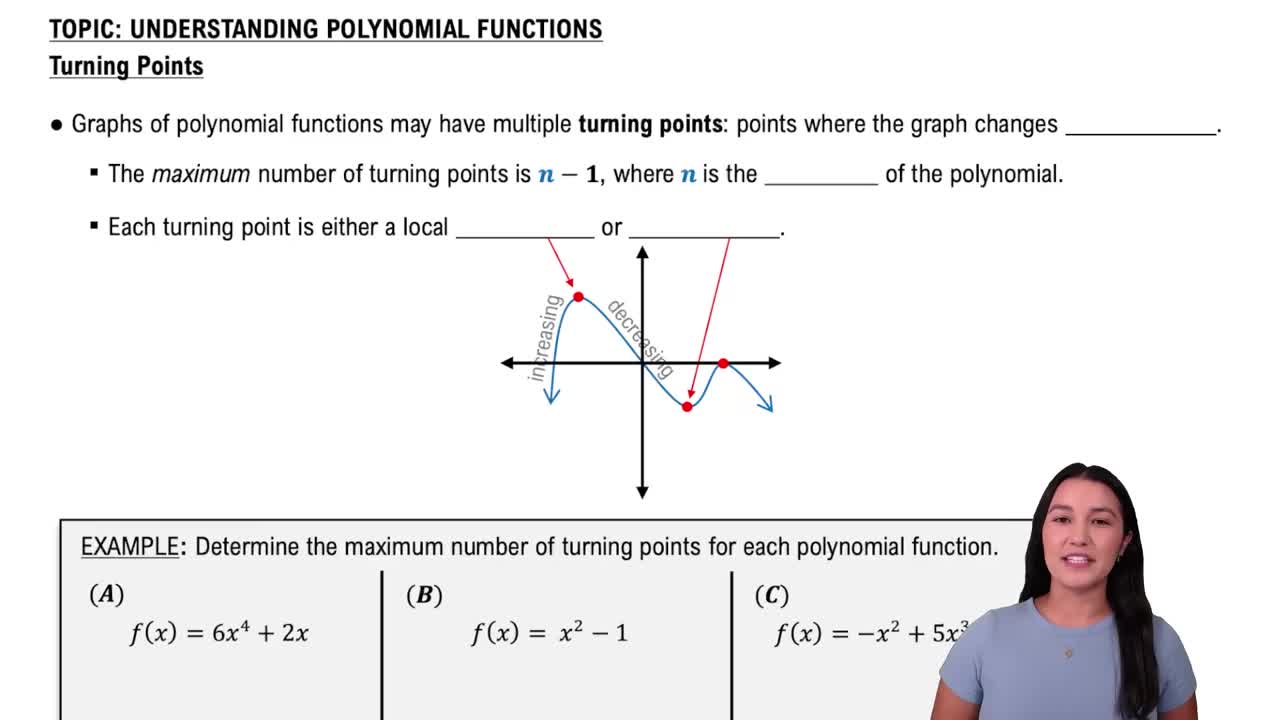
Turning points are points on the graph where the function changes direction from increasing to decreasing or vice versa. For polynomial functions, these correspond to local maxima or minima, which occur where the derivative equals zero. Identifying turning points helps understand the shape and behavior of the graph.
Using a Graphing Calculator to Find Turning Points
A graphing calculator can approximate turning points by graphing the function and using built-in tools like 'maximum' and 'minimum' within a specified domain. This method provides numerical coordinates of turning points, especially useful when algebraic solutions are complex or not easily obtainable.
Restricting the domain to [1.4, 2] means only turning points within this interval are considered. Rounding answers to the nearest hundredth ensures numerical results are precise but manageable, which is important for practical interpretation and reporting of coordinates.