Use the given row transformation to change each matrix as indicated.
Verified step by step guidance
1
Identify the given matrix and label its rows as \( R_1 \), \( R_2 \), and \( R_3 \).
Understand the row operation: "4 times row 1 added to row 2" means you will replace \( R_2 \) with \( R_2 + 4 \times R_1 \).
Write the new row 2 as \( R_2' = R_2 + 4R_1 \). This means you add 4 times each element of row 1 to the corresponding element of row 2.
Keep rows 1 and 3 unchanged, so \( R_1' = R_1 \) and \( R_3' = R_3 \).
Perform the addition element-wise for row 2 to get the updated matrix after the row transformation.
Verified video answer for a similar problem:
This video solution was recommended by our tutors as helpful for the problem above
Video duration:
3m
Play a video:
0 Comments
Key Concepts
Here are the essential concepts you must grasp in order to answer the question correctly.
Elementary Row Operations
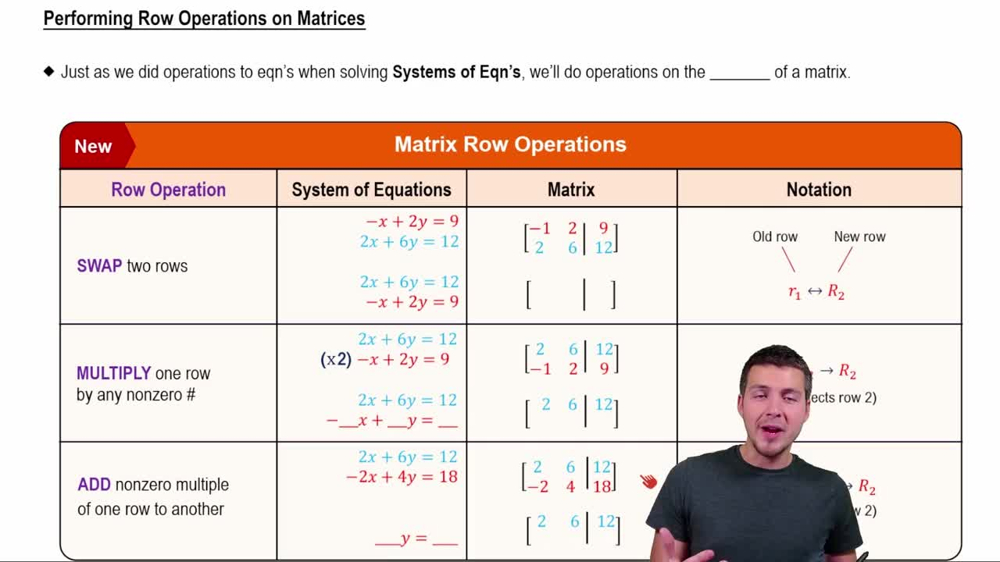
Elementary row operations are basic manipulations performed on the rows of a matrix to simplify or solve systems of equations. These include swapping rows, multiplying a row by a nonzero scalar, and adding a multiple of one row to another. Understanding these operations is essential for matrix transformations and solving linear systems.
A matrix is a rectangular array of numbers arranged in rows and columns. Each element is identified by its row and column position. Familiarity with matrix notation helps in accurately performing and describing operations like adding multiples of one row to another.
The row addition operation involves adding a multiple of one row to another row to create zeros or simplify the matrix. For example, '4 times row 1 added to row 2' means multiplying every element in row 1 by 4 and adding the result to the corresponding elements in row 2, altering row 2 while keeping other rows unchanged.

 3:00 minutes
 Verified step by step guidance
 8:38
8:38