In Exercises 23–30, use expansion by minors to evaluate each determinant. 3−3−114300−5
Verified step by step guidance
1
Identify the 3x3 matrix for which you need to find the determinant using expansion by minors:
\[\begin{vmatrix} 3 & 1 & 0 \\ -3 & 4 & 0 \\ -1 & 3 & -5 \end{vmatrix}\]
Choose a row or column to expand along. It is often easiest to choose a row or column with zeros to simplify calculations. Here, the third column has two zeros, so expand along the third column.
Write the determinant as a sum of the elements in the chosen column multiplied by their corresponding cofactors. For the third column, the determinant is:
\[0 \cdot C_{13} + 0 \cdot C_{23} + (-5) \cdot C_{33}\]
where \(C_{ij}\) is the cofactor of the element in row \(i\), column \(j\).
Calculate the cofactor \(C_{33}\). The cofactor is given by:
\[C_{33} = (-1)^{3+3} \times M_{33}\]
where \(M_{33}\) is the minor obtained by deleting the third row and third column from the matrix. So, find the determinant of the 2x2 matrix:
\[\begin{vmatrix} 3 & 1 \\ -3 & 4 \end{vmatrix}\]
Compute the 2x2 determinant:
\[M_{33} = (3)(4) - (1)(-3)\]
Then multiply by \((-1)^{6} = 1\) to get \(C_{33}\). Finally, multiply \(C_{33}\) by the element \(-5\) from the original matrix to get the determinant of the 3x3 matrix.
Verified video answer for a similar problem:
This video solution was recommended by our tutors as helpful for the problem above
Video duration:
5m
Play a video:
0 Comments
Key Concepts
Here are the essential concepts you must grasp in order to answer the question correctly.
Determinant of a Matrix
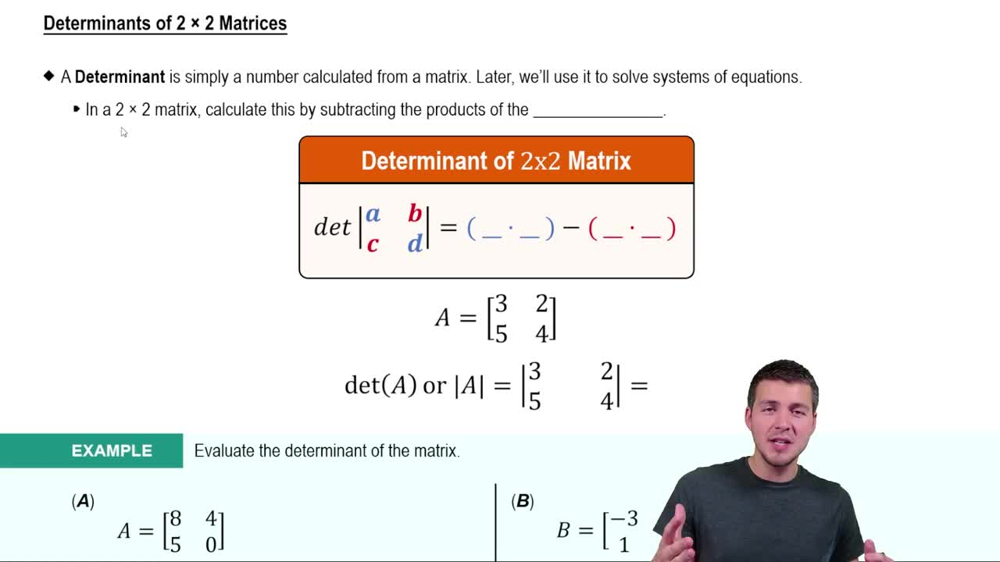
The determinant is a scalar value that can be computed from a square matrix and provides important properties such as invertibility. For a 3x3 matrix, the determinant helps determine if the matrix is singular or nonsingular and is essential in solving systems of linear equations.
Expansion by minors is a method to calculate the determinant of a matrix by expanding along a row or column. It involves computing minors, which are determinants of smaller matrices formed by deleting one row and one column, and combining them with cofactors that include sign adjustments.
A cofactor is the minor of an element multiplied by (-1) raised to the sum of the element's row and column indices. The sign pattern alternates in a checkerboard fashion starting with a positive sign at the top-left element, which is crucial for correctly calculating the determinant using expansion by minors.

 5:36 minutes
 Verified step by step guidance
 4:36
4:36