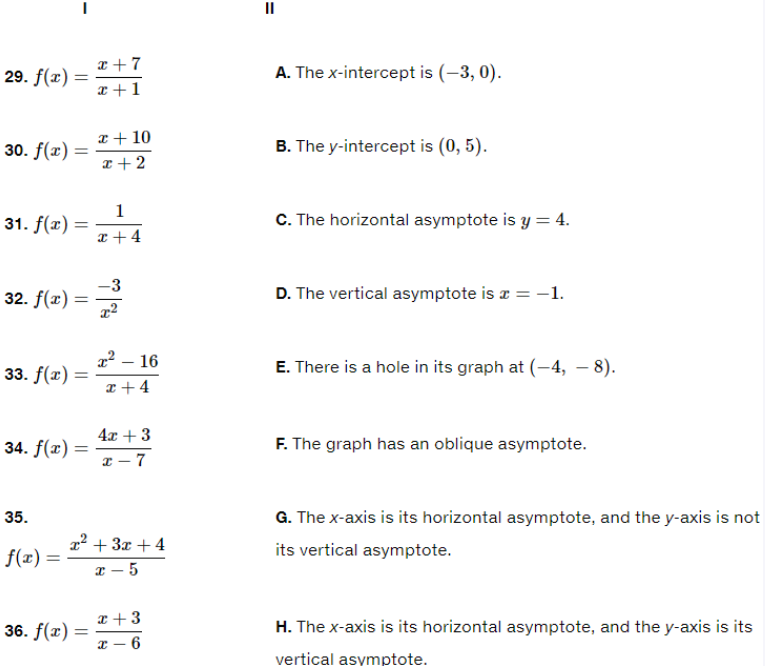
Match the rational function in Column I with the appropriate description in Column II. Choices in Column II can be used only once. ƒ(x)=1/(x+4)
Verified step by step guidance
1
Identify the given rational function: \(f(x) = \frac{1}{x+4}\).
Recognize that the function is a transformation of the parent function \(f(x) = \frac{1}{x}\), shifted horizontally.
Determine the vertical asymptote by setting the denominator equal to zero: \(x + 4 = 0\), which gives \(x = -4\).
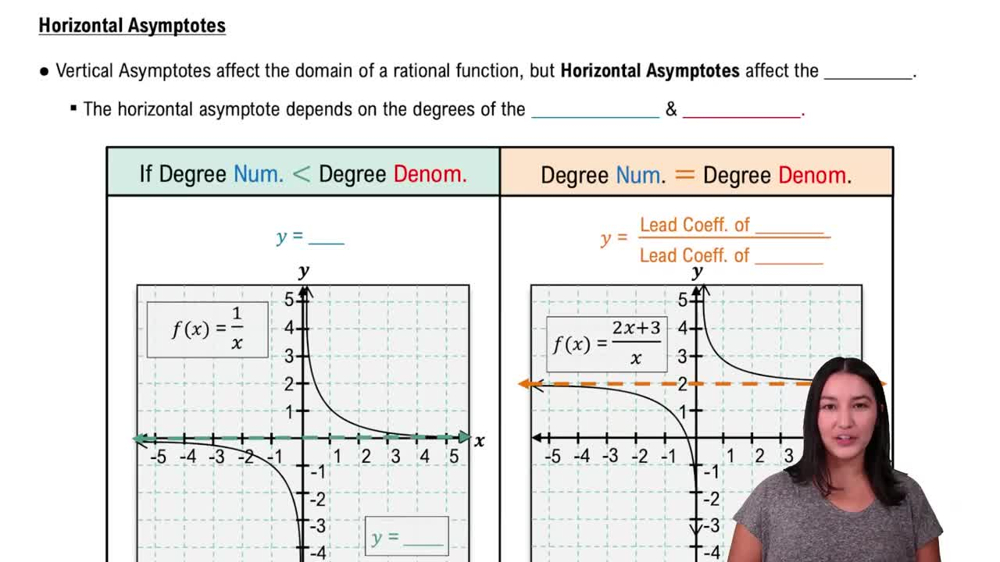
Note that the horizontal asymptote of the function remains \(y = 0\) because the degree of the numerator is less than the degree of the denominator.
Match the function to the description that mentions a vertical asymptote at \(x = -4\) and a horizontal asymptote at \(y = 0\), indicating a horizontal shift of the parent function.
Verified video answer for a similar problem:
This video solution was recommended by our tutors as helpful for the problem above
Video duration:
1m
Play a video:
0 Comments
Key Concepts
Here are the essential concepts you must grasp in order to answer the question correctly.
Rational Functions
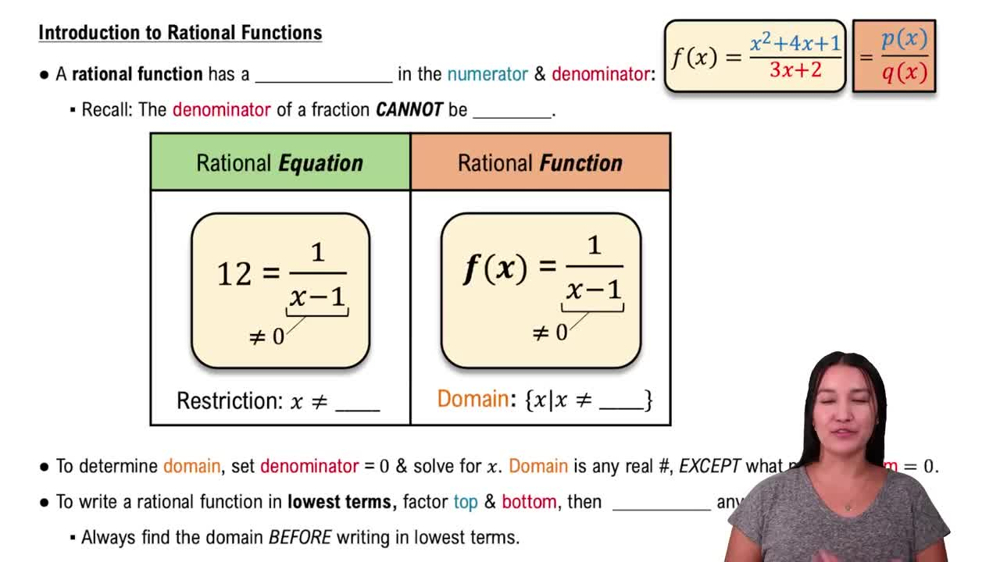
A rational function is a ratio of two polynomials, expressed as f(x) = P(x)/Q(x), where Q(x) ≠ 0. Understanding the form and behavior of rational functions helps in identifying their key features such as asymptotes and domain restrictions.
The domain of a rational function includes all real numbers except where the denominator equals zero. For f(x) = 1/(x+4), the domain excludes x = -4, since division by zero is undefined, which is critical for matching the function to its description.
Vertical asymptotes occur where the denominator is zero, indicating values the function cannot take. Horizontal asymptotes describe the end behavior of the function as x approaches infinity or negative infinity. For f(x) = 1/(x+4), x = -4 is a vertical asymptote, and y = 0 is a horizontal asymptote.