Find the vertical asymptotes, if any, and the values of x corresponding to holes, if any, of the graph of each rational function. f(x)=(x2−9)/(x−3)
Verified step by step guidance
1
Start by identifying the rational function given: \(f(x) = \frac{x^{2} - 9}{x - 3}\).
Factor the numerator \(x^{2} - 9\) using the difference of squares formula: \(a^{2} - b^{2} = (a - b)(a + b)\), so \(x^{2} - 9 = (x - 3)(x + 3)\).
Rewrite the function using the factored form: \(f(x) = \frac{(x - 3)(x + 3)}{x - 3}\).
Look for common factors in the numerator and denominator. Since \((x - 3)\) appears in both, it can be canceled out, but note that \(x \neq 3\) because it would make the denominator zero.
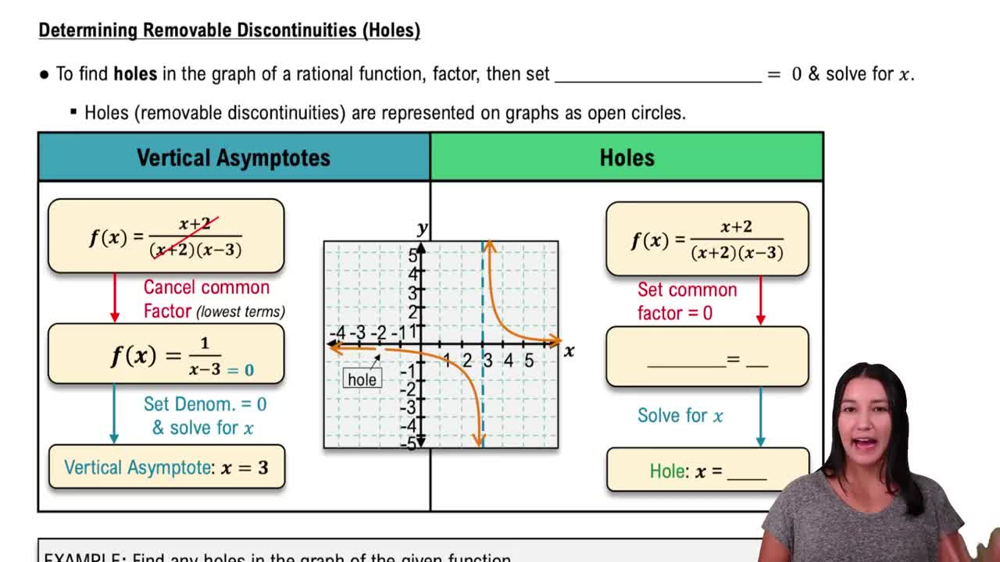
Determine the vertical asymptotes and holes: the value \(x = 3\) causes the denominator to be zero. Since \((x - 3)\) cancels, there is a hole at \(x = 3\). There are no other values making the denominator zero, so there are no vertical asymptotes.
Verified video answer for a similar problem:
This video solution was recommended by our tutors as helpful for the problem above
Video duration:
2m
Play a video:
0 Comments
Key Concepts
Here are the essential concepts you must grasp in order to answer the question correctly.
Rational Functions
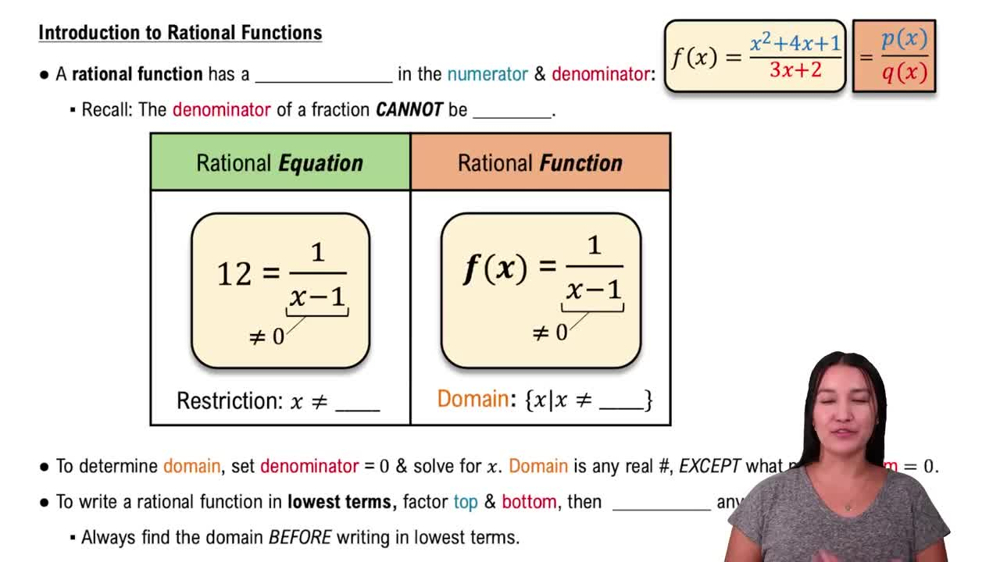
A rational function is a ratio of two polynomials, expressed as f(x) = P(x)/Q(x). Understanding the behavior of rational functions involves analyzing their domains, zeros, and discontinuities, which occur where the denominator equals zero.
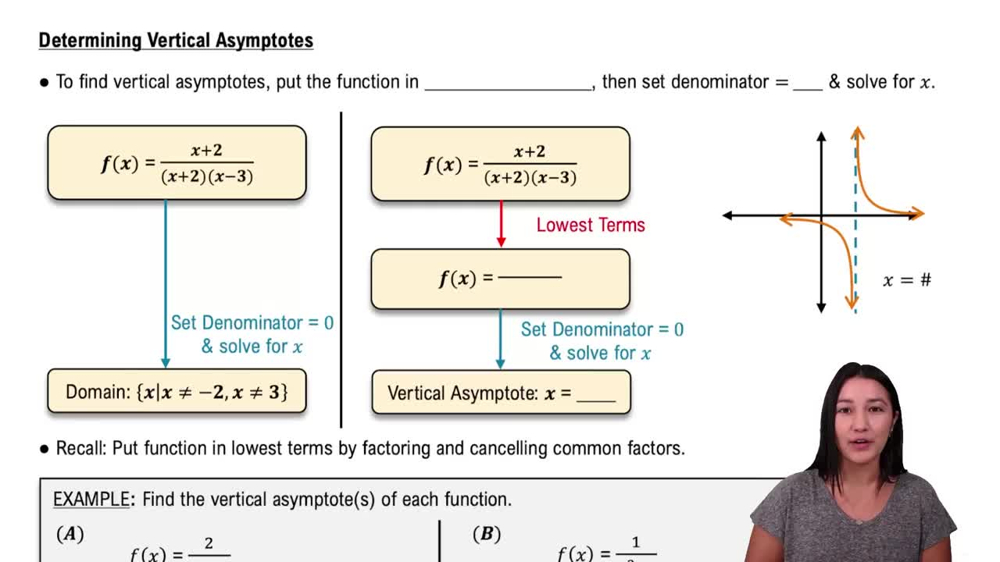
Vertical asymptotes occur at values of x where the denominator of a rational function is zero and the numerator is nonzero, causing the function to approach infinity or negative infinity. They represent lines the graph approaches but never touches.
Holes occur when a factor cancels out from both numerator and denominator, creating a removable discontinuity. At these x-values, the function is undefined, but the limit exists, resulting in a 'hole' in the graph rather than an asymptote.

 2:23 minutes
 Verified step by step guidance
 6:04
6:04