Find the slope of the line passing through each pair of points or state that the slope is undefined. Then indicate whether the line through the points rises, falls, is horizontal, or is vertical. (4, -1) and (3, −1)
Table of contents
- 0. Review of Algebra4h 18m
- 1. Equations & Inequalities3h 18m
- 2. Graphs of Equations1h 43m
- 3. Functions2h 17m
- 4. Polynomial Functions1h 44m
- 5. Rational Functions1h 23m
- 6. Exponential & Logarithmic Functions2h 28m
- 7. Systems of Equations & Matrices4h 5m
- 8. Conic Sections2h 23m
- 9. Sequences, Series, & Induction1h 22m
- 10. Combinatorics & Probability1h 45m
2. Graphs of Equations
Lines
Problem 17
Textbook Question
Find the average rate of change of the function from x1 to x2. f(x) = √x from x1 = 4 to x2 = 9
Verified step by step guidance1
Identify the function given: \(f(x) = \sqrt{x}\), and the interval endpoints \(x_1 = 4\) and \(x_2 = 9\).
Recall the formula for the average rate of change of a function \(f(x)\) over the interval \([x_1, x_2]\):
\(\text{Average Rate of Change} = \frac{f(x_2) - f(x_1)}{x_2 - x_1}\).
Calculate the function values at the endpoints:
\(f(x_1) = f(4) = \sqrt{4}\) and \(f(x_2) = f(9) = \sqrt{9}\).
Substitute these values into the average rate of change formula:
\(\frac{\sqrt{9} - \sqrt{4}}{9 - 4}\).
Simplify the numerator and denominator separately, then divide to find the average rate of change over the interval.
Verified video answer for a similar problem:This video solution was recommended by our tutors as helpful for the problem above
Video duration:
3mPlay a video:
Key Concepts
Here are the essential concepts you must grasp in order to answer the question correctly.
Average Rate of Change
The average rate of change of a function between two points measures how much the function's output changes per unit change in input. It is calculated as the difference in function values divided by the difference in input values, similar to the slope of a secant line connecting the two points.
Recommended video:
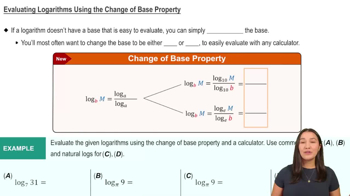
Change of Base Property
Square Root Function
The square root function, denoted as f(x) = √x, outputs the non-negative number whose square is x. It is defined for x ≥ 0 and is a common example of a radical function, which often requires careful evaluation when calculating function values at specific points.
Recommended video:
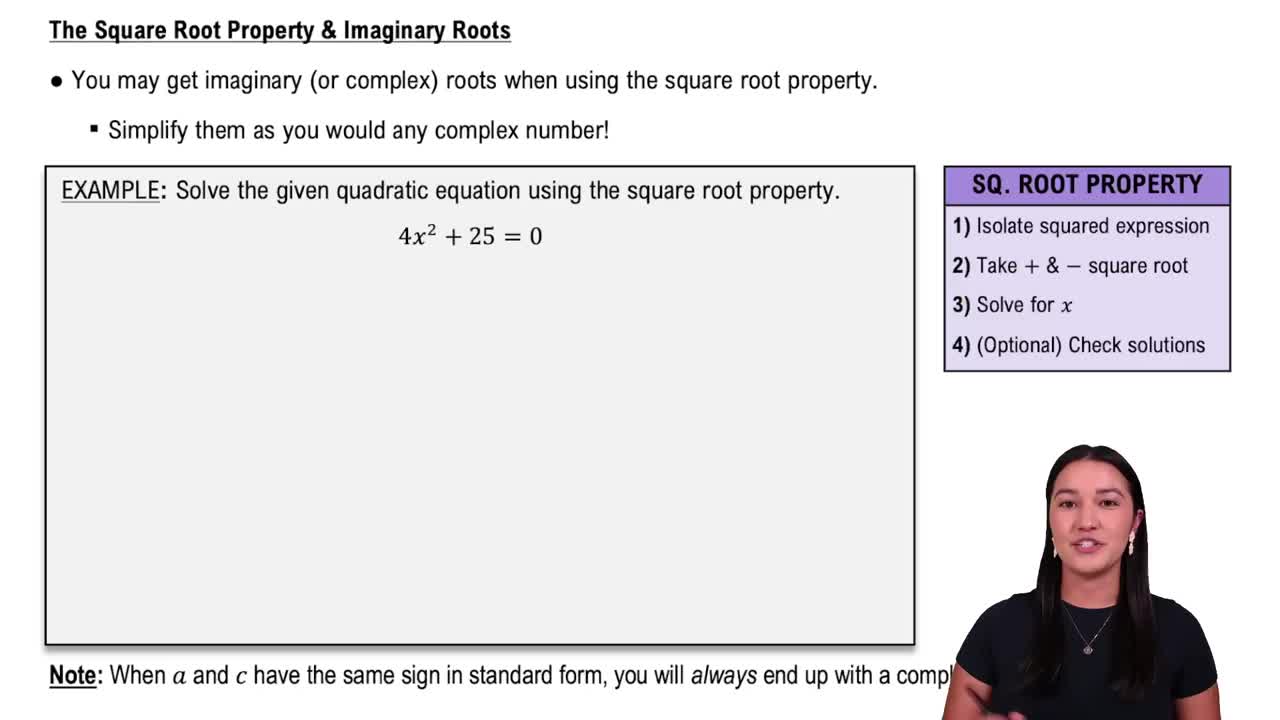
Imaginary Roots with the Square Root Property
Evaluating Functions at Given Points
To find the average rate of change, you must correctly evaluate the function at the specified input values. This involves substituting the input values into the function and simplifying, ensuring accurate calculation of the function's outputs at those points.
Recommended video:
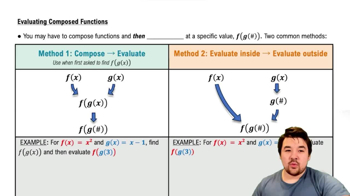
Evaluating Composed Functions
Related Videos
Related Practice
Textbook Question
55
views
