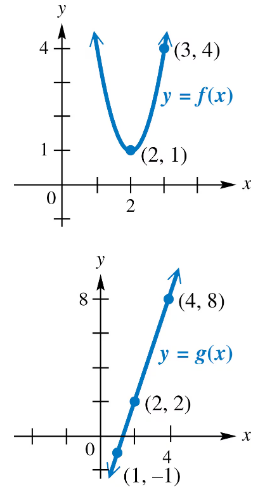
The graphs of two functions ƒ and g are shown in the figures. Find (g∘ƒ)(3).
Verified step by step guidance
1
Identify the value of ƒ(3) by using the graph of the function ƒ. Since the graph shows points (1, -2) and (4, 10), first find the equation of the line passing through these points.
Calculate the slope \( m \) of the line using the formula \( m = \frac{y_2 - y_1}{x_2 - x_1} \), where \( (x_1, y_1) = (1, -2) \) and \( (x_2, y_2) = (4, 10) \).
Use the point-slope form of a line equation \( y - y_1 = m(x - x_1) \) to write the equation of the function \( f(x) \). Substitute one of the points and the slope \( m \) into this formula.
Substitute \( x = 3 \) into the equation of \( f(x) \) to find \( f(3) \). This gives the output value of the function \( f \) at \( x = 3 \).
Next, use the value \( f(3) \) as the input for the function \( g \), i.e., find \( g(f(3)) \). To do this, you will need the graph or equation of \( g \) (which is not provided here), so locate \( g(f(3)) \) on the graph of \( g \) or use its equation to find the final value.
Verified video answer for a similar problem:
This video solution was recommended by our tutors as helpful for the problem above
Video duration:
3m
Play a video:
0 Comments
Key Concepts
Here are the essential concepts you must grasp in order to answer the question correctly.
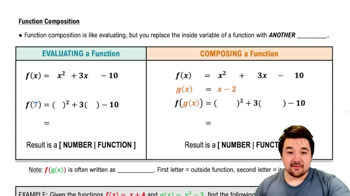
Function Composition
Function composition involves applying one function to the result of another, denoted as (g∘f)(x) = g(f(x)). To find (g∘f)(3), first find f(3), then use that output as the input for g. This concept is essential for understanding how two functions combine to form a new function.
To evaluate functions from their graphs, identify the input value on the x-axis and find the corresponding output on the y-axis. Points marked on the graph, like (1, -2) and (4, 10), help determine exact function values. Accurate reading is crucial for solving problems involving function evaluation.
A linear function graphs as a straight line and can be identified by two points. The slope and intercept define the function's behavior. Understanding linear functions helps in estimating or calculating values not explicitly marked on the graph, such as f(3) in this problem.