Graph each function. See Examples 6–8 and the Summary of Graphing Techniques box following Example 9. g(x)=(x+2)2
Table of contents
- 0. Review of Algebra4h 18m
- 1. Equations & Inequalities3h 18m
- 2. Graphs of Equations1h 43m
- 3. Functions2h 17m
- 4. Polynomial Functions1h 44m
- 5. Rational Functions1h 23m
- 6. Exponential & Logarithmic Functions2h 28m
- 7. Systems of Equations & Matrices4h 5m
- 8. Conic Sections2h 23m
- 9. Sequences, Series, & Induction1h 22m
- 10. Combinatorics & Probability1h 45m
3. Functions
Transformations
Problem 5
Textbook Question
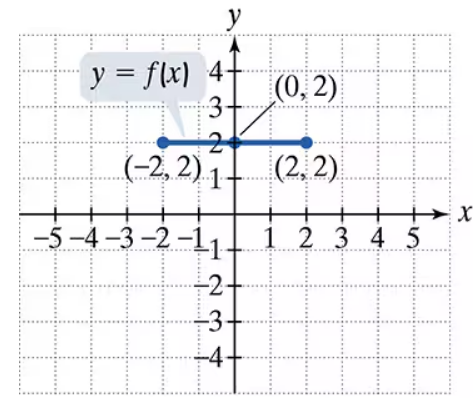
Use the graph of y = f(x) to graph each function g.

g(x) = f(x-1) - 2
Verified step by step guidance1
Identify the original function f(x) from the graph. Here, f(x) is a horizontal line segment from x = 1 to x = 4 with a constant value of y = -3.
Understand the transformation in g(x) = f(x - 1) - 2. The term (x - 1) inside the function shifts the graph of f(x) horizontally to the right by 1 unit.
The '- 2' outside the function shifts the graph vertically downward by 2 units.
Apply the horizontal shift: move the original segment from [1, 4] to [2, 5] because each x-value increases by 1.
Apply the vertical shift: subtract 2 from the y-value of -3, resulting in a new y-value of -5. So, the new segment for g(x) is from (2, -5) to (5, -5).
Verified video answer for a similar problem:This video solution was recommended by our tutors as helpful for the problem above
Video duration:
1mPlay a video:
0 Comments
Key Concepts
Here are the essential concepts you must grasp in order to answer the question correctly.
Function Transformation
Function transformations involve shifting, stretching, or reflecting the graph of a function. In this problem, g(x) = f(x-1) - 2 represents a horizontal shift to the right by 1 unit and a vertical shift downward by 2 units of the original function f(x). Understanding these shifts helps in accurately graphing the new function.
Recommended video:
Domain & Range of Transformed Functions
Horizontal Shift
A horizontal shift occurs when the input variable x is replaced by (x - h), shifting the graph h units to the right if h is positive, or to the left if h is negative. Here, f(x-1) shifts the graph of f(x) one unit to the right, moving every point on the graph accordingly.
Recommended video:
Shifts of Functions
Vertical Shift
A vertical shift involves adding or subtracting a constant to the function's output, moving the graph up or down. In g(x) = f(x-1) - 2, subtracting 2 shifts the entire graph of f(x-1) down by 2 units, lowering the y-values of all points by 2.
Recommended video:
Shifts of Functions
Related Videos
Related Practice
Textbook Question
874
views