 Back
BackAbsolute Value Equations and Inequalities: College Algebra Study Guide
Study Guide - Smart Notes
 Tailored notes based on your materials, expanded with key definitions, examples, and context.
Equations & Inequalities
Absolute Value Equations and Inequalities
Absolute value equations and inequalities are fundamental tools in algebra, allowing us to describe distances and tolerances mathematically. This section covers how to solve equations and inequalities involving absolute value, interpret their solutions, and apply them to real-world contexts.
Definition of Absolute Value
Absolute Value of a number is its distance from 0 on the number line, denoted as |x|.
For any real number x:
Absolute value is always non-negative.
Solving Absolute Value Equations
To solve equations involving absolute value, rewrite the equation without absolute value bars, resulting in two separate equations.
If (where c > 0), then or .
If , then .
If (where c < 0), there is no solution because absolute value cannot be negative.
Example: Solve .
Rewrite: or
Solutions: or
Solving Absolute Value Inequalities
Absolute value inequalities often yield solution sets that are intervals rather than single points. The method depends on the form of the inequality.
Type 1: (c > 0) →
Type 2: (c > 0) → or
Type 3: (c < 0): - has no solution - is true for all real numbers for which u is defined
Example: Solving
Rewrite:
Add 1:
Divide by 3:
Graphical Representation of Solution Sets
Solutions to absolute value inequalities are often represented on a number line. Closed intervals indicate inclusive bounds, while open intervals indicate exclusive bounds.
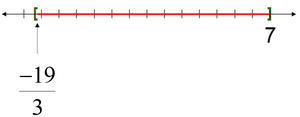
Example: The solution set is shown as a closed interval on the number line.

Example: The solution set or is shown as two open intervals on the number line.

Example: The solution set is shown as a closed interval on the number line.
Applications of Absolute Value Inequalities
Absolute value inequalities are used to describe tolerances and margins of error in real-world situations.
Example: If a machine part is supposed to be 9.4 cm with a tolerance of 0.01 cm, the acceptable range is .
Solving: →
Interpretation: The part is acceptable if its length is between 9.39 cm and 9.41 cm.
Example: A poll shows 41% of adults dread going to the dentist, with a margin of error of 3.2%. The range is .
Solving:
Interpretation: The percentage is between 37.8% and 44.2%.
Summary Table: Types of Absolute Value Equations and Inequalities
Form | Solution Method | Solution Set |
|---|---|---|
(c > 0) | Rewrite as or | Two points |
Rewrite as | One point | |
(c < 0) | No solution | Empty set |
(c > 0) | Rewrite as | Interval |
(c > 0) | Rewrite as or | Two intervals |
(c < 0) | No solution | Empty set |
(c < 0) | All real numbers | Entire real line |
Key Points
Absolute value equations often yield two solutions.
Absolute value inequalities typically yield intervals as solution sets.
Graphical representation helps visualize solution sets.
Applications include tolerances in manufacturing and margins of error in statistics.
