 Back
BackChapter 1.5: Solving Inequalities – College Algebra Study Guide
Study Guide - Smart Notes
 Tailored notes based on your materials, expanded with key definitions, examples, and context.
Equations and Inequalities
Solving Inequalities
This section introduces the concept of inequalities, their notation, properties, and methods for solving and graphing them. Understanding inequalities is fundamental in algebra, as they describe ranges of values rather than single solutions.
Intervals and Interval Notation
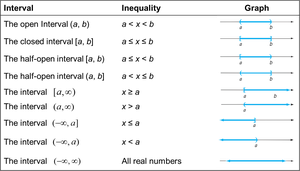
Intervals are sets of real numbers defined by inequalities. Interval notation is a concise way to represent these sets.
Open Interval: represents all real numbers such that .
Closed Interval: represents all real numbers such that .
Half-Open/Half-Closed Intervals: or represent all real numbers such that or , respectively.
Infinite Intervals: , , , represent all real numbers greater or less than a given value.
Example: The interval consists of all such that .
Writing Inequalities Using Interval Notation
Example: is written as in interval notation.
Example: is written as .
Example: is written as .
Example: is written as .
Writing Intervals Using Inequality Notation
Example: means .
Example: means .
Example: means .
Example: means .
Properties of Inequalities
Several properties govern the manipulation of inequalities, allowing us to solve and simplify them.
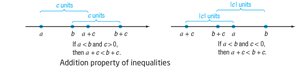
Addition Property: For real numbers :
If , then .
If , then .
Multiplication Property: For real numbers :
If and , then .
If and , then (the inequality reverses).
If and , then .
If and , then (the inequality reverses).
Reciprocal Property:
If , then .
If , then .
If , then .
If , then .
Procedures Affecting Inequality Symbols
Unchanged Symbol:
Simplifying both sides
Adding/subtracting the same expression
Multiplying/dividing by a positive expression
Reversed Symbol:
Interchanging sides (e.g., becomes )
Multiplying/dividing by a negative expression
Solving Inequalities
Solving inequalities involves isolating the variable and applying the properties above. The solution is often represented in interval notation and graphed on a number line.
Example: Solve .
Subtract 5:
Divide by (reverse symbol):
Interval notation:

Example: Solve .
Add 2:
Subtract :
Interval notation:

Solving Combined (Compound) Inequalities
Compound inequalities involve two inequalities joined together, often describing a range of values.
Example: Solve .
Split into two: and
Solve both:
Interval notation:

Example: Solve .
Multiply by 2:
Subtract 2:
Divide by (reverse symbol):
Reverse order:
Interval notation:

Using Reciprocal Properties to Solve Inequalities
Reciprocal properties are useful when inequalities involve fractions or variables in the denominator.
Example: Solve .
Add 4:
Divide by 2:
Apply reciprocal property as needed

Creating Equivalent Inequalities
Equivalent inequalities can be formed by applying properties to each part of a compound inequality.
Example: If , dividing each part by 2 gives .
Application: Ohm’s Law in Physics
Algebraic inequalities are used in real-world applications, such as physics. Ohm’s Law relates voltage, current, and resistance.
Formula:
Example: If and , then gives amperes.
Interval Notation | Inequality Notation | Graph Description |
|---|---|---|
(a, b) | a < x < b | Open endpoints |
[a, b] | a \leq x \leq b | Closed endpoints |
[a, b) | a \leq x < b | Closed at a, open at b |
(a, b] | a < x \leq b | Open at a, closed at b |
(a, \infty) | x > a | Open at a, arrow right |
[a, \infty) | x \geq a | Closed at a, arrow right |
(-\infty, b) | x < b | Open at b, arrow left |
(-\infty, b] | x \leq b | Closed at b, arrow left |
Additional info: The notes expand on brief points by providing full definitions, examples, and applications, ensuring completeness and academic quality for exam preparation.
