 Back
BackCollege Algebra: Core Concepts and Applications
Study Guide - Smart Notes
 Tailored notes based on your materials, expanded with key definitions, examples, and context.
R. Review of Basic Concepts
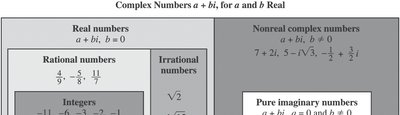
Complex Numbers and Number Sets
Understanding the structure of the real and complex number systems is foundational in algebra. Numbers can be classified into several sets, each with unique properties.
Natural Numbers: Counting numbers (1, 2, 3, ...).
Whole Numbers: Natural numbers plus zero (0, 1, 2, ...).
Integers: Whole numbers and their negatives (..., -2, -1, 0, 1, 2, ...).
Rational Numbers: Numbers expressible as a fraction of two integers (e.g., , ).
Irrational Numbers: Numbers that cannot be written as a simple fraction (e.g., , ).
Real Numbers: All rational and irrational numbers.
Complex Numbers: Numbers of the form , where and are real and .
1. Equations and Inequalities
Solving Linear Equations
Linear equations are equations of the first degree, typically written as where .
Solution: A value of that makes the equation true.
Solution Set: The set of all solutions.
Equivalent Equations: Equations with the same solution set.
To solve a linear equation:
Simplify both sides.
Use addition/subtraction to isolate terms with the variable on one side.
Use multiplication/division to solve for the variable.
Applications and Modeling
Linear equations are used to model real-world problems, such as geometry, motion, and mixtures.
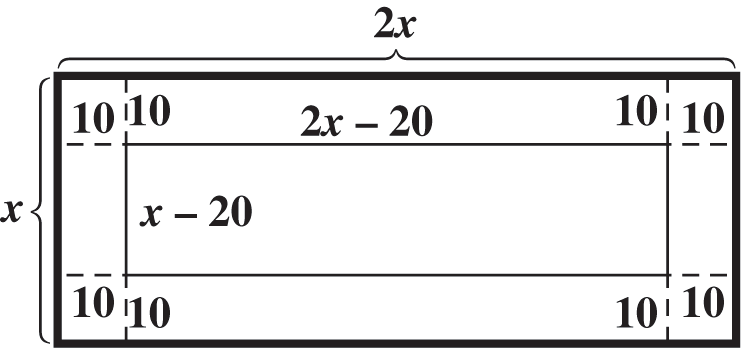
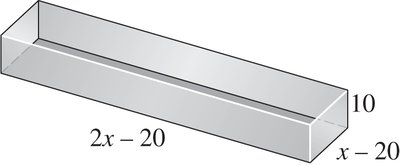
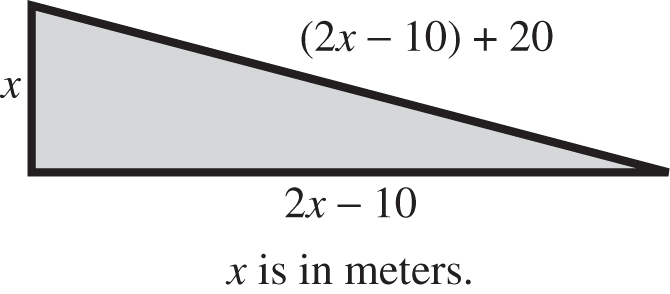
Geometry Example: Finding dimensions of a rectangle or triangle given perimeter or area constraints.
Motion Example: Using to relate distance, rate, and time.
2. Graphs and Functions
Rectangular Coordinate System
The coordinate plane is formed by the intersection of the -axis and -axis, dividing the plane into four quadrants. Points are represented as ordered pairs .
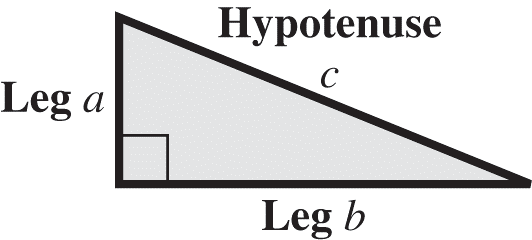
Distance Formula: The distance between and is .
Midpoint Formula: The midpoint between and is .
Functions and Their Representations
A function is a relation in which each input (domain value) corresponds to exactly one output (range value). Function notation: .
Domain: Set of all possible input values.
Range: Set of all possible output values.
Vertical Line Test: A graph represents a function if no vertical line intersects it more than once.
3. Polynomial and Rational Functions
Factoring Polynomials
Factoring is the process of expressing a polynomial as a product of its factors. Key techniques include:
Factoring out the GCF: Remove the greatest common factor from all terms.
Factoring by Grouping: Group terms to factor common binomials.
Factoring Trinomials: Express as .
Special Products: Difference of squares, sum/difference of cubes.
Quadratic Equations
A quadratic equation is of the form . Methods of solution include:
Factoring
Square Root Property: If , then
Completing the Square
Quadratic Formula:
The discriminant determines the nature of the roots (real and distinct, real and equal, or complex).
Polynomial and Rational Inequalities
To solve inequalities involving polynomials or rational expressions:
Rewrite so one side is zero.
Find zeros of numerator and denominator.
Test intervals between zeros to determine where the inequality holds.
4. Inverse, Exponential, and Logarithmic Functions
Inverse Functions
An inverse function reverses the effect of the original function. If is one-to-one, its inverse satisfies and .
Exponential and Logarithmic Functions
Exponential Function: , ,
Logarithmic Function: , the inverse of the exponential function
Properties of Logarithms: Product, quotient, and power rules
Change-of-Base Formula:
5. Systems and Matrices
Solving Systems of Equations
Substitution and Elimination Methods: For systems of two or more equations.
Matrix Methods: Represent systems as matrices and solve using row operations or Cramer's Rule.
6. Analytic Geometry
Conic Sections
Conic sections include circles, parabolas, ellipses, and hyperbolas, each with standard equations and unique properties.
Circle:
Parabola: or
Ellipse:
Hyperbola:
7. Further Topics in Algebra
Sequences and Series
Arithmetic Sequence:
Geometric Sequence:
Sum of Arithmetic Series:
Sum of Geometric Series: ,
Binomial Theorem: $
Appendix: Table of Contents and Reference Images
The table of contents confirms the alignment of these topics with standard college algebra curricula:
R - Review of Basic Concepts
1 - Equations and Inequalities
2 - Graphs and Functions
3 - Polynomial and Rational Functions
4 - Inverse, Exponential, and Logarithmic Functions
5 - Systems and Matrices
6 - Analytic Geometry
7 - Further Topics in Algebra
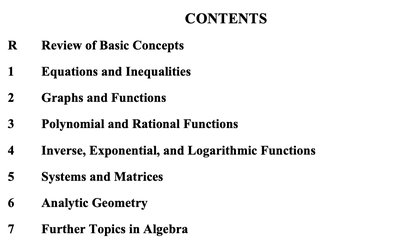
Additional info: This summary is based on the provided textbook images and content, which comprehensively cover the foundational topics in a college algebra course.
