 Back
BackCollege Algebra Exam 1 Study Guide: Equations, Inequalities, Functions, and Graphs
Study Guide - Smart Notes
 Tailored notes based on your materials, expanded with key definitions, examples, and context.
Unit 1 · Solving Equations
Linear Equations (including fractions)
Linear equations are equations where the highest power of the variable is 1. They may include parentheses or fractions, but no variables under roots or in denominators.
Definition: A linear equation has the form ax + b = c.
Key Steps:
Clear fractions by multiplying every term by the least common denominator (LCD).
Distribute to remove parentheses.
Combine like terms on each side.
Isolate the variable on one side.
Divide by the coefficient of the variable.
Check your solution by substitution.
Possible Outcomes: One solution (conditional), all real numbers (identity), or no solution (inconsistent).
Example: Solve Simplify: Add : Add $36 Solution:
Rational Equations (variable in a denominator)
Rational equations contain variables in the denominator. Some values are not allowed because they make the denominator zero.
Definition: A rational equation has at least one variable in the denominator, e.g., .
Key Steps:
Find restrictions by setting each denominator equal to zero.
Multiply every term by the LCD to clear fractions.
Solve the resulting equation.
Check for extraneous solutions (values that are not allowed).
Example: Solve Restriction: Multiply by : is valid.
Quadratic Equations
Quadratic equations have the highest power of 2. They can be solved by factoring, the square root property, or the quadratic formula.
Standard Form:
Factoring: Factor and use the Zero Product Rule.
Square Root Property: If , then .
Quadratic Formula:
Discriminant: determines the number and type of solutions.
Example (Factoring):
Example (Quadratic Formula):
Polynomial Equations (degree 3+)
Polynomial equations of degree 3 or higher are often solved by factoring, especially by grouping.
Example: Group: Factor: Solutions:
Radical Equations (variable under a root)
Radical equations have variables under a square root. Squaring both sides can introduce extraneous solutions, so always check your answers.
Example: Square both sides: Rearrange: Check: (both valid)
Equations in Quadratic Form (u-substitution)
Some equations look like quadratics in disguise, with one power exactly double another. Use substitution to solve.
Example: Let :
Absolute Value Equations
Absolute value equations involve expressions like . If is negative, there is no solution.
Example: Split: or Solutions:
Unit 2 · Complex Numbers
Operations with Complex Numbers
Complex numbers are numbers of the form , where .
Add/Subtract: Combine real and imaginary parts separately.
Multiply: Use FOIL, replace with .
Divide: Multiply numerator and denominator by the conjugate of the denominator.
Example: Multiply by conjugate :
Unit 3 · Inequalities
Linear Inequalities
Linear inequalities are solved like linear equations, but if you multiply or divide by a negative, flip the inequality sign.
Example: Divide by (flip sign): Interval Notation:
Compound Inequalities
Compound inequalities trap the variable between two numbers. Solve by performing operations on all three parts.
Example: Add $4 Interval Notation:
Absolute Value Inequalities
Absolute value inequalities use two patterns:
"Less thAND": (one interval)
"GreatOR": or (two intervals)
Example:
Unit 4 · Word Problems (Models & Applications)
Translating and Solving Word Problems
Word problems require translating real-world scenarios into equations, then solving them.
Key Steps:
Let be the unknown.
Express other quantities in terms of .
Translate words to equations (e.g., "of" = multiply, "is" = equals).
Solve and check the answer in context.
Example: "When 70% of a number is added to the number, the result is 204."
Unit 5 · Functions & Graphs
Is It a Function?
A relation is a function if each input has only one output . For graphs, use the Vertical Line Test.
Vertical Line Test: If any vertical line crosses the graph more than once, it is not a function.
Example: The set is a function because all -values are unique.
Evaluating Functions
To evaluate a function, substitute the input into the function rule and simplify.
Example: If , then
Domain & Range from a Graph
The domain is all possible -values; the range is all possible -values. Use interval notation.
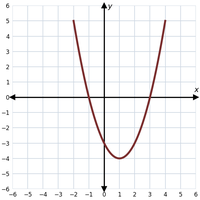
Example (Graph B): Domain , Range
Increasing, Decreasing, and Constant Intervals
Describe where a function rises, falls, or stays flat by reading the graph from left to right and using -intervals.
Increasing: Graph rises as increases.
Decreasing: Graph falls as increases.
Constant: Graph is flat (horizontal).
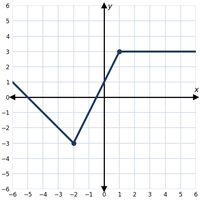
Example (Graph A): Decreasing on , increasing on , constant on .
Slope & Equations of Lines
The slope of a line is the ratio of rise to run. There are several forms for the equation of a line:
Slope:
Point-slope form:
Slope-intercept form:
Example: Line through with slope $4y - 8 = 4(x + 7)$
Parallel & Perpendicular Lines
Parallel lines have the same slope; perpendicular lines have negative reciprocal slopes.
Parallel: Same slope as the given line.
Perpendicular: Slope is if the original slope is .
Example: Line through perpendicular to has slope .
One Last Thing: Recognizing the type of problem and following the steps is key. Practice regularly and check your answers to build confidence for test day.
