 Back
BackCollege Algebra Exam Review: Functions, Graphs, and Rates of Change
Study Guide - Smart Notes
 Tailored notes based on your materials, expanded with key definitions, examples, and context.
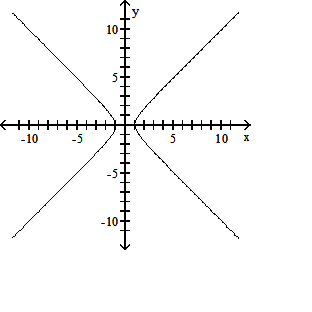
Q9. Determine whether the graph is that of a function. If it is, use the graph to find its domain and range, the intercepts, if any, and any symmetry with respect to the x-axis, the y-axis, or the origin.
Background
Topic: Functions and Graphs
This question tests your understanding of how to interpret graphs and determine whether they represent functions. It also asks you to analyze the graph for domain, range, intercepts, and symmetry.
Key Terms and Concepts:
Function: A relation in which each input (x-value) has exactly one output (y-value).
Domain: The set of all possible x-values.
Range: The set of all possible y-values.
Intercepts: Points where the graph crosses the axes.
Symmetry: Whether the graph is symmetric about the x-axis, y-axis, or origin.
Vertical Line Test: A method to determine if a graph represents a function: if any vertical line crosses the graph more than once, it is not a function.
Step-by-Step Guidance
Apply the vertical line test to the graph. Imagine drawing vertical lines at various x-values and observe whether each line crosses the graph only once.
If the graph passes the vertical line test, identify the domain by looking at the x-values for which the graph exists.
Next, determine the range by identifying the y-values covered by the graph.
Locate the intercepts: find where the graph crosses the x-axis (x-intercepts) and y-axis (y-intercepts).
Analyze the graph for symmetry. Check if the graph is symmetric about the y-axis, x-axis, or origin by comparing points on either side of these axes.
Try solving on your own before revealing the answer!
Final Answer:
The graph passes the vertical line test, so it is a function. The domain is all real numbers (), and the range is all real numbers (). The graph has an x-intercept and a y-intercept at the origin (0,0). It is symmetric about the origin, indicating it is an odd function.
