 Back
BackCollege Algebra Midterm Study Guidance – Triangle Sides and the Pythagorean Theorem
Study Guide - Smart Notes
 Tailored notes based on your materials, expanded with key definitions, examples, and context.
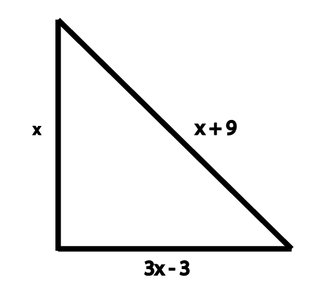
Q16. Which of the following equations represent the sides of a triangle given below?
Background
Topic: The Square Root Property / Pythagorean Theorem
This question tests your understanding of how to relate the sides of a right triangle using the Pythagorean Theorem. You need to identify which equation correctly expresses the relationship between the three sides labeled as x, x+9, and 3x-3.
Key Terms and Formulas
Pythagorean Theorem: For a right triangle with legs a and b, and hypotenuse c:
Legs: The two shorter sides of the triangle.
Hypotenuse: The longest side, opposite the right angle.
Step-by-Step Guidance
Examine the triangle and identify which side is likely the hypotenuse (the longest side). Compare the expressions x, x+9, and 3x-3 for possible values of x.
Recall that the Pythagorean Theorem relates the two legs and the hypotenuse: .
Assign the sides to the variables a, b, and c based on their likely roles (legs or hypotenuse).
Set up the equation using the expressions for the sides. For example, if x and x+9 are the legs and 3x-3 is the hypotenuse, the equation would be .
Expand and simplify the equation to check if it matches any of the answer choices.
Try solving on your own before revealing the answer!
Final Answer: x^2 + (x+9)^2 = (3x-3)^2
This equation uses the Pythagorean Theorem, with x and x+9 as the legs and 3x-3 as the hypotenuse.
