Back
BackCollege Algebra Study Guide: Functions and Their Graphs (Unit 1)
Study Guide - Smart Notes
 Tailored notes based on your materials, expanded with key definitions, examples, and context.
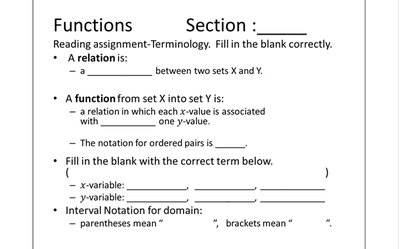
Q1. Define a relation and a function. Fill in the blanks:
Background
Topic: Relations and Functions
This question tests your understanding of the basic terminology in algebra, specifically the difference between a relation and a function.
Key Terms:
Relation: A pairing between elements of two sets.
Function: A relation where each input (x-value) is paired with exactly one output (y-value).
Ordered Pair: Notation (x, y) representing a relation.
Step-by-Step Guidance
Recall that a relation is any set of ordered pairs connecting elements from set X to set Y.
Understand that a function is a special type of relation where each x-value has only one corresponding y-value.
Think about the notation for ordered pairs, which is usually written as (x, y).
Review the terms for x-variable (independent variable) and y-variable (dependent variable).
Try solving on your own before revealing the answer!
Q2. Relation or Function? Analyze the mappings and sets.
Background
Topic: Identifying Functions
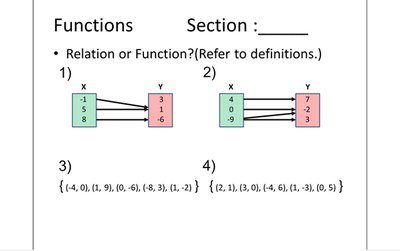
This question asks you to determine whether a given mapping or set of ordered pairs represents a function, based on the definition.
Key Terms:
Function: Each input (x) maps to only one output (y).
Relation: Any mapping between x and y.
Step-by-Step Guidance
For each diagram or set, check if any x-value is paired with more than one y-value.
If an x-value is paired with multiple y-values, it is not a function.
If every x-value is paired with only one y-value, it is a function.
Apply this reasoning to each example provided.
Try solving on your own before revealing the answer!
Q3. Is the equation below a function of x?
Background
Topic: Functions Defined by Equations
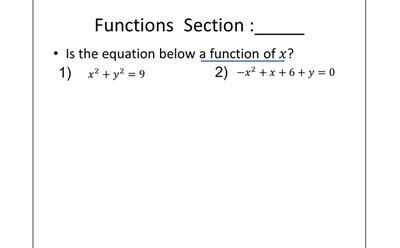
This question tests your ability to determine if an equation defines y as a function of x.
Key Terms:
Function of x: For each x, there is only one y.
Implicit equations: Equations involving both x and y.
Step-by-Step Guidance
For each equation, try to solve for y in terms of x.
Check if, for every x-value, there is only one corresponding y-value.
If there are multiple y-values for a single x, it is not a function.
Apply this reasoning to both equations provided.
Try solving on your own before revealing the answer!
Q4. Function Notation and Domain
Background
Topic: Function Notation and Domain
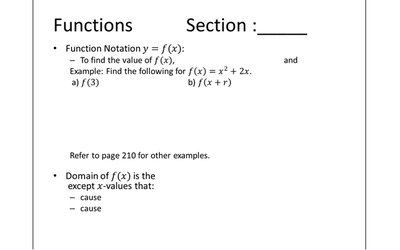
This question tests your understanding of function notation and how to find the domain of a function.
Key Terms and Formulas:
Function notation:
Domain: Set of all possible x-values for which the function is defined.
Step-by-Step Guidance
To find , substitute into the function .
To find , substitute for in the function.
For domain, identify x-values that cause division by zero or negative values under a square root.
List the domain using interval notation, excluding restricted values.
Try solving on your own before revealing the answer!
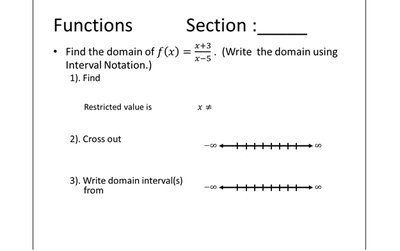
Q5. Find the domain of using interval notation.
Background
Topic: Domain of Rational Functions
This question tests your ability to find the domain of a rational function and express it in interval notation.
Key Formula:
Domain: All real numbers except where the denominator is zero.
Step-by-Step Guidance
Set the denominator equal to zero and solve for .
Identify the restricted value (where the function is undefined).
Write the domain as all real numbers except the restricted value, using interval notation.
Draw a number line and cross out the restricted value.
Try solving on your own before revealing the answer!
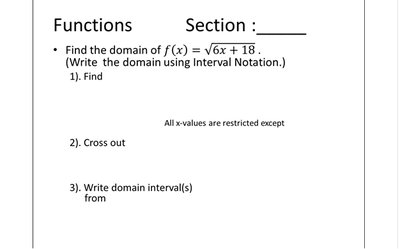
Q6. Find the domain of using interval notation.
Background
Topic: Domain of Radical Functions
This question tests your ability to find the domain of a function involving a square root.
Key Formula:
Domain: Values of for which the expression under the square root is non-negative.
Step-by-Step Guidance
Set and solve for .
Identify the interval of values where the function is defined.
Write the domain using interval notation.
Draw a number line and shade the valid interval.
Try solving on your own before revealing the answer!
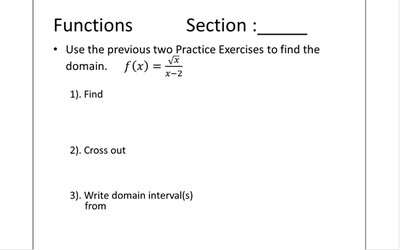
Q7. Find the domain of using previous exercises.
Background
Topic: Domain of Combined Radical and Rational Functions
This question tests your ability to combine domain restrictions from both radical and rational functions.
Key Formula:
Domain: Values of where and .
Step-by-Step Guidance
Set for the square root to be defined.
Set for the denominator to not be zero.
Combine these restrictions to write the domain in interval notation.
Draw a number line and indicate the valid intervals.
Try solving on your own before revealing the answer!
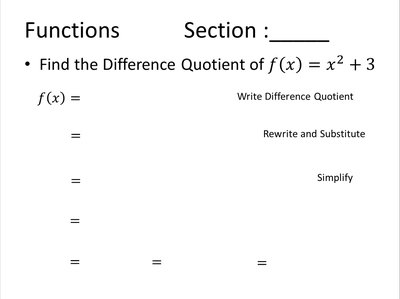
Q8. Difference Quotient of a Function
Background
Topic: Difference Quotient
This question tests your understanding of the difference quotient, which is foundational for calculus and rate of change.
Key Formula:
Difference Quotient:
Step-by-Step Guidance
Write the difference quotient formula for the given function.
Substitute into the formula.
Expand and , then simplify the numerator.
Factor and simplify as much as possible, stopping before the final answer.
Try solving on your own before revealing the answer!
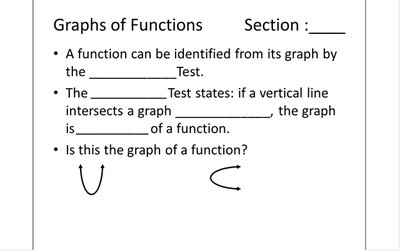
Q9. Identify a function from its graph using the Vertical Line Test.
Background
Topic: Graphs of Functions
This question tests your ability to use the vertical line test to determine if a graph represents a function.
Key Terms:
Vertical Line Test: If any vertical line crosses the graph more than once, it is not a function.
Step-by-Step Guidance
Visualize or draw vertical lines through the graph.
Check if any line intersects the graph at more than one point.
If so, the graph is not a function; otherwise, it is a function.
Apply this reasoning to the provided graphs.
Try solving on your own before revealing the answer!
Q10. Information from the graph of a function
Background
Topic: Reading Graphs of Functions
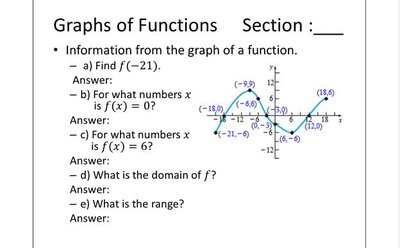
This question tests your ability to extract information such as domain, range, intercepts, and specific values from a graph.
Key Terms:
Domain: Set of x-values for which the function is defined.
Range: Set of y-values the function takes.
x-intercept: Where the graph crosses the x-axis.
y-intercept: Where the graph crosses the y-axis.
Step-by-Step Guidance
Locate points on the graph for specific values (e.g., ).
Identify where the graph crosses the axes for intercepts.
Read the domain and range from the graph, considering endpoints and gaps.
List the answers for each part, stopping before the final values.
Try solving on your own before revealing the answer!
Q11. Piecewise-defined Functions
Background
Topic: Piecewise Functions
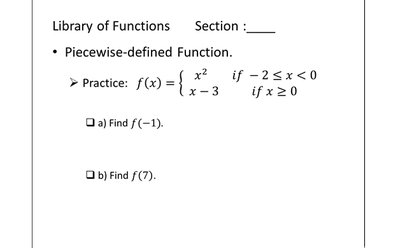
This question tests your ability to evaluate and define piecewise functions, which use different expressions for different intervals of the domain.
Key Terms:
Piecewise Function: Defined by different formulas for different parts of its domain.
Step-by-Step Guidance
Identify which formula to use based on the value of .
Substitute the value of into the appropriate formula.
Simplify the expression to find for the given .
Repeat for each value provided, stopping before the final answer.
Try solving on your own before revealing the answer!
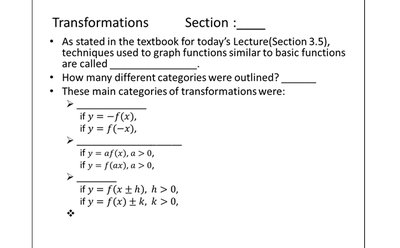
Q12. Transformations of Functions
Background
Topic: Transformations
This question tests your understanding of how functions change when their equations are modified (shifts, stretches, reflections).
Key Terms:
Transformation: Change in position, shape, or direction of a graph.
Types: Vertical/horizontal shifts, stretches/compressions, reflections.
Step-by-Step Guidance
Identify the type of transformation based on the equation (e.g., , , ).
Describe how the graph changes (shift left/right, up/down, reflect, stretch/compress).
Apply the transformation to the basic function graph.
State the new domain and range, stopping before the final values.
Try solving on your own before revealing the answer!
Q13. Local Maximum and Minimum on a Graph
Background
Topic: Extrema of Functions
This question tests your ability to identify local maxima and minima on a graph, which are important for understanding function behavior.
Key Terms:
Local Maximum: Highest point in a neighborhood.
Local Minimum: Lowest point in a neighborhood.
Step-by-Step Guidance
Look for points on the graph where the function changes direction from increasing to decreasing (maximum) or decreasing to increasing (minimum).
Identify these points visually or using a calculator.
Mark the locations, stopping before stating the exact values.
Try solving on your own before revealing the answer!
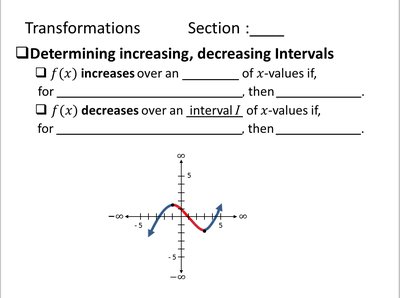
Q14. Determining Increasing and Decreasing Intervals
Background
Topic: Increasing/Decreasing Intervals
This question tests your ability to identify intervals where a function is increasing or decreasing.
Key Terms:
Increasing Interval: Where gets larger as increases.
Decreasing Interval: Where gets smaller as increases.
Step-by-Step Guidance
Examine the graph and note where the function rises or falls.
Identify the intervals of where the function is increasing or decreasing.
Write these intervals using proper notation, stopping before the final answer.
Try solving on your own before revealing the answer!
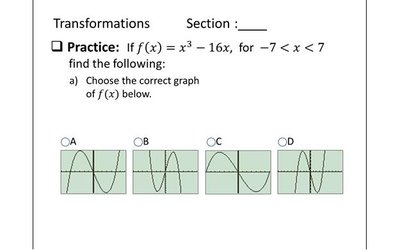
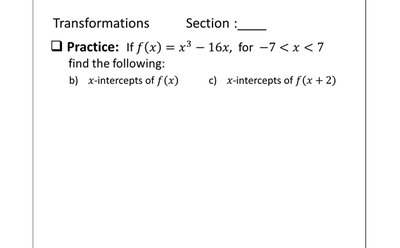
Q15. Practice: Choose the correct graph and find intercepts for
Background
Topic: Graphs and Intercepts of Polynomial Functions
This question tests your ability to match a function to its graph and find x-intercepts.
Key Terms:
x-intercept: Where .
Polynomial graph: Shape depends on degree and coefficients.
Step-by-Step Guidance
Analyze the function for its general shape (cubic).
Set and solve for to find intercepts.
Compare the function to the provided graphs and select the correct one.
List the intercepts, stopping before the final values.
Try solving on your own before revealing the answer!