 Back
BackCollege Algebra Study Guide: Functions, Graphs, and Transformations
Study Guide - Smart Notes
 Tailored notes based on your materials, expanded with key definitions, examples, and context.
Functions and Graphs
Relations and Functions
In algebra, a relation is a connection between input (x) and output (y) values, often represented as ordered pairs (x, y). A function is a special type of relation where each input has at most one output. This means for every x-value, there is only one corresponding y-value.
Vertical Line Test: A graph represents a function if no vertical line intersects the graph at more than one point.
Inputs (x): The independent variable.
Outputs (y): The dependent variable.
Verifying Functions from Equations and Graphs
To determine if an equation is a function, solve for y and check if each x-value produces only one y-value. If y is raised to an even power or the equation forms a circle, it is not a function.
Function Notation: Replace y with f(x) to express the equation as a function.
Example: y = 3x - 4 can be written as f(x) = 3x - 4.
Domain and Range
Finding Domain and Range from Graphs
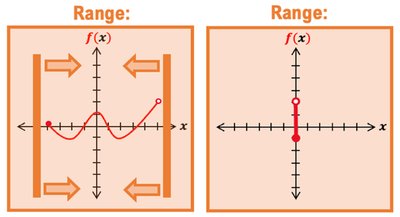
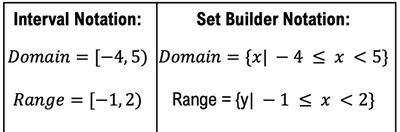
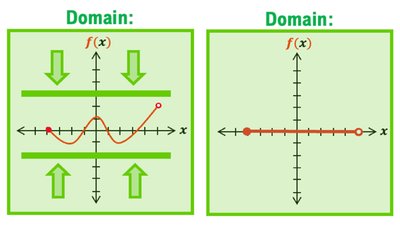
The domain of a function is the set of allowed x-values, and the range is the set of allowed y-values. To find the domain, project the graph onto the x-axis; for the range, project onto the y-axis. Use interval notation or set builder notation to express answers.
Interval Notation: Uses brackets and parentheses to indicate inclusion or exclusion of endpoints.
Set Builder Notation: Describes the set of values using inequalities.
Finding Domain from Equations
When given an equation, identify restrictions:
For square roots, x-values must not make the inside negative.
For fractions, x-values must not make the denominator zero.
Example: For , domain is .
Example: For , domain is .
Common Functions and Their Graphs
Types of Functions
Several basic functions frequently appear in algebra:
Constant Function:
Identity Function:
Square Function:
Cube Function:
Square Root Function:
Cube Root Function:
Each function has characteristic domain and range.
Equations of Two Variables
Graphing and Satisfying Equations
Equations with two variables (x and y) can be graphed by plotting points that satisfy the equation. The graph represents all (x, y) pairs that make the equation true.
To check if a point satisfies an equation: Substitute x and y values and see if the equation holds.
Graphing by Plotting Points: Isolate y, choose x-values, calculate y-values, plot points, and connect.
Intercepts
Finding x- and y-Intercepts
Intercepts are points where the graph crosses the axes:
x-intercept: Set y = 0 and solve for x.
y-intercept: Set x = 0 and solve for y.
Lines and Slope
Slope of a Line
The slope measures how steep a line is, calculated as the change in y divided by the change in x:
Slope formula:
Types of Slope: Positive, negative, zero (horizontal), or undefined (vertical).
Slope-Intercept Form
The equation of a line can be written as , where m is the slope and b is the y-intercept.
Point-Slope Form
If a line passes through a point (x1, y1) with slope m, use .
Standard Form
Standard form is . To find slope and intercepts, rewrite in slope-intercept form or set variables to zero.
Parallel and Perpendicular Lines
Parallel lines: Have equal slopes ().
Perpendicular lines: Slopes are negative reciprocals ().
Transformations of Functions
Types of Transformations
Transformations change the position or shape of a function's graph. The main types are:
Reflection: Flips the graph over an axis.
Shift: Moves the graph horizontally or vertically.
Stretch/Shrink: Changes the graph's size.
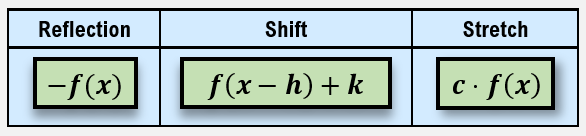
General transformation:
Function Operations
Adding, Subtracting, Multiplying, and Dividing Functions
Functions can be combined by addition, subtraction, multiplication, or division. The domain of the resulting function is the intersection of the domains of the original functions, with additional restrictions for division (denominator ≠ 0).
Add/Subtract: Combine like terms.
Multiply: Multiply expressions.
Divide: Divide expressions, restrict domain where denominator is zero.
Function Composition and Decomposition
Function Composition
Composition involves plugging one function into another: . The domain is restricted by both functions.
Function Decomposition
Decomposition is expressing a function as a composition of two simpler functions.
Circles
Standard Form of a Circle
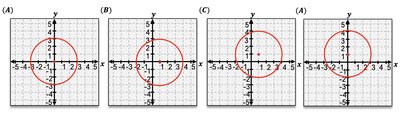
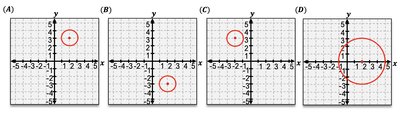
The equation of a circle in standard form is , where (h, k) is the center and r is the radius. A circle is not a function because it fails the vertical line test.
To graph: Plot the center, mark points r units away in all directions, and connect with a smooth curve.
General Form to Standard Form
Convert to standard form by completing the square for x and y.
Example: becomes
Practice and Applications
Identify whether an equation represents a circle, and find its center and radius by rewriting in standard form.
----------------------------------------
