 Back
BackCollege Algebra Study Guide: Graphs, Functions, and Linear Models
Study Guide - Smart Notes
 Tailored notes based on your materials, expanded with key definitions, examples, and context.
Graphs, Functions, and Models
Introduction to Functions & Their Graphs
Functions are fundamental mathematical objects that describe relationships between two sets, typically inputs (x-values) and outputs (y-values). In college algebra, functions are represented in various ways: equations, tables, graphs, and verbal descriptions.
Definition of a Function: A function is a relation in which each input (x-value) has exactly one output (y-value).
Domain: The set of all possible input values (x-values).
Range: The set of all possible output values (y-values).
Function Notation: Functions are often written as f(x) = expression, where y = f(x).
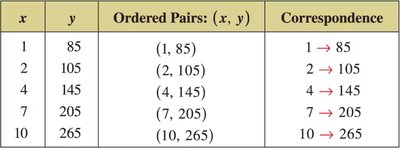
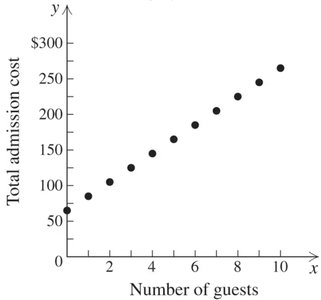
Example: Cameron’s zoo membership cost can be modeled as $20x + $65 = y, where x is the number of guests and y is the total annual cost.
Representations of Functions
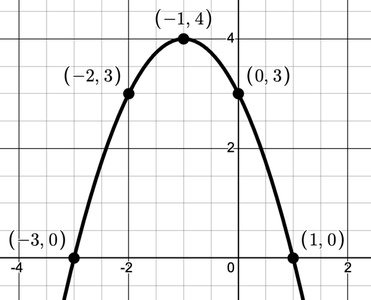
Functions can be described verbally, in tables, and graphically. For example, the function f(x) = -x^2 - 2x + 3 can be shown in all three forms.
Verbal: The output equals the negative of the squared input, minus two times the input, plus three.
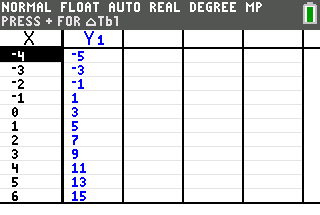
Table: Shows specific input-output pairs.
Graph: Visualizes the relationship between x and y.
Using Graphing Calculators
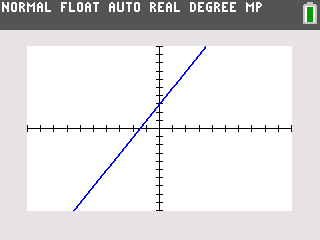
Graphing calculators like the TI-84/83 are essential tools for visualizing functions and analyzing their properties.
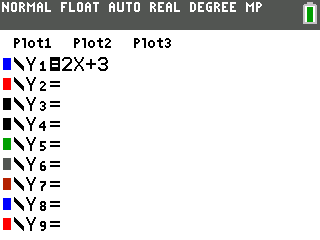
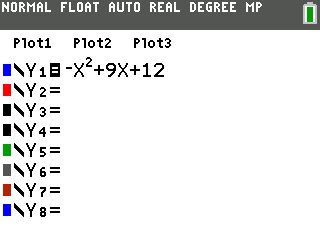
Entering Functions: Use the Y= editor to input functions.
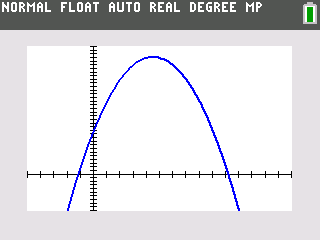
Viewing Graphs: Adjust window settings to fit the graph.
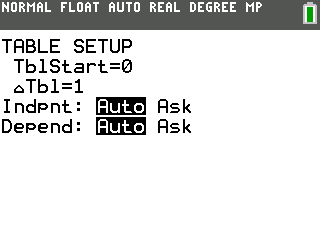
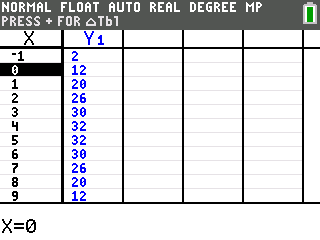
Table Feature: View specific x and y values for the function.
Graphing Quadratic Functions
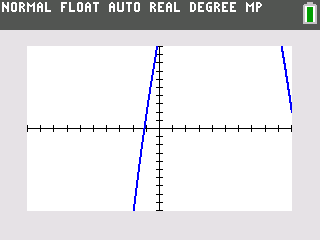
Quadratic functions have the form g(x) = ax^2 + bx + c and their graphs are parabolas. Adjusting the viewing window is often necessary to see the entire graph.
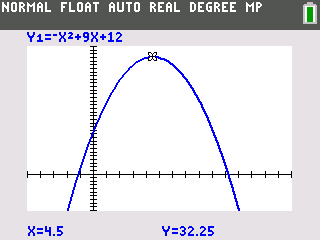
Example: g(x) = -x^2 + 9x + 12
Table Feature: Useful for finding specific values.
Trace Feature: Allows you to find function values on the graph.
Domain and Range
The domain and range of a function describe the set of possible inputs and outputs. Restrictions may occur for rational or radical functions.
Example: f(x) = \sqrt{x-2} has domain [2, ∞) because the square root is undefined for x < 2.
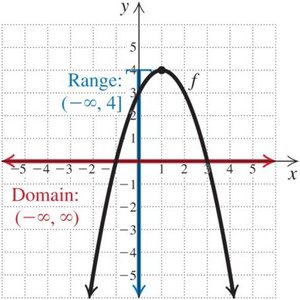
Example: f(x) = -(x-1)^2 + 4 has domain (-∞, ∞) and range (-∞, 4].
Interval Notation
Interval notation is used to describe sets of numbers, especially domains and ranges. Parentheses indicate endpoints are not included; brackets indicate inclusion.
Set-builder notation: {x | x < 5} is equivalent to interval notation (-∞, 5).
Examples: (a) {x | x > 3} → (3, ∞) (b) {x | x ≤ -2} → (-∞, -2] (c) {x | -3 ≤ x ≤ -1} → [-3, -1] (d) {x | -4 < x < 0} → (-4, 0) (e) {x | 1 < x ≤ 4} → (1, 4]
Function Notation and Evaluation
Function notation provides a concise way to express and evaluate functions. To find f(a), substitute a for x in the function.
Example: If h(x) = 2x^2 - x + 3, then h(-3) = 2(-3)^2 - (-3) + 3 = 18 + 3 + 3 = 24.
Multiplying Binomials (FOIL Method)
The FOIL method is used to multiply two binomials, applying the distributive property.
Formula: (x + a)(x + b) = x^2 + (a + b)x + ab
Example: (x + 7)(x + 4) = x^2 + 11x + 28

Linear Functions & Their Graphs
Graphing Linear Equations
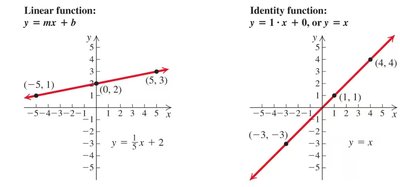
Linear functions have the form f(x) = mx + b, where m is the slope and b is the y-intercept. Their graphs are straight lines.
Slope (m): The rate of change of y with respect to x.
Y-intercept (b): The value of y when x = 0.
Example: f(x) = 2x + 3
Finding Slopes and Intercepts
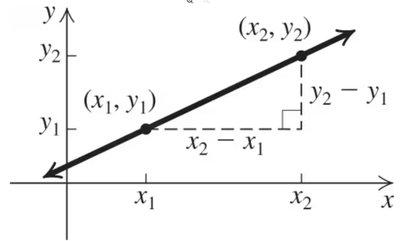
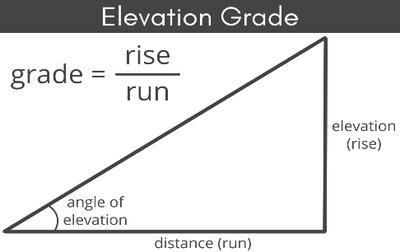
The slope of a line is calculated as the ratio of vertical change (rise) to horizontal change (run).
Formula:
X-intercept: Set y = 0 and solve for x.
Y-intercept: Set x = 0 and solve for y.
Horizontal and Vertical Lines
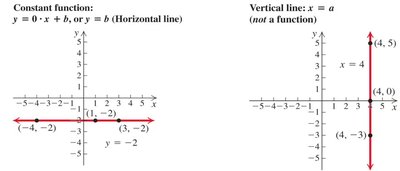
Horizontal lines have slope 0 and are functions. Vertical lines have undefined slope and are not functions.
Horizontal line: y = b
Vertical line: x = a
Applications of Slope
Slope is used to describe rates of change in real-world contexts, such as road grades, water usage, and population changes.
Grade:
Example: A 4% grade means a road rises 4 ft for every 100 ft horizontally.
Solving Linear Equations & Inequalities
Simplifying Linear Expressions
Combine like terms and use the distributive property to simplify expressions.
Example: 3x - 5x + x = -x
Distributive Property: a(b + c) = ab + ac
Solving Linear Equations
Use the addition and multiplication principles to isolate variables and solve equations.
General Steps:
Simplify each side.
Collect variable terms on one side.
Collect constant terms on the other side.
Make the coefficient of the variable equal to 1.
Check the solution.
Example:
Solving Equations with Fractions
Multiply both sides by the least common denominator (LCD) to clear fractions.
Example:
Multiply both sides by 12 (LCD):
Solving Linear Inequalities
Apply the addition and multiplication principles for inequalities. Remember to reverse the inequality sign when multiplying or dividing by a negative number.
Example:
Interval notation: (-∞, -4]
Linear Application Models
Fixed Cost + Variable Rate Models
Many real-world scenarios involve a fixed cost plus a variable rate. These are modeled by linear functions.
Formula:
Example: Gym membership:
Percent Commission Models
Income models often include a base salary plus a percent commission on sales.
Formula:
Final Amount After Percent Increase or Decrease
Formula for Increase:
Formula for Decrease:
Systems of Linear Equations
Solving Systems of Equations
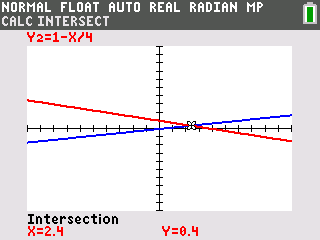
A system of equations consists of two or more equations considered simultaneously. The solution is the set of values that satisfy all equations.
Methods: Graphing, substitution, and elimination.
Example: and
Solution: (2, -3)
Solving by Substitution
Solve one equation for one variable.
Substitute into the other equation.
Solve for the remaining variable.
Solving by Elimination
Align variables and constants.
Multiply equations to eliminate a variable.
Add or subtract equations.
Solve for the remaining variable.
Applications of Systems
Systems of equations are used to solve real-world problems involving multiple constraints, such as break-even analysis, pricing, and resource allocation.
Tables
Ordered Pairs and Correspondence Table
This table shows the relationship between the number of guests and total admission cost, illustrating the concept of a function.
x | y | Ordered Pairs: (x, y) | Correspondence |
|---|---|---|---|
1 | 85 | (1, 85) | 1 → 85 |
2 | 105 | (2, 105) | 2 → 105 |
4 | 145 | (4, 145) | 4 → 145 |
7 | 205 | (7, 205) | 7 → 205 |
10 | 265 | (10, 265) | 10 → 265 |
*Additional info: This study guide covers all major topics from Chapter 1 and part of Chapter 6, including functions, graphs, linear models, solving equations and inequalities, and systems of equations, as outlined in the college algebra syllabus.*
