 Back
BackCollege Algebra Study Guide: Quadratic, Rational, Radical, and Absolute Value Equations
Study Guide - Smart Notes
 Tailored notes based on your materials, expanded with key definitions, examples, and context.
Quadratic Functions and Equations
Definition and Properties
Quadratic functions are fundamental in algebra and are defined by the general form , where and , , are real numbers. Quadratic equations are written as and are in standard form when arranged as such.
Domain: All real numbers ().
Range: Depends on the direction the parabola opens.
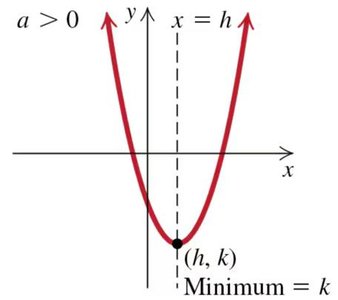
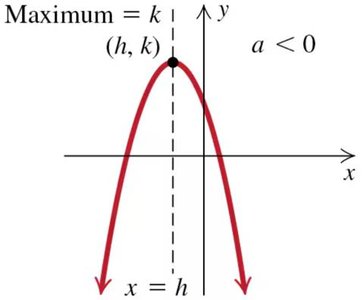
Extrema: The minimum or maximum value occurs at the vertex.
Zeros: The solutions to ; these are the x-intercepts of the graph if real.
Graphing Quadratic Functions
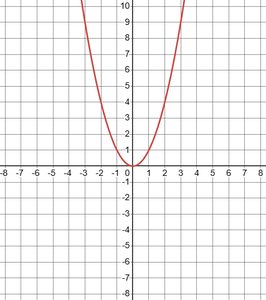
The graph of a quadratic function is a parabola. The vertex represents the turning point, and the axis of symmetry passes through the vertex.
Vertex:
Axis of Symmetry:
Opens Up: If
Opens Down: If
Solving Quadratic Equations
Quadratic equations can be solved by factoring, completing the square, or using the quadratic formula.
Factoring: Express as a product of two binomials.
Completing the Square: Transform the equation into and solve for .
Quadratic Formula:
Example: Solving by Factoring
Factor :
Find two numbers that multiply to and add to $2 and ).
Factored form:
Example: Solving by Completing the Square
Solve :
Isolate variable terms:
Add to both sides:
Rewrite:
Apply square roots:
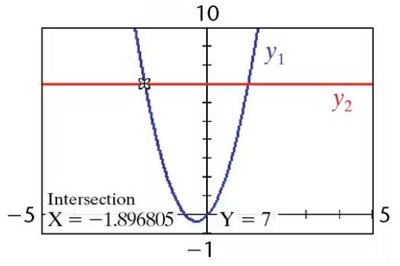
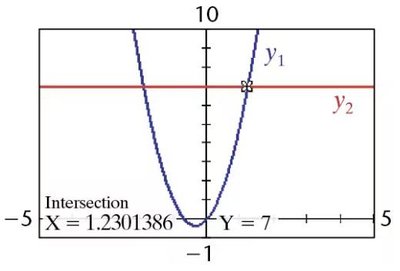
Example: Solving by Quadratic Formula
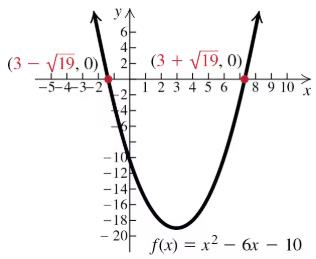
Solve :
Standard form:
Apply formula:
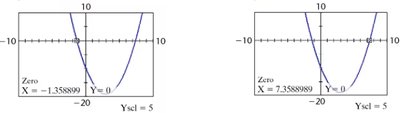
Approximate solutions: and
The Discriminant
The discriminant determines the nature of the solutions:
: Two distinct real solutions
: One real solution (repeated root)
: Two imaginary solutions (complex conjugates)
Complex Numbers
A complex number is any number of the form , where and are real numbers and .
Add/Subtract: Combine real and imaginary parts.
Multiply: Use .
Conjugate: The conjugate of is .
Factoring Quadratic Expressions
Multiplying Binomials (Area Model/Box Method)
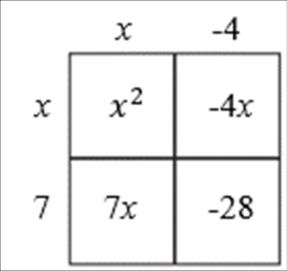
The area model helps visualize the multiplication of binomials.
Example:
Box entries: , , ,
Combine:
Factoring Trinomials
To factor , find two numbers and such that and .
Example: factors to
Graphing Quadratic Functions in Vertex Form
Transformations
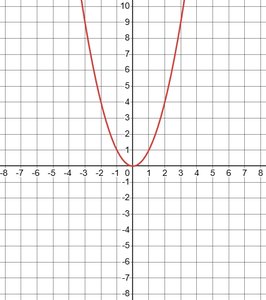
The vertex form allows for easy identification of transformations:
a: Vertical stretch/shrink and reflection
h: Horizontal translation
k: Vertical translation
Quadratic Applications
Real-World Problems
Projectile Motion: models height over time.
Optimization: Quadratic functions are used to maximize or minimize area, cost, etc.
Rational Equations
Solving Rational Equations
Rational equations contain fractions with variables in the denominator. To solve:
Multiply both sides by the least common denominator (LCD) to clear fractions.
Check for extraneous solutions by substituting back into the original equation.
Example:
Solve :
LCD is 6.
Multiply both sides:
Solve:
Radical Equations
Solving Radical Equations
Radical equations have variables under a root. To solve:
Isolate the radical.
Apply the principle of powers (raise both sides to the appropriate power).
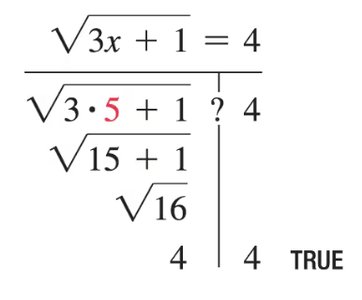
Check for extraneous solutions.
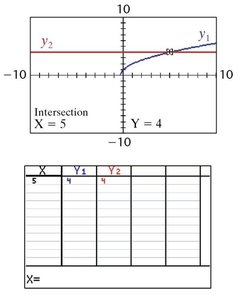
Example:
Solve :
Square both sides:
Absolute Value Equations and Inequalities
Solving Absolute Value Equations
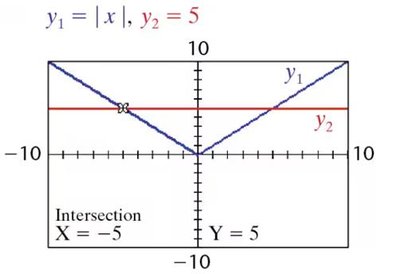
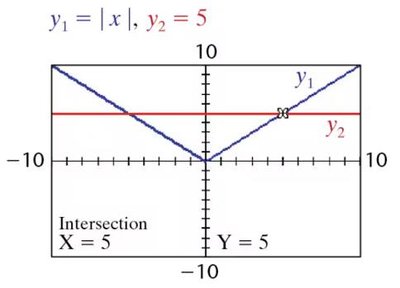
The absolute value is equivalent to or for .
For , is equivalent to .
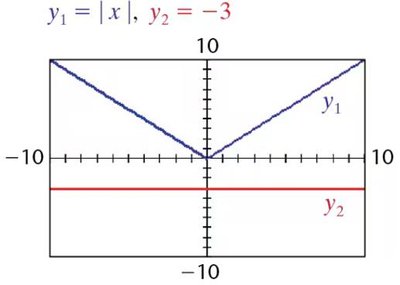
For , has no solution.
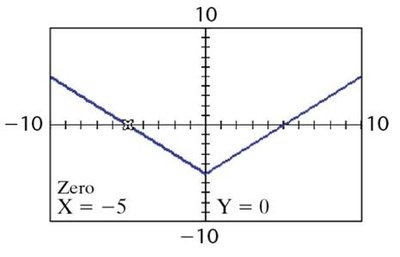
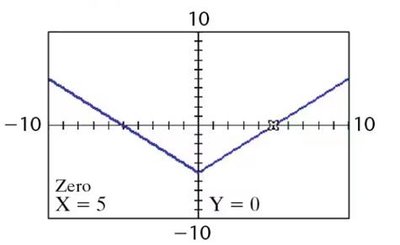
Example:
Solve :
Solutions: or
Solving Absolute Value Inequalities
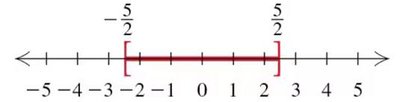
is equivalent to
is equivalent to or
Summary Table: Nature of Quadratic Solutions
Discriminant () | Number/Nature of Solutions |
|---|---|
Positive | Two distinct real solutions |
Zero | One real solution (repeated root) |
Negative | Two imaginary solutions (complex conjugates) |
Additional info:
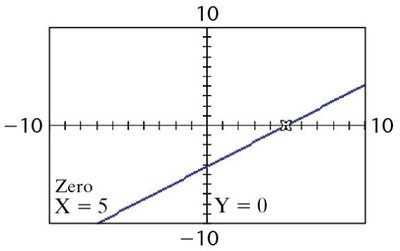
TI-83/84 calculators can be used to graph functions, find zeros, and check solutions.
Quadratic models are widely used in physics, engineering, and economics for optimization and modeling.
