 Back
BackDivision of Polynomials: Long Division and Synthetic Division
Study Guide - Smart Notes
 Tailored notes based on your materials, expanded with key definitions, examples, and context.
Division of Polynomials
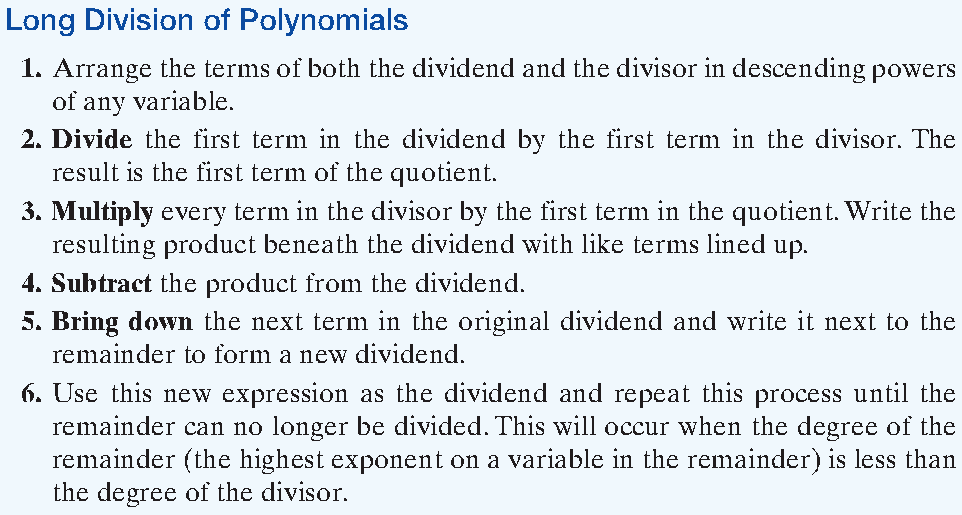
Long Division of Polynomials
Long division is a systematic method for dividing one polynomial by another, similar to the process used for dividing numbers. It is especially useful when the divisor is a polynomial of degree greater than one.
Arrange: Write both the dividend and divisor in descending powers of the variable.
Divide: Divide the first term of the dividend by the first term of the divisor. The result is the first term of the quotient.
Multiply: Multiply every term in the divisor by the first term in the quotient. Write the resulting product beneath the dividend, aligning like terms.
Subtract: Subtract the product from the dividend to obtain a new expression.
Bring Down: Bring down the next term from the original dividend and write it next to the remainder to form a new dividend.
Repeat: Use the new expression as the dividend and repeat the process until the remainder cannot be divided further. This occurs when the degree of the remainder is less than the degree of the divisor.
Example: Divide by using long division.
Step-by-step:
Divide by to get .
Multiply by to get .
Subtract: .
Repeat the process with .
Synthetic Division of Polynomials
Synthetic division is a shortcut method for dividing a polynomial by a linear divisor of the form . It is more efficient than long division for this specific case and involves only the coefficients of the polynomial.
Arrange: Write the polynomial in descending powers, with a coefficient for every missing term.
Write: For the divisor , write to the right. Write the coefficients of the dividend in a row.
Multiply and Add: Multiply the value just written in the bottom row by , write the product in the next column, and add the values in the new column, writing the sum in the bottom row.
Repeat: Continue this process until all columns are filled.
Interpret: The numbers in the last row are the coefficients of the quotient, and the final value is the remainder. The degree of the quotient is one less than the degree of the dividend.
Example: Divide by using synthetic division.
Step-by-step:
Write $2-3, (coefficients) and $2x - 2$).
Carry down the first coefficient, multiply by $2$, add to the next coefficient, and repeat.
Key Points:
Synthetic division can only be used when the divisor is linear ( or ).
The remainder is the value of the polynomial evaluated at .
Comparison Table:
Method | Divisor Form | Process | Use Cases |
|---|---|---|---|
Long Division | Any polynomial | Step-by-step division, subtraction, bring down | General division, higher degree divisors |
Synthetic Division | Linear () | Multiply and add coefficients | Quick division, remainder theorem |
