 Back
BackElementary Algebra for STEM: Course Overview and Study Guide
Study Guide - Smart Notes
 Tailored notes based on your materials, expanded with key definitions, examples, and context.
Course Overview
Introduction to Elementary Algebra for STEM
This course provides foundational algebraic concepts essential for students pursuing STEM fields. The curriculum covers properties and operations on real numbers, linear equations, inequalities, graphing, function notation, systems of equations, exponents, polynomials, factoring, and algebraic word problem analysis. The course is designed to prepare students for intermediate algebra and further mathematical studies.
Course Structure and Requirements
Textbook and Online Access
Required Text: Developmental Mathematics with Applications and Visualization: Prealgebra, Beginning Algebra, and Intermediate Algebra by Rockswold & Krieger (2nd Edition).
MyLab Math: Online platform for homework assignments and access to the eTextbook. Registration is mandatory for course participation.
Attendance and Participation
Regular attendance is required; missing more than four classes may result in being dropped from the course.
Active participation in group work and class discussions is expected.
Grading Scheme
Homework Assignments: 10%
Engagement & Reflections: 15%
Quizzes: 15%
Midterm Exams (Celebrations of Learning): 30%
Final Exam: 30%
Grade cutoffs: A (90%), B (80%), C (70%), D (60%)
Policies
Make-up Policy: No make-up assignments; arrangements must be made in advance for excused absences.
Academic Integrity: All submitted work must be original; generative AI use is prohibited.
Technology: Devices must be stowed during class and assessments unless used for note-taking with permission.
Inclusivity: The classroom is a respectful and inclusive environment for all students.
Student Learning Outcomes
Intellectual Skills Developed
Apply order of operations correctly.
Operate with signed numbers in equations and application problems.
Solve linear and absolute value equations.
Solve absolute value inequalities and express solution sets in interval notation.
Graph linear equations and inequalities in two variables.
Solve systems of linear equations algebraically and graphically.
Combine polynomials through addition, subtraction, multiplication, and division.
Factor simple polynomials.
Solve quadratic equations by factoring.
Solve application problems algebraically.
Assessment Methods
Types of Assessments
Exams (Celebrations of Learning): Multiple exams throughout the semester, including a cumulative final.
Quizzes: In-class quizzes on course material.
Homework: Regular assignments via MyLab Math; collaboration is encouraged but submissions must be individual.
Reflections: Written assignments reflecting on learning progress and skills.
Engagement: Participation in group work and class discussions.
Proposed Class Schedule
Weekly Topics
Weeks 1-2: Course Introduction and Review
Weeks 3-4: Chapter 9 - Introduction to Graphing and Equations of Lines
Weeks 5-6: Chapter 10 - Systems of Linear Equations and Inequalities
Weeks 7-8: Chapter 11 - Exponents and Polynomials
Weeks 9-10: Chapter 12 - Factoring Polynomials
Weeks 11-12: Chapter 13 - Rational Expressions and Equations
Weeks 13-14: Chapter 13 continued and review
Week 15: Flex Days and Final Review
Key Algebraic Concepts
Order of Operations
Order of operations is essential for correctly evaluating mathematical expressions. The standard sequence is Parentheses, Exponents, Multiplication and Division (left to right), Addition and Subtraction (left to right).
Example:
Solution:
Linear Equations and Inequalities
Linear equations are equations of the form , where , , and are constants. Linear inequalities involve expressions such as or .
Solving Linear Equations: Isolate the variable using inverse operations.
Example:
Interval Notation: Used to express solution sets, e.g., is .
Graphing and Functions
Graphing linear equations and inequalities in two variables is a fundamental skill. Functions are mathematical relationships where each input has a unique output.
Function Notation:
Graphing: Plot points and draw lines or curves based on the equation.
Example:
Polynomials and Factoring
Polynomials are expressions involving sums of powers of variables. Factoring is the process of expressing a polynomial as a product of its factors.
Example:
Factoring Methods: Common factor, difference of squares, trinomial factoring.
Systems of Equations
Systems of linear equations involve finding values that satisfy multiple equations simultaneously. Methods include substitution, elimination, and graphical solutions.
Example: Solve and
Solution: ,
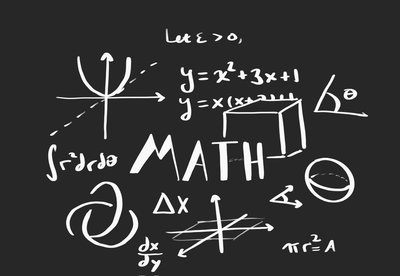
Visual Overview of Algebraic Concepts
The following image illustrates key algebraic concepts, including graphing, equations, and geometric representations relevant to the course:
Additional Information
Accommodations are available for students with documented disabilities.
Group work is encouraged for collaborative learning.
Course policies and schedule may be updated as needed.
