 Back
BackInverse Functions and One-to-One Functions: College Algebra Study Guidance
Study Guide - Smart Notes
 Tailored notes based on your materials, expanded with key definitions, examples, and context.
Q1. Find f(g(x)) and g(f(x)) and determine whether the pair of functions f and g are inverses of each other.
Background
Topic: Function Composition and Inverse Functions
This question tests your understanding of how to compose two functions and how to determine if two functions are inverses of each other. Inverse functions 'undo' each other's operations, so composing them should return the input value.
Key Terms and Formulas:
Function composition: means applying first, then to the result.
Inverse functions: and are inverses if and for all in the domain.
Step-by-Step Guidance
Write out the explicit formulas for and if given, or use generic forms if not specified.
Compute by substituting into wherever appears.
Compute by substituting into wherever appears.
Check if and for all in the domain. If both are true, and are inverses.
Try solving on your own before revealing the answer!
Q2. The function is one-to-one. a) Find an equation for the inverse function. b) Verify that your equation is correct by showing the compositions.
Background
Topic: One-to-One Functions and Finding Inverses
This question tests your ability to find the inverse of a function and verify it by composition. A function is one-to-one if each output corresponds to exactly one input.
Key Terms and Formulas:
One-to-one function: Passes the horizontal line test; each value comes from only one value.
Inverse function: is found by solving for in terms of , then replacing $y$ with $x$.
Verification: and .
Step-by-Step Guidance
Write the function as .
Swap and to get .
Solve for in terms of to find .
Verify by composing and to check if both equal .
Try solving on your own before revealing the answer!
Q3. Does the graph represent a function that has an inverse? (Horizontal Line Test)
Background
Topic: Graphical Test for Inverses
This question tests your ability to use the horizontal line test to determine if a function is one-to-one, which is necessary for it to have an inverse.
Key Terms and Formulas:
Horizontal Line Test: If every horizontal line crosses the graph at most once, the function is one-to-one.
Step-by-Step Guidance
Examine the graph of the function.
Imagine or draw horizontal lines across the graph.
Check if any horizontal line intersects the graph more than once.
If all horizontal lines intersect at most once, the function is one-to-one and has an inverse.
Try solving on your own before revealing the answer!
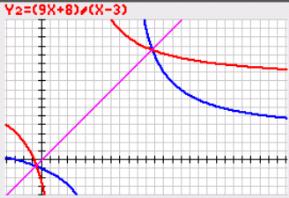
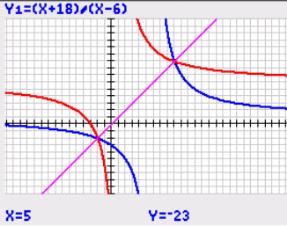
Q4. Use the graph of f to draw the graph of its inverse function.
Background
Topic: Graphing Inverse Functions
This question tests your ability to graph the inverse of a function. The graph of the inverse is a reflection of the original graph across the line .
Key Terms and Formulas:
Inverse graph: Reflect the graph of across the line to get .
Line : The axis of symmetry for the reflection.
Step-by-Step Guidance
Identify the graph of .
Draw the line as a reference.
Reflect each point on to for .
Sketch the reflected graph to represent the inverse function.
Try solving on your own before revealing the answer!
Q5. Given the function, a) Find the inverse b) Graph both functions c) State domain and range in interval notation
Background
Topic: Inverse Functions, Graphing, Domain and Range
This question tests your ability to find the inverse of a function, graph both the function and its inverse, and describe their domains and ranges using interval notation.
Key Terms and Formulas:
Inverse function: , found by solving for .
Domain: Set of all possible input values.
Range: Set of all possible output values.
Interval notation: Used to describe domain and range, e.g., .
Step-by-Step Guidance
Write the function as and solve for to find .
Graph and on the same coordinate system, using the line as a reference.
Identify the domain and range of and from the graphs.
Express the domain and range in interval notation.
Try solving on your own before revealing the answer!
