 Back
BackKey Concepts in Equations, Functions, and Transformations (College Algebra Study Notes)
Study Guide - Smart Notes
 Tailored notes based on your materials, expanded with key definitions, examples, and context.
Equations and Extraneous Solutions
Undoing Squares and Extraneous Solutions
When solving equations, certain algebraic operations can introduce solutions that do not satisfy the original equation. These are called extraneous solutions. This most commonly occurs when both sides of an equation are squared or raised to an even power, as these operations are not logically reversible.
Squaring Both Sides: May introduce extraneous solutions. Always check all solutions in the original equation.
Undoing a Square (Taking Square Roots): Introduces a ± sign, but does not create extraneous solutions if simply rewriting an identity.
Domain Restrictions: For any square root, the radicand (expression under the root) must be non-negative.
Example: To solve , take the square root of both sides to get .
General Rule: Always check potential solutions in the original equation when squaring both sides or working with radicals.
Domain Restrictions and Radical Equations
Domain Restrictions
Domain restrictions specify the set of allowable input values for a function or equation. For radical expressions, the radicand must be greater than or equal to zero.
Square Roots: is defined only for .
Radicals in Denominators: The radicand must be positive and the denominator cannot be zero.
Example: For , the domain is .
Linear Equations and Slope
Forms of Linear Equations
Linear equations can be written in several forms, each highlighting different properties:
Slope-Intercept Form:
Point-Slope Form:
General Form:
Horizontal Line:
Vertical Line:
Slope (): Measures the steepness of a line. Calculated as:
Intercepts: The y-intercept is where the line crosses the y-axis (), and the x-intercept is where it crosses the x-axis ().
Difference Quotient and Average Rate of Change
Difference Quotient
The difference quotient is used to compute the average rate of change of a function over an interval:
As approaches zero, this expression approaches the instantaneous rate of change (the derivative in calculus).
Function Properties and Notation
Function Identification
A function assigns exactly one output to each input. The vertical line test determines if a graph represents a function: if any vertical line crosses the graph more than once, it is not a function.
Even Function: (symmetric about the y-axis)
Odd Function: (symmetric about the origin)
Neither: If neither condition holds.
Transformations of Functions
Vertical and Horizontal Transformations
Transformations change the position or shape of a function's graph. For :
Vertical Stretch: , (multiply y-values by )
Vertical Compression: , (multiply y-values by )
Horizontal Stretch: , (multiply x-values by )
Horizontal Compression: , (multiply x-values by )
Reflection across x-axis:
Reflection across y-axis:
Vertical Shift:
Horizontal Shift:
Note: Horizontal transformations are "reversed": multiplication inside the function compresses, division stretches.
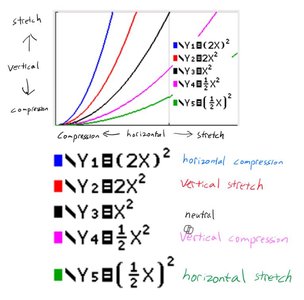
Example: is a vertical stretch; is a horizontal compression.
Inverse Functions
Finding Inverses
To find the inverse of a function:
Replace with .
Swap and .
Solve for .
Rename as .
Horizontal Line Test: Determines if a function has an inverse that is also a function (no horizontal line crosses the graph more than once).
Rational Expressions and Division Rules
Dividing Fractions
Division by a fraction is equivalent to multiplication by its reciprocal:
For dividing a quotient by a nonzero integer:
Non-Associativity of Division: Division is not associative; the order of operations matters.
Piecewise Functions
Definition and Evaluation
A piecewise function is defined by different expressions over different intervals of the domain. To evaluate, determine which interval the input belongs to and use the corresponding expression.
Summary Table: Function Symmetry
Symmetry Type | Algebraic Test | Function? | Visual Meaning |
|---|---|---|---|
y-axis | Yes | Mirror left & right | |
x-axis | Replace with | No | Mirror top & bottom |
Origin | Yes | 180° rotation symmetry |
Summary Table: Linear Equation Forms
Form | Equation | Description |
|---|---|---|
Slope-Intercept | m = slope, b = y-intercept | |
Point-Slope | Line through with slope m | |
General | Standard linear form | |
Horizontal | Horizontal line | |
Vertical | Vertical line |
