 Back
BackLinear Equations in One Variable: College Algebra Section 1.2 Study Guide
Study Guide - Smart Notes
 Tailored notes based on your materials, expanded with key definitions, examples, and context.
Linear Equations
Definition and Properties of Linear Equations in One Variable
Linear equations in one variable are foundational in college algebra, forming the basis for solving more complex equations and systems. Understanding their structure and solution methods is essential for further study in mathematics.
Linear Equation in One Variable: An equation that can be written in the form , where a and b are real numbers, and a is not zero.
Solution (Root): The value of x that makes the equation true.
Solution Set: The set containing all solutions to the equation.
Equivalent Equations: Equations that have the same solution set.
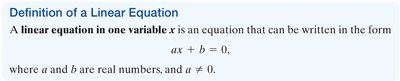
Example: is a linear equation in one variable. The solution is .
Identifying Linear vs. Nonlinear Equations
It is important to distinguish linear equations from nonlinear equations, as their solution methods differ significantly.
Linear Equations: Only contain the variable to the first power and no products of variables.
Nonlinear Equations: May include variables raised to powers other than one, products of variables, or multiple variables.
Examples:
Linear:
Nonlinear: ,
Solving Linear Equations in One Variable
Basic Steps for Solving Linear Equations
Solving linear equations involves isolating the variable using algebraic operations. The goal is to find the value of x that satisfies the equation.
Simplify both sides: Expand and combine like terms.
Isolate the variable: Use addition, subtraction, multiplication, or division to get x alone.
Check the solution: Substitute the value back into the original equation to verify.
Example: Solve Step 1: Expand: Step 2: Combine: Step 3: Subtract 5: Step 4: Divide by 5:
Solving Linear Equations Containing Fractions
Linear equations often contain fractions, which require additional steps to clear denominators and simplify the equation.
Clear fractions: Multiply both sides by the least common denominator (LCD) to eliminate fractions.
Solve as usual: After clearing fractions, proceed with standard steps to isolate the variable.
Example: Solve
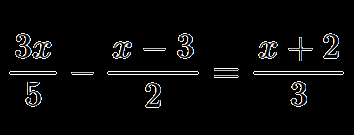
Step-by-step:
Find LCD of 5, 2, and 3: LCD = 30.
Multiply both sides by 30 to clear fractions.
Solve resulting linear equation.
Additional Examples:
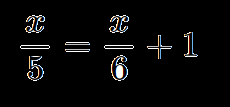
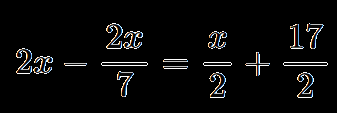
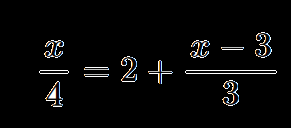
Example Solution: For Step 1: Multiply both sides by 30 (LCD of 5 and 6): Step 2: Subtract :
Key Vocabulary
Linear Equation: An equation of the form .
Solving an Equation: The process of finding all values of the variable that make the equation true.
Solution Set: The set of all solutions.
Equivalent Equations: Equations with identical solution sets.
Summary Table: Linear vs. Nonlinear Equations
Type | Form | Example |
|---|---|---|
Linear (one variable) | ||
Nonlinear | Variable raised to power > 1, or products of variables | , |
Additional info: These notes expand on the brief points in the original materials, providing definitions, step-by-step examples, and a summary table for clarity and completeness.
