 Back
BackSolving Equations: Polynomial, Radical, Rational, and Absolute Value Equations
Study Guide - Smart Notes
 Tailored notes based on your materials, expanded with key definitions, examples, and context.
Equations and Inequalities
Solving Polynomial Equations by Factoring
Polynomial equations are equations involving polynomials set equal to another expression, often zero. The degree of a polynomial equation is determined by the highest power of the variable present. Solving these equations often involves factoring and applying the zero-product principle.
Zero-Product Principle: If a product of factors equals zero, then at least one of the factors must be zero.
Factoring: Express the polynomial as a product of simpler polynomials.
Solving: Set each factor equal to zero and solve for the variable.
Example: Solve by factoring:
Factor:
Set each factor to zero: or
Solutions: or
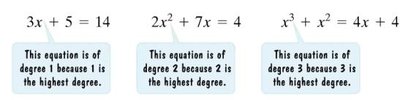
Additional info: The degree of a polynomial equation determines the maximum number of solutions it can have. For example, a degree 1 equation (linear) has one solution, degree 2 (quadratic) has up to two, and degree 3 (cubic) has up to three.
Solving Radical Equations
Radical equations contain variables within a root. When solving radical equations, especially those with even roots, it is important to check all proposed solutions, as extraneous solutions may arise from the process of squaring both sides.
Steps to Solve:
Isolate the radical expression.
Raise both sides to the power that eliminates the radical.
Solve the resulting equation.
Check all solutions in the original equation.
Example: Solve
Square both sides:
Expand:
Rearrange:
Factor:
Solutions: or
Check in original equation to confirm validity.
Additional info: Extraneous solutions are common in radical equations due to the process of raising both sides to a power.
Solving Rational Equations
Rational equations involve fractions with polynomials in the numerator and denominator. Solutions must be checked to ensure they do not make any denominator zero.
Steps to Solve:
Find a common denominator.
Multiply both sides by the common denominator to clear fractions.
Solve the resulting equation.
Check for extraneous solutions (values that make any denominator zero).
Example: Solve
Multiply both sides by :
Solve:
Check: (no denominator is zero)
Solving Absolute Value Equations
Absolute value equations involve expressions within absolute value bars. The solution process requires considering both the positive and negative cases.
Steps to Solve:
Set the expression inside the absolute value equal to the positive and negative values of the other side.
Solve each resulting equation.
Example: Solve
Case 1:
Case 2:
Solutions: or
Additional info: Absolute value equations may have two, one, or no solutions depending on the values involved.
