 Back
BackStudy Guide: Matrices and Basic Operations in College Algebra
Study Guide - Smart Notes
 Tailored notes based on your materials, expanded with key definitions, examples, and context.
Systems of Linear Equations; Matrices
Introduction to Matrices
Matrices are rectangular arrays of numbers arranged in rows and columns. They are fundamental tools in algebra for representing and solving systems of linear equations, as well as for modeling real-world applications in business, economics, and sciences.
Matrix Size: Defined by the number of rows and columns (e.g., a 2x3 matrix has 2 rows and 3 columns).
Notation: Matrices are usually denoted by uppercase letters (A, B, C, etc.).
Application: Used to organize data, perform calculations, and solve systems efficiently.
Matrices: Basic Operations
Matrix Addition and Subtraction
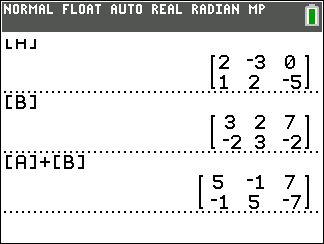
Matrix addition and subtraction are defined only for matrices of the same size. The operations are performed element-wise, meaning each corresponding element is added or subtracted.
Equality: Two matrices are equal if they have the same size and all corresponding elements are equal.
Addition: for all .
Subtraction: for all .
Undefined Operations: Addition or subtraction is not defined for matrices of different sizes.
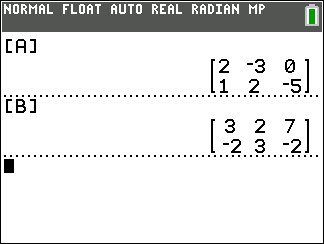
Example: If and , then:
Matrix Properties
Matrix addition has several important properties, provided the matrices are of the same size:
Commutative Property:
Associative Property:
Zero Matrix
A zero matrix is a matrix in which all elements are zero. It acts as the additive identity in matrix addition.
Notation: Often denoted simply as "0" for any size.
Property: for any matrix A.
Negative of a Matrix
The negative of a matrix , denoted , is formed by taking the negative of each element in $M$.
Definition: If , then .
Property:
Subtraction of Matrices
Matrix subtraction is defined as adding the negative of one matrix to another:
Formula:
Multiplication of a Matrix by a Number (Scalar Multiplication)
Multiplying a matrix by a scalar (number) means multiplying each element of the matrix by that number.
Formula:
Example: If and , then
Applications of Matrix Operations
Sales Commissions Example
Matrices can be used to model real-world scenarios such as sales data and commissions. For example, matrices can represent sales figures for different products and months, and matrix operations can be used to calculate combined sales, increases, or commissions.
Addition: Combine sales data from two months.
Subtraction: Find the increase in sales from one month to another.
Scalar Multiplication: Calculate commissions by multiplying sales by the commission rate.
Matrix Multiplication
Product of a Row Matrix and a Column Matrix
The product of a row matrix and a column matrix is defined if the number of elements in the row equals the number in the column. The result is a single number (scalar), calculated as the sum of products of corresponding elements.
Formula:
General Matrix Product
If is an matrix and is an matrix, the product is an matrix. The element in the th row and th column is the sum of products of the $i$th row of $A$ and the $j$th column of $B$.
Formula: , where
Existence: The product is defined only if the number of columns in equals the number of rows in .
Size of Matrix Product
Before multiplying matrices, check their sizes:
If is and is , then is .
If the sizes do not match, the product is not defined.
Matrix Multiplication Examples
Several examples demonstrate how to multiply matrices, check for existence of products, and interpret the results. These include both numeric and application-based examples, such as labor cost calculations.
Example: Labor costs for manufacturing skis can be calculated by multiplying matrices representing labor hours and wage rates.
Solving Matrix Equations
Matrix Equations and Systems
Matrix equations can be used to solve for unknowns in systems of equations. By equating matrices, you can set up and solve multiple equations simultaneously.
Method: Equate corresponding elements to form a system of equations.
Solution: Use substitution, elimination, or matrix methods (such as Gauss-Jordan elimination) to solve.
Summary Table: Matrix Operations
Operation | Definition | Conditions | Example |
|---|---|---|---|
Addition | Same size matrices | ||
Subtraction | Same size matrices | ||
Scalar Multiplication | Any matrix | ||
Matrix Multiplication | , | Columns of A = Rows of B |
Additional info: These notes expand on the original slides by providing full definitions, formulas, and examples for each operation, as well as a summary table for quick reference. Images included are directly relevant to matrix addition and calculator technology as shown in the slides.
