 Back
BackSystems of Linear Equations and Gauss-Jordan Elimination: Study Notes
Study Guide - Smart Notes
 Tailored notes based on your materials, expanded with key definitions, examples, and context.
Systems of Linear Equations; Matrices
Introduction to Systems of Linear Equations
Systems of linear equations are collections of two or more linear equations involving the same set of variables. These systems are fundamental in algebra and have applications in business, economics, life sciences, and social sciences. The solution to a system is the set of variable values that satisfy all equations simultaneously.
Consistent and Independent: Exactly one solution exists.
Consistent and Dependent: Infinitely many solutions exist.
Inconsistent: No solution exists.
Augmented Matrices and Row Operations
To solve systems efficiently, we use matrices to represent the system and perform row operations to simplify the system. The augmented matrix includes the coefficients and constants from the equations.
Row Operations: Swapping rows, multiplying a row by a nonzero constant, and adding multiples of one row to another.
Goal: Transform the matrix into a form that reveals the solution(s) directly.
Gauss-Jordan Elimination
Overview of Gauss-Jordan Elimination
Gauss-Jordan elimination is a systematic method for solving systems of linear equations by transforming the augmented matrix into reduced row echelon form (RREF). This process uses a sequence of row operations to simplify the matrix.
Reduced Row Echelon Form (RREF): A matrix is in RREF if:
Each row of all zeros is below any row with a nonzero element.
The leftmost nonzero entry in each row is 1 (called a leading 1).
All other entries in the column containing a leading 1 are zeros.
The leading 1 in any row is to the right of the leading 1 in the row above.
Procedure for Gauss-Jordan Elimination
Choose the leftmost nonzero column and use row operations to get a 1 at the top.
Use multiples of the row containing the 1 to get zeros in all other entries of that column.
Repeat the process with the submatrix below and to the right.
Continue until the entire matrix is in reduced form.
Note: If a row of the form with appears, the system is inconsistent and has no solution.
Types of Solutions
Unique Solution: Each variable corresponds to a leading 1 in the matrix.
Infinitely Many Solutions: Fewer leading 1's than variables; express some variables in terms of parameters.
No Solution: Contradictory row appears in the matrix.
Examples of Gauss-Jordan Elimination
Example: Solving a System with Gauss-Jordan Elimination
Consider the system:
Step 1: Write the augmented matrix:
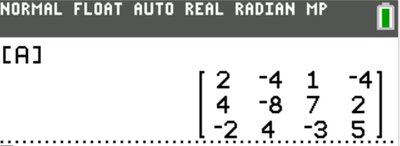
Step 2: Apply row operations to reach RREF. Using a calculator, the RREF is:
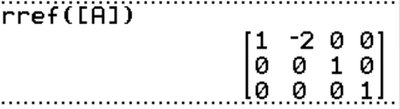
Interpretation: The last row indicates a contradiction (), so the system has no solution.
Example: System with Infinitely Many Solutions
Suppose after row reduction, the matrix is:
This corresponds to the system:
Let (a parameter), then , , for any real number .
Application: Real-World Problem Solving with Systems of Equations
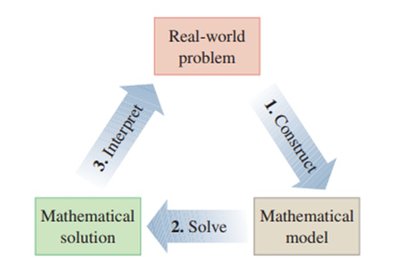
The Three-Step Mathematical Modeling Process
Solving real-world problems with systems of equations involves three main steps:
Construct a mathematical model (system of equations) based on the problem.
Solve the mathematical model using algebraic methods (e.g., Gauss-Jordan elimination).
Interpret the solution in the context of the original problem.
Example: Purchasing Trucks
A company wants to buy 25 trucks with a total capacity of 28,000 cubic feet. Three types of trucks are available:
10-foot truck: 350 cubic feet
14-foot truck: 700 cubic feet
24-foot truck: 1,400 cubic feet
Let , , be the number of 10-foot, 14-foot, and 24-foot trucks, respectively. The system is:
After forming and reducing the augmented matrix, the solution is expressed in terms of a parameter (e.g., ), and the other variables are written in terms of . Only nonnegative integer solutions are meaningful in this context.
Summary Table: Types of Solutions for Systems of Linear Equations
Matrix Form | Type of Solution | Description |
|---|---|---|
Each variable has a leading 1 | Unique Solution | Exactly one solution exists |
Fewer leading 1's than variables, no contradiction | Infinitely Many Solutions | Some variables are free parameters |
Row of zeros with nonzero constant | No Solution | System is inconsistent |
