Ch. 1 - Equations and Inequalities
Blitzer - College Algebra 8th Edition
Blitzer8th EditionCollege AlgebraISBN: 9780136970514Not the one you use?Change textbook
Chapter 2, Problem 45

In Exercises 37–52, perform the indicated operations and write the result in standard form. (- 8 + √-32)/24

Verified step by step guidance
1
Step 1: Recognize that the expression involves a square root of a negative number, √-32. Recall that the square root of a negative number introduces the imaginary unit 'i', where i = √-1. Rewrite √-32 as √32 * i.
Step 2: Simplify √32. Since 32 = 16 * 2, and √16 = 4, we can express √32 as 4√2. Therefore, √-32 becomes 4√2 * i.
Step 3: Substitute the simplified form of √-32 back into the original expression. The expression now becomes (-8 + 4√2 * i) / 24.
Step 4: Separate the real and imaginary parts of the numerator. The real part is -8, and the imaginary part is 4√2 * i. Divide each part by 24 separately: (-8/24) + (4√2 * i / 24).
Step 5: Simplify each term. Reduce -8/24 to -1/3, and simplify (4√2 * i / 24) to (√2 * i / 6). The final expression in standard form is (-1/3) + (√2 * i / 6).

Verified video answer for a similar problem:

This video solution was recommended by our tutors as helpful for the problem above.
Video duration:
3m
Was this helpful?

Key Concepts

Here are the essential concepts you must grasp in order to answer the question correctly.

Complex Numbers

Complex numbers are numbers that have a real part and an imaginary part, expressed in the form a + bi, where 'a' is the real part and 'b' is the coefficient of the imaginary unit 'i', which is defined as the square root of -1. Understanding complex numbers is essential for operations involving square roots of negative numbers, as they allow us to express these values in a meaningful way.
Recommended video:
04:22
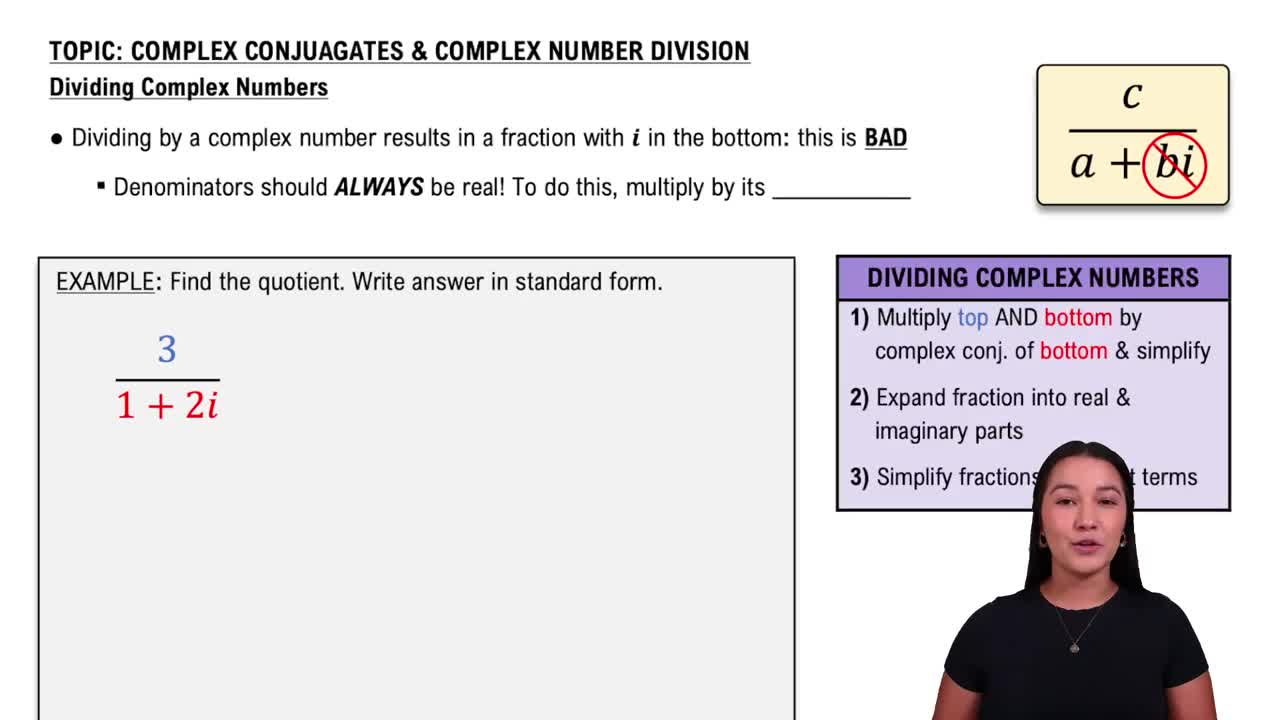
Dividing Complex Numbers

Standard Form of Complex Numbers

The standard form of a complex number is a + bi, where 'a' and 'b' are real numbers. When performing operations with complex numbers, it is important to express the final result in this form to clearly distinguish between the real and imaginary components. This format is crucial for further mathematical operations and applications in various fields.
Recommended video:
05:02
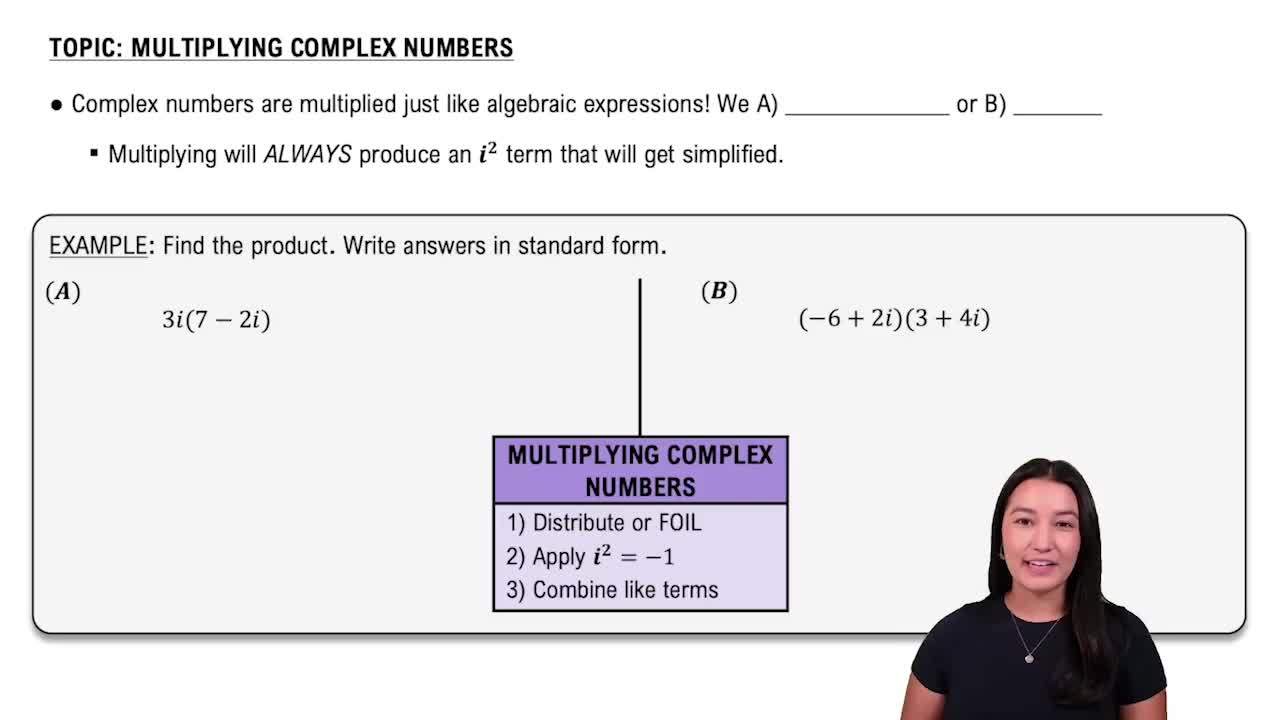
Multiplying Complex Numbers

Simplifying Square Roots of Negative Numbers

To simplify square roots of negative numbers, we use the property that √(-x) = i√x, where 'i' is the imaginary unit. This allows us to rewrite expressions involving square roots of negative values in terms of complex numbers. Mastery of this concept is necessary for correctly handling expressions like √-32 in the given problem.
Recommended video:
05:02
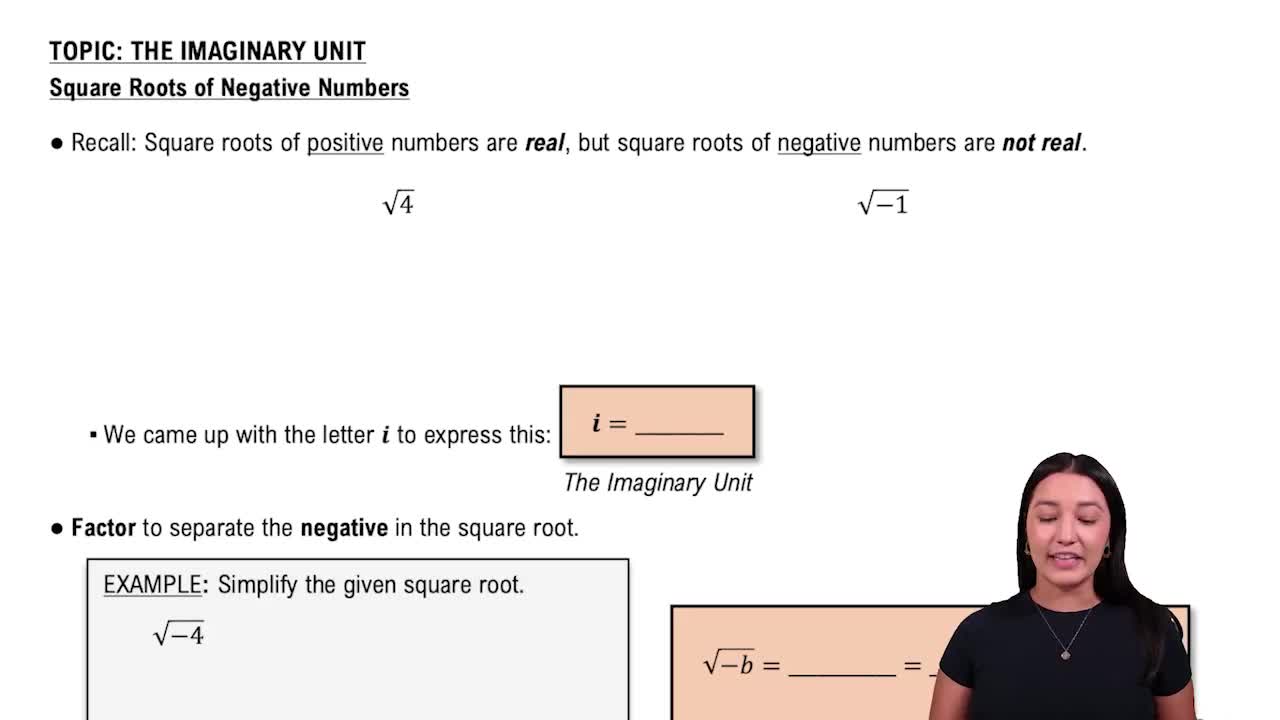
Square Roots of Negative Numbers