Ch. 2 - Functions and Graphs
Blitzer - College Algebra 8th Edition
Blitzer8th EditionCollege AlgebraISBN: 9780136970514Not the one you use?Change textbook
Chapter 3, Problem 10

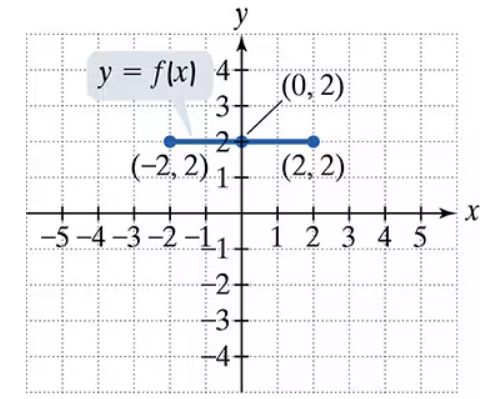
Use the graph of y = f(x) to graph each function g.

g(x) = f(-x)+3

Verified step by step guidance
1
Step 1: Analyze the given graph of y = f(x). The graph is a horizontal line segment from (1, -3) to (4, -3). This means that f(x) = -3 for all x in the interval [1, 4].
Step 2: Understand the transformation g(x) = f(-x) + 3. The function f(-x) reflects the graph of f(x) across the y-axis. This means the x-coordinates of the points on the graph will be negated.
Step 3: Apply the reflection transformation f(-x). The original points (1, -3) and (4, -3) will become (-1, -3) and (-4, -3), respectively. The horizontal line segment is now between (-4, -3) and (-1, -3).
Step 4: Apply the vertical shift of +3 to the reflected graph. This means adding 3 to the y-coordinates of all points on the graph. The points (-4, -3) and (-1, -3) will become (-4, 0) and (-1, 0), respectively.
Step 5: Plot the transformed graph g(x). The new graph is a horizontal line segment from (-4, 0) to (-1, 0).

Verified video answer for a similar problem:

This video solution was recommended by our tutors as helpful for the problem above.
Video duration:
1m
Was this helpful?

Key Concepts

Here are the essential concepts you must grasp in order to answer the question correctly.

Function Transformation

Function transformations involve altering the graph of a function through shifts, stretches, or reflections. In this case, the function g(x) = f(-x) + 3 represents a horizontal reflection of f(x) across the y-axis, followed by a vertical shift upward by 3 units. Understanding these transformations is crucial for accurately graphing the new function.
Recommended video:
4:22
Domain & Range of Transformed Functions

Reflection Across the Y-Axis

Reflecting a function across the y-axis means that for every point (x, y) on the original graph, there is a corresponding point (-x, y) on the reflected graph. This transformation changes the sign of the x-coordinates while keeping the y-coordinates the same, which is essential for graphing g(x) = f(-x).
Recommended video:
5:00
Reflections of Functions

Vertical Shift

A vertical shift involves moving the entire graph of a function up or down without altering its shape. In the function g(x) = f(-x) + 3, the '+3' indicates that the graph of f(-x) will be shifted upward by 3 units. This shift affects the y-coordinates of all points on the graph, which is important for determining the final position of g(x).
Recommended video:
5:34
Shifts of Functions