In Exercises 11–26, determine whether each equation defines y as a function of x. x + y = 16
Ch. 2 - Functions and Graphs

Chapter 3, Problem 11
Use the given conditions to write an equation for each line in point-slope form and slope-intercept form. Slope = 2, passing through (3, 5)
Verified step by step guidance1
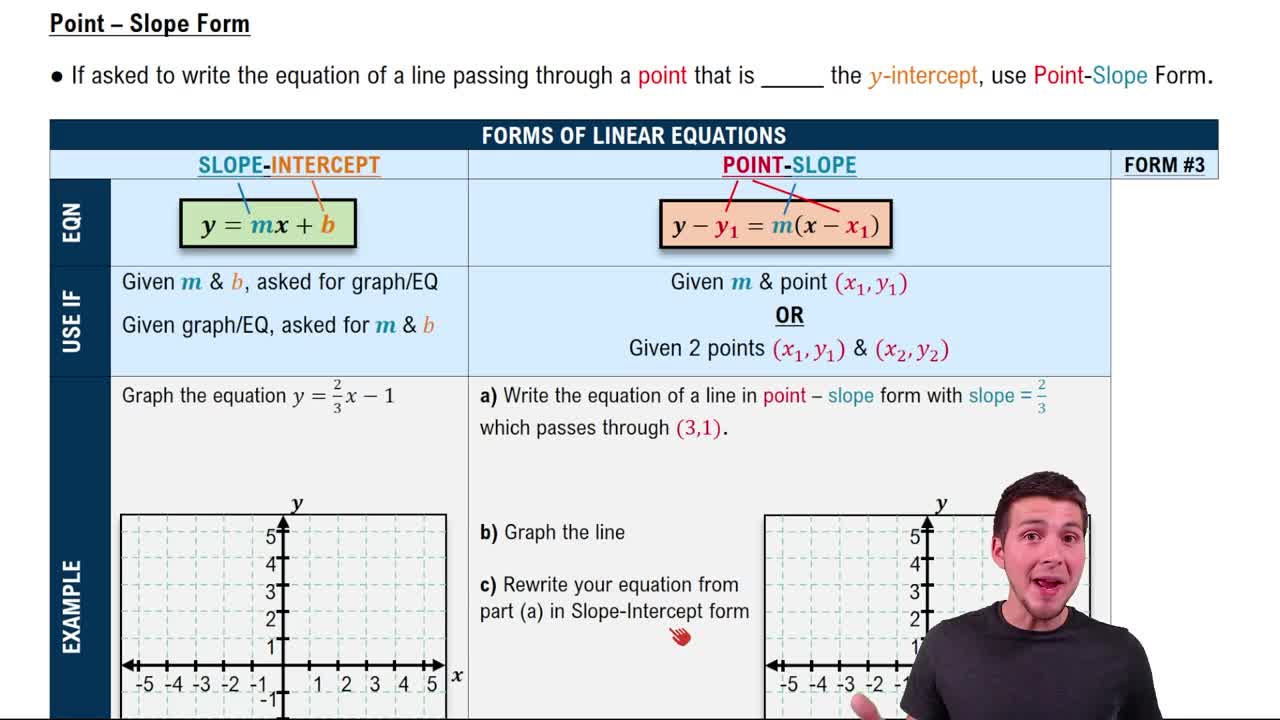
Recall the point-slope form of a line equation: \(y - y_1 = m(x - x_1)\), where \(m\) is the slope and \((x_1, y_1)\) is a point on the line.
Substitute the given slope \(m = 2\) and the point \((3, 5)\) into the point-slope form: \(y - 5 = 2(x - 3)\).
To convert to slope-intercept form, start by distributing the slope on the right side: \(y - 5 = 2x - 6\).
Next, isolate \(y\) by adding 5 to both sides: \(y = 2x - 6 + 5\).
Simplify the right side to get the slope-intercept form: \(y = 2x - 1\).

Verified video answer for a similar problem:
This video solution was recommended by our tutors as helpful for the problem above.
Video duration:
1mWas this helpful?
Key Concepts
Here are the essential concepts you must grasp in order to answer the question correctly.
Point-Slope Form of a Line
The point-slope form is an equation of a line expressed as y - y₁ = m(x - x₁), where m is the slope and (x₁, y₁) is a point on the line. It is useful for writing the equation when you know a point and the slope.
Recommended video:
Guided course
Point-Slope Form
Slope-Intercept Form of a Line
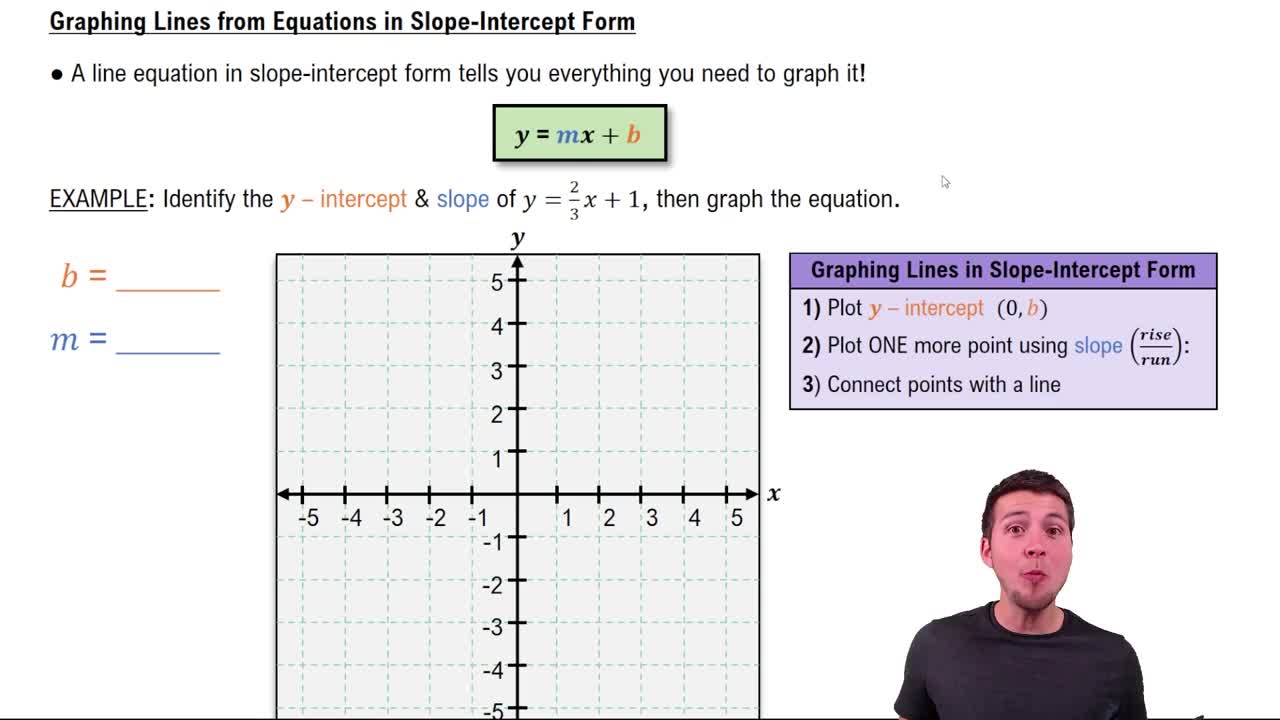
The slope-intercept form is y = mx + b, where m is the slope and b is the y-intercept. This form clearly shows the slope and where the line crosses the y-axis, making it easy to graph and interpret.
Recommended video:
Guided course
Graphing Lines in Slope-Intercept Form
Using Given Conditions to Find the Equation
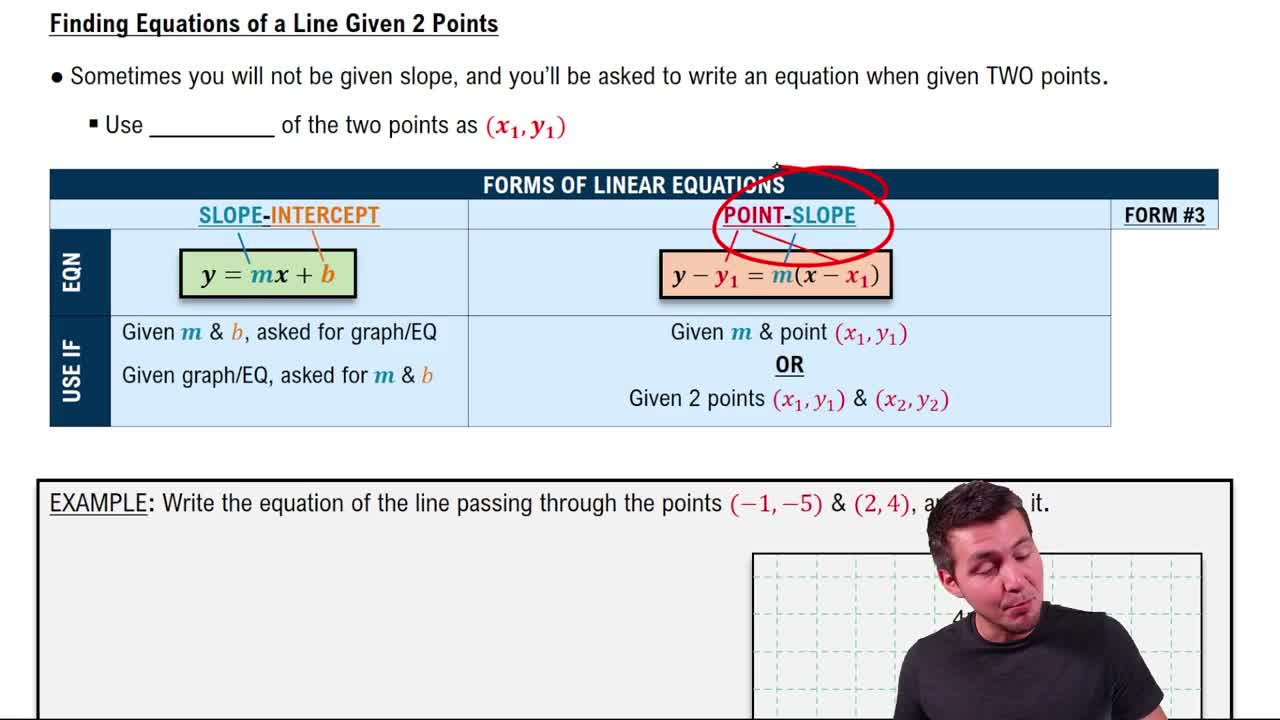
Given a slope and a point, you substitute these values into the point-slope form to write the equation. Then, by simplifying and solving for y, you convert it into slope-intercept form, revealing the y-intercept.
Recommended video:
Guided course
Finding Equations of Lines Given Two Points
Related Practice
Textbook Question
1922
views
Textbook Question
Use the graph of y = f(x) to graph each function g.
g(x) = ½ f(x)
1721
views
Textbook Question
Find f(g(x)) and g (f(x)) and determine whether each pair of functions ƒ and g are inverses of each other. f(x) = ∛(x − 4) and g(x) = x³ +4
609
views
Textbook Question
Use the graph of y = f(x) to graph each function g.
g(x) = f(-x)+3
1044
views
Textbook Question
The functions in Exercises 11-28 are all one-to-one. For each function, a. Find an equation for f-1(x), the inverse function. b. Verify that your equation is correct by showing that f(ƒ-1 (x)) = = x and ƒ-1 (f(x)) = x. f(x) = x +3
635
views
Textbook Question
Find the distance between each pair of points. If necessary, express answers in simplified radical form and then round to two decimal places. (3.5, 8.2) and (-0.5, 6.2)
831
views