Begin by graphing the absolute value function, f(x) = |x|. Then use transformations of this graph to graph the given function. g(x) = -2|x+3|+2
Ch. 2 - Functions and Graphs

Chapter 3, Problem 95
Let f and g be defined by the following table: Find
Verified step by step guidance1
Identify the values of the functions f and g at the specified inputs from the given table: find f(−1), f(0), f(−2), g(2), and g(−1).
Calculate the expression inside the square root: compute f(−1) − f(0).
Take the square root of the result from the previous step: calculate \$\(\sqrt{f(−1) − f(0)}\)\$.
Calculate the square of g(2): compute \$[g(2)]^{2}\$.
Evaluate the entire expression by combining all parts: \$\(\sqrt{f(−1) − f(0)}\) - [g(2)]^{2} + \(\frac{f(−2)}{g(2)}\) \(\cdot\) g(−1)\$. Follow the order of operations carefully, performing multiplication and division before addition and subtraction.

Verified video answer for a similar problem:
This video solution was recommended by our tutors as helpful for the problem above.
Video duration:
2mWas this helpful?
Key Concepts
Here are the essential concepts you must grasp in order to answer the question correctly.
Function Evaluation
Function evaluation involves finding the output value of a function for a given input. In this problem, you need to determine values like f(-1), f(0), g(2), and g(-1) by referring to the provided table, which is essential before performing any arithmetic operations.
Recommended video:
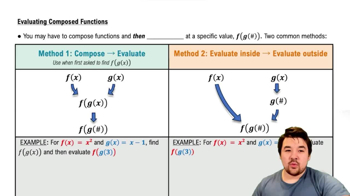
Evaluating Composed Functions
Order of Operations
The order of operations (PEMDAS) dictates the sequence in which mathematical operations should be performed: Parentheses, Exponents, Multiplication and Division (left to right), Addition and Subtraction (left to right). Correctly applying this ensures accurate simplification of the given expression.
Recommended video:
Guided course
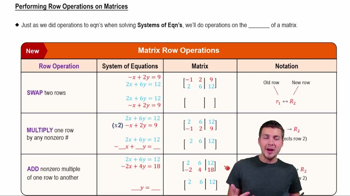
Performing Row Operations on Matrices
Square Root and Exponents
Understanding how to handle square roots and exponents is crucial here. The square root symbol (√) indicates the principal (non-negative) root, and squaring a value means raising it to the power of two. Properly applying these operations affects the final result.
Recommended video:
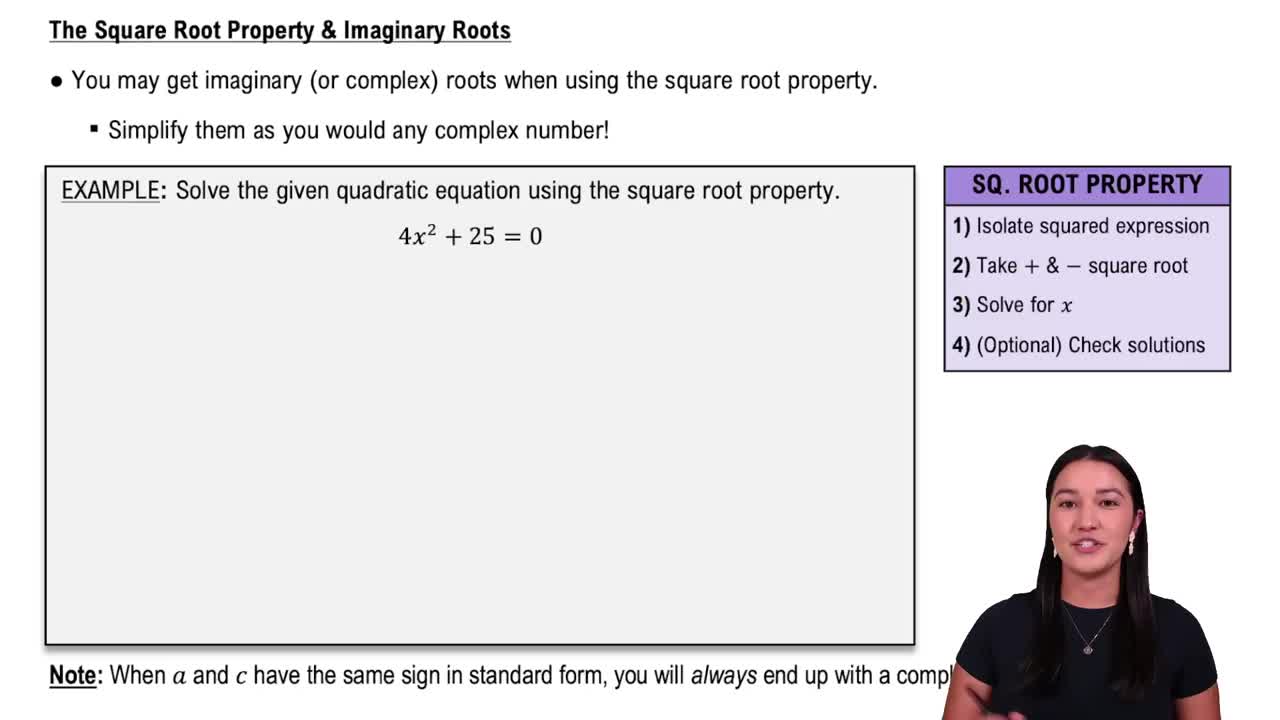
Imaginary Roots with the Square Root Property
Related Practice
Textbook Question
673
views
Textbook Question
The functions in Exercises 93–95 are all one-to-one. For each function, (a) find an equation for f^(-1)x, the inverse function. (b) Verify that your equation is correct by showing that f(f^(-1)(x)) = x and f^(-1)(f(x)) = x. f(x) = (x - 7)/(x + 2)
761
views
Textbook Question
Let f(x) = x² − x + 4 and g(x) = 3x – 5. Find g(-1) and f(g(-1)).
116
views
Textbook Question
Determine whether each statement is true or false. If the statement is false, make the necessary change(s) to produce a true statement.
If and , find and .
641
views
Textbook Question
Let f(x) = x² − x + 4 and g(x) = 3x – 5. Find g (1) and f(g(1)).
95
views
Textbook Question
Find all values of x satisfying the given conditions. f(x) = 2x − 5, g(x) = x² − 3x + 8, and (ƒ o g) (x) = 7.
1378
views