Ch. 2 - Functions and Graphs
Blitzer - College Algebra 8th Edition
Blitzer8th EditionCollege AlgebraISBN: 9780136970514Not the one you use?Change textbook
Chapter 3, Problem 95

The functions in Exercises 93–95 are all one-to-one. For each function, (a) find an equation for f^(-1)x, the inverse function. (b) Verify that your equation is correct by showing that f(f^(-1)(x)) = x and f^(-1)(f(x)) = x. f(x) = (x - 7)/(x + 2)

Verified step by step guidance
1
Step 1: To find the inverse function f^(-1)(x), start by replacing f(x) with y. This gives y = (x - 7)/(x + 2).
Step 2: Swap x and y in the equation to reflect the inverse relationship. This gives x = (y - 7)/(y + 2).
Step 3: Solve for y in terms of x. Multiply both sides by (y + 2) to eliminate the denominator: x(y + 2) = y - 7. Expand and rearrange to isolate y.
Step 4: Once y is isolated, replace y with f^(-1)(x) to express the inverse function explicitly.
Step 5: Verify the inverse by substituting f^(-1)(x) into f(x) and vice versa. Show that f(f^(-1)(x)) = x and f^(-1)(f(x)) = x by simplifying both compositions step by step.

Verified video answer for a similar problem:

This video solution was recommended by our tutors as helpful for the problem above.
Video duration:
3m
Was this helpful?

Key Concepts

Here are the essential concepts you must grasp in order to answer the question correctly.

Inverse Functions

An inverse function reverses the effect of the original function. If f(x) takes an input x and produces an output y, then the inverse function f^(-1)(y) takes y back to x. To find the inverse, we typically swap the roles of x and y in the equation and solve for y.
Recommended video:
4:30
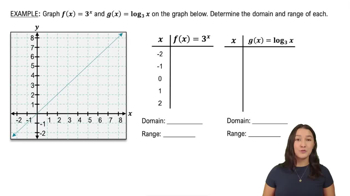
Graphing Logarithmic Functions

Verification of Inverse Functions

To confirm that two functions are inverses, we must show that applying one function to the result of the other returns the original input. This is done by proving f(f^(-1)(x)) = x and f^(-1)(f(x)) = x. If both conditions hold true, the functions are indeed inverses.
Recommended video:
4:30
Graphing Logarithmic Functions

One-to-One Functions

A function is one-to-one if it assigns a unique output for every unique input, meaning no two different inputs produce the same output. This property is essential for the existence of an inverse function, as it ensures that the inverse will also be a function, mapping each output back to a single input.
Recommended video:
4:07
Decomposition of Functions