Write a polynomial that represents the length of each rectangle. Transcription: The area of the rectangle is 0.5x3 - 0.3x2 + 0.22x + 0.06 square units and its width is x + 0.2 units
Ch. 3 - Polynomial and Rational Functions

Chapter 4, Problem 55
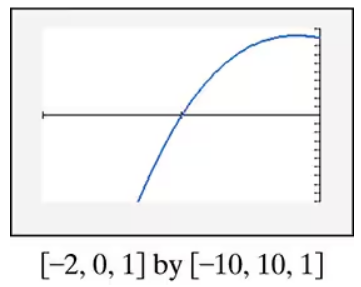
Exercises 53–60 show incomplete graphs of given polynomial functions. a) Find all the zeros of each function. b) Without using a graphing utility, draw a complete graph of the function. f(x)=4x3−8x2−3x+9

Verified step by step guidance1
Start by identifying the polynomial function given: \(f(x) = 4x^{3} - 8x^{2} - 3x + 9\).
To find the zeros of the function, set \(f(x) = 0\), which gives the equation \(4x^{3} - 8x^{2} - 3x + 9 = 0\).
Use the Rational Root Theorem to list possible rational zeros. These are of the form \(\pm \frac{p}{q}\), where \(p\) divides the constant term (9) and \(q\) divides the leading coefficient (4). So possible roots are \(\pm1, \pm3, \pm9, \pm\frac{1}{2}, \pm\frac{3}{2}, \pm\frac{9}{2}, \pm\frac{1}{4}, \pm\frac{3}{4}, \pm\frac{9}{4}\).
Test these possible roots by substituting them into the polynomial to find which values make \(f(x) = 0\). Once a root is found, use polynomial division or synthetic division to factor the polynomial and reduce its degree.
After factoring completely, solve the remaining quadratic or linear factors to find all zeros. Then, use the zeros and the end behavior of the cubic function to sketch the complete graph without a graphing utility.

Verified video answer for a similar problem:
This video solution was recommended by our tutors as helpful for the problem above.
Video duration:
6mWas this helpful?
Key Concepts
Here are the essential concepts you must grasp in order to answer the question correctly.
Finding Zeros of Polynomial Functions
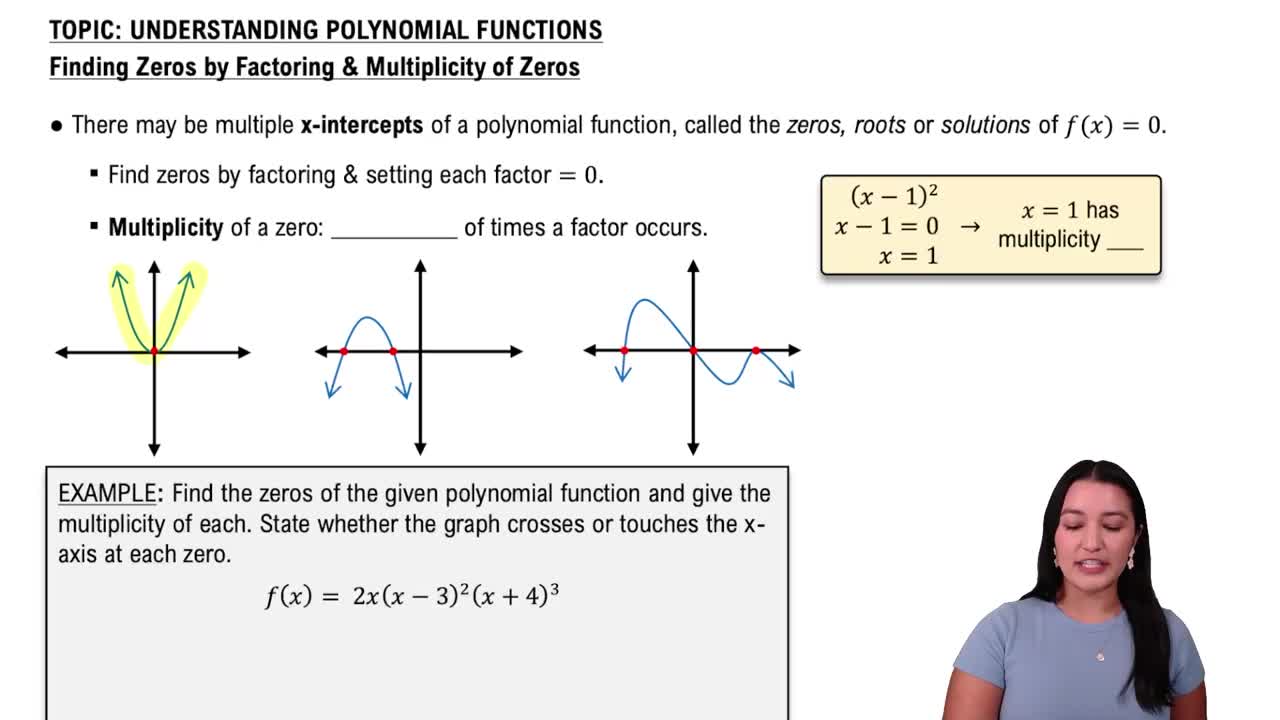
Zeros of a polynomial are the values of x for which the function equals zero. To find them, one can use factoring, synthetic division, or the Rational Root Theorem to identify possible roots. These zeros correspond to the x-intercepts on the graph.
Recommended video:
Finding Zeros & Their Multiplicity
Behavior of Polynomial Graphs
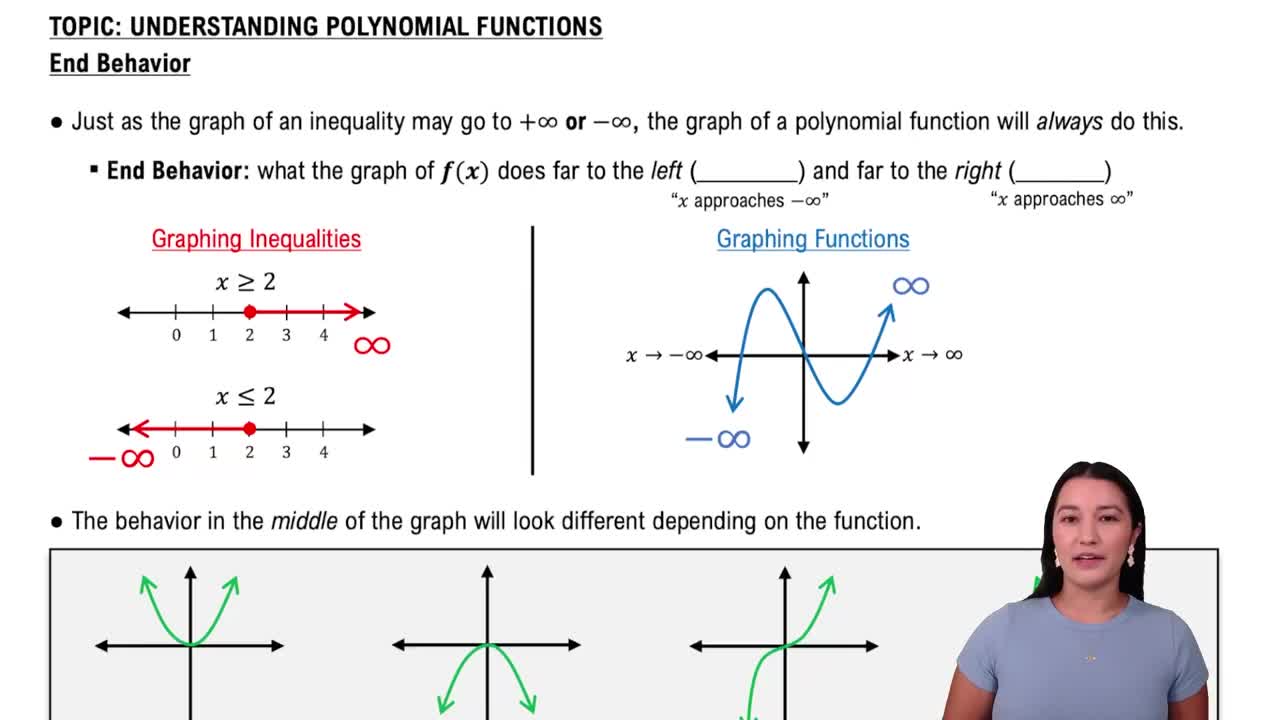
Understanding the shape of a polynomial graph involves analyzing its degree and leading coefficient. The degree determines the number of turning points and end behavior, while the leading coefficient affects whether the graph rises or falls at the extremes.
Recommended video:
End Behavior of Polynomial Functions
Sketching Polynomial Graphs Without Technology
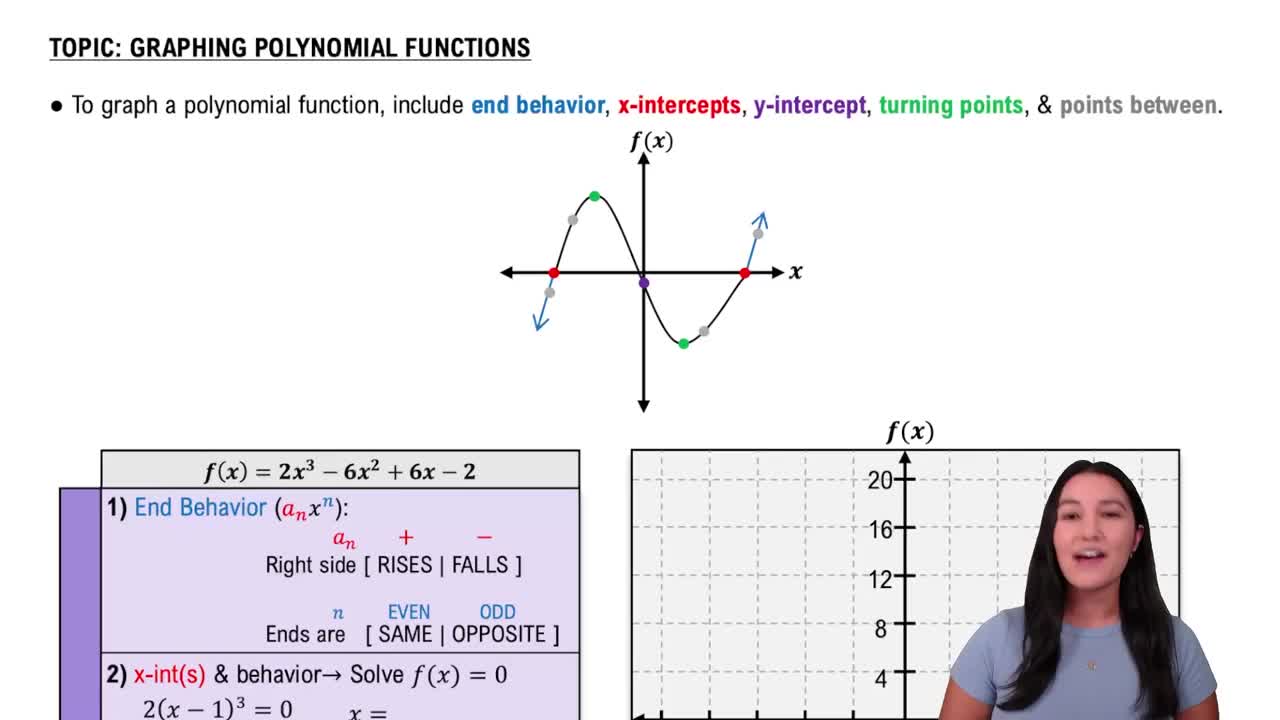
To sketch a polynomial graph by hand, identify zeros, determine their multiplicities, analyze end behavior, and find critical points using derivatives if possible. This approach helps create an accurate representation without relying on graphing utilities.
Recommended video:
Graphing Polynomial Functions
Related Practice
Textbook Question
1198
views
Textbook Question
Solve each rational inequality in Exercises 43–60 and graph the solution set on a real number line. Express each solution set in interval notation. (x+4)(x−1)/(x+2)≤0
475
views
Textbook Question
Write an equation in vertex form of the parabola that has the same shape as the graph of f(x) = 3x2 or g(x) = -3x2, but with the given maximum or minimum. Minimum = 0 at x = 11
1194
views
Textbook Question
Use transformations of f(x) = (1/x) or f(x) = (1/x2) to graph each rational function. g(x) = 1/(x + 2)2 - 1
1039
views
Textbook Question
Use transformations of f(x)=1/x or f(x)=1/x2 to graph each rational function. h(x)=1/(x−3)2+1
678
views
Textbook Question
Write an equation in vertex form of the parabola that has the same shape as the graph of f(x) = 3x2 or g(x) = -3x2, but with the given maximum or minimum. Maximum = 4 at x = -2
1313
views