Ch. 3 - Polynomial and Rational Functions
Blitzer - College Algebra 8th Edition
Blitzer8th EditionCollege AlgebraISBN: 9780136970514Not the one you use?Change textbook
Chapter 4, Problem 55

Use transformations of f(x)=1/x or f(x)=1/x2 to graph each rational function. h(x)=1/(x−3)2+1

Verified step by step guidance
1
Identify the base function given, which is \(f(x) = \frac{1}{x^2}\). This is the starting point for the transformations.
Recognize the horizontal shift in the function \(h(x) = \frac{1}{(x-3)^2} + 1\). The term \((x-3)\) inside the denominator indicates a shift to the right by 3 units.
Understand the vertical shift: the \(+1\) outside the fraction means the entire graph of \(\frac{1}{(x-3)^2}\) is shifted upward by 1 unit.
Combine the transformations: start with the graph of \(f(x) = \frac{1}{x^2}\), shift it right by 3 units to get \(\frac{1}{(x-3)^2}\), then shift it up by 1 unit to get \(h(x) = \frac{1}{(x-3)^2} + 1\).
Analyze the asymptotes: the vertical asymptote moves from \(x=0\) to \(x=3\) due to the horizontal shift, and the horizontal asymptote moves from \(y=0\) to \(y=1\) due to the vertical shift.

Verified video answer for a similar problem:

This video solution was recommended by our tutors as helpful for the problem above.
Video duration:
2m
Was this helpful?

Key Concepts

Here are the essential concepts you must grasp in order to answer the question correctly.

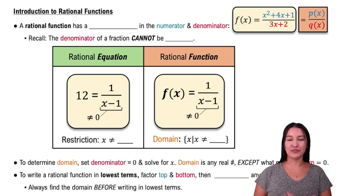
Parent Rational Functions

Parent rational functions like f(x) = 1/x and f(x) = 1/x² serve as the basic models for more complex rational functions. Understanding their graphs, including asymptotes and general shape, is essential before applying transformations. For example, f(x) = 1/x has vertical and horizontal asymptotes at x=0 and y=0, respectively.
Recommended video:
6:04
Intro to Rational Functions

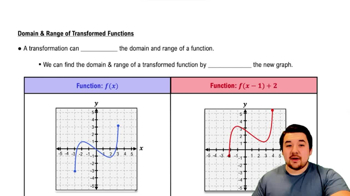
Transformations of Functions

Transformations include shifts, stretches, compressions, and reflections applied to the parent function's graph. Horizontal shifts move the graph left or right, vertical shifts move it up or down, and changes inside the function's formula affect these shifts. For h(x) = 1/(x−3)² + 1, the graph shifts right by 3 units and up by 1 unit.
Recommended video:
4:22
Domain & Range of Transformed Functions

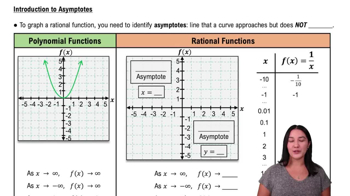
Asymptotes of Rational Functions

Asymptotes are lines that the graph approaches but never touches. Vertical asymptotes occur where the denominator is zero, indicating undefined points, while horizontal asymptotes describe end behavior as x approaches infinity. For h(x) = 1/(x−3)² + 1, the vertical asymptote is x=3 and the horizontal asymptote is y=1.
Recommended video:
6:24
Introduction to Asymptotes