
Textbook Question
Solve:
597
views

 Verified step by step guidance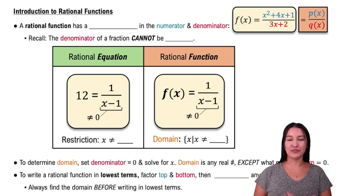
 6:04
6:04
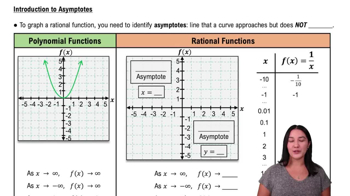 6:24
6:24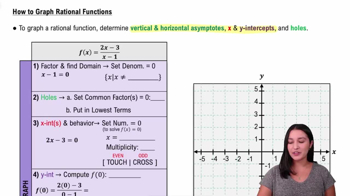 8:19
8:19Solve:
Exercises 53–60 show incomplete graphs of given polynomial functions. a) Find all the zeros of each function. b) Without using a graphing utility, draw a complete graph of the function. f(x)=3x5+2x4−15x3−10x2+12x+8
In Exercises 57–64, find the vertical asymptotes, if any, the horizontal asymptote, if one exists, and the slant asymptote, if there is one, of the graph of each rational function. Then graph the rational function. f(x) = 2x/(x^2 - 9)
In Exercises 57–64, find the vertical asymptotes, if any, the horizontal asymptote, if one exists, and the slant asymptote, if there is one, of the graph of each rational function. Then graph the rational function. g(x) = (2x - 4)/(x + 3)
In Exercises 57–64, find the vertical asymptotes, if any, the horizontal asymptote, if one exists, and the slant asymptote, if there is one, of the graph of each rational function. Then graph the rational function. h(x) = (x^2 - 3x - 4)/(x^2 - x -6)
Solve each rational inequality in Exercises 43–60 and graph the solution set on a real number line. Express each solution set in interval notation.1/(x - 3) < 1