Solve each rational inequality in Exercises 43–60 and graph the solution set on a real number line. Express each solution set in interval notation. x/(x + 2) ≥ 2
Ch. 3 - Polynomial and Rational Functions

Chapter 4, Problem 59
In Exercises 57–64, find the vertical asymptotes, if any, the horizontal asymptote, if one exists, and the slant asymptote, if there is one, of the graph of each rational function. Then graph the rational function. h(x) = (x^2 - 3x - 4)/(x^2 - x -6)
Verified step by step guidance1
Step 1: Factor the numerator and the denominator.
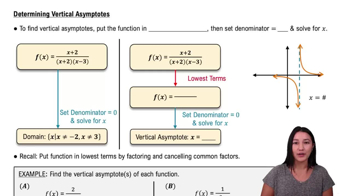
Step 2: Identify the vertical asymptotes by setting the denominator equal to zero and solving for x.
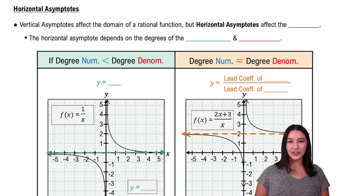
Step 3: Determine the horizontal asymptote by comparing the degrees of the numerator and the denominator.
Step 4: Check for a slant asymptote by performing polynomial long division if the degree of the numerator is exactly one more than the degree of the denominator.
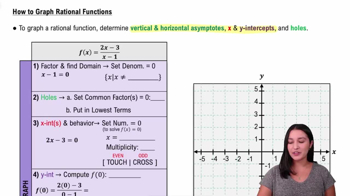
Step 5: Use the information from the previous steps to sketch the graph of the rational function, noting the asymptotes and any intercepts.

Verified video answer for a similar problem:
This video solution was recommended by our tutors as helpful for the problem above.
Video duration:
8mWas this helpful?
Key Concepts
Here are the essential concepts you must grasp in order to answer the question correctly.
Vertical Asymptotes
Vertical asymptotes occur in rational functions where the denominator equals zero, leading to undefined values. To find them, set the denominator of the function to zero and solve for the variable. The values obtained indicate the x-coordinates where the graph approaches infinity or negative infinity, creating vertical lines that the graph cannot cross.
Recommended video:
Determining Vertical Asymptotes
Horizontal and Slant Asymptotes
Horizontal asymptotes describe the behavior of a function as x approaches infinity or negative infinity. For rational functions, if the degree of the numerator is less than or equal to the degree of the denominator, a horizontal asymptote exists. Slant (or oblique) asymptotes occur when the degree of the numerator is exactly one more than that of the denominator, indicating that the graph will approach a linear function as x becomes very large or very small.
Recommended video:
Determining Horizontal Asymptotes
Graphing Rational Functions
Graphing rational functions involves plotting key features such as intercepts, asymptotes, and behavior at critical points. After identifying vertical and horizontal/slant asymptotes, one can determine the function's end behavior and sketch the graph accordingly. Additionally, finding x-intercepts and y-intercepts helps in accurately representing the function's overall shape and behavior.
Recommended video:
How to Graph Rational Functions
Related Practice
Textbook Question
579
views
Textbook Question
Solve:
597
views
Textbook Question
Exercises 53–60 show incomplete graphs of given polynomial functions. a) Find all the zeros of each function. b) Without using a graphing utility, draw a complete graph of the function. f(x)=3x5+2x4−15x3−10x2+12x+8
489
views
Textbook Question
Solve each rational inequality in Exercises 43–60 and graph the solution set on a real number line. Express each solution set in interval notation. (x - 2)/(x + 2) ≤ 2
460
views
Textbook Question
In Exercises 57–64, find the vertical asymptotes, if any, the horizontal asymptote, if one exists, and the slant asymptote, if there is one, of the graph of each rational function. Then graph the rational function. g(x) = (2x - 4)/(x + 3)
748
views
Textbook Question
Follow the seven steps to graph each rational function. f(x)=2x/(x2−4)
51
views