In Exercises 57–62, use the vertex and the direction in which the parabola opens to determine the relation's domain and range. Is the relation a function?
Ch. 7 - Conic Sections

Chapter 8, Problem 59
In Exercises 57–62, use the vertex and the direction in which the parabola opens to determine the relation's domain and range. Is the relation a function?
Verified step by step guidance1
Identify the given quadratic function: .
Determine the direction in which the parabola opens by looking at the coefficient of . Since it is negative (-1), the parabola opens downward.
Find the vertex of the parabola using the vertex formula for : , where and . Calculate .
Substitute the -value of the vertex back into the original equation to find the -coordinate of the vertex, which gives the maximum value of because the parabola opens downward.
Determine the domain and range: The domain of any quadratic function is all real numbers, so . The range is all -values less than or equal to the vertex's -coordinate, so . Since each corresponds to exactly one , the relation is a function.

Verified video answer for a similar problem:
This video solution was recommended by our tutors as helpful for the problem above.
Video duration:
8mWas this helpful?
Key Concepts
Here are the essential concepts you must grasp in order to answer the question correctly.
Vertex of a Parabola
The vertex is the highest or lowest point on a parabola, found using the formula x = -b/(2a) for a quadratic y = ax^2 + bx + c. It helps identify the maximum or minimum value of the function, which is crucial for determining the range.
Recommended video:
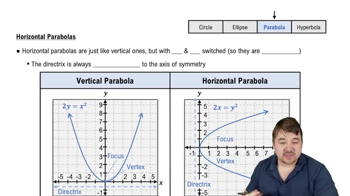
Horizontal Parabolas
Direction of the Parabola
The direction a parabola opens depends on the coefficient 'a' in y = ax^2 + bx + c. If 'a' is positive, it opens upward; if negative, downward. This direction indicates whether the vertex is a maximum or minimum point, affecting the range of the relation.
Recommended video:
Horizontal Parabolas
Domain and Range of Quadratic Functions
The domain of a quadratic function is all real numbers since x can take any value. The range depends on the vertex and the parabola's direction: if it opens downward, the range is all y-values less than or equal to the vertex's y-coordinate; if upward, all y-values greater than or equal to it.
Recommended video:
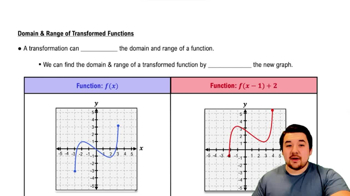
Domain & Range of Transformed Functions
Related Practice
Textbook Question
736
views
Textbook Question
Convert each equation to standard form by completing the square on x and y. Then graph the ellipse and give the location of its foci. 25x²+4y² – 150x + 32y + 189 = 0
827
views
Textbook Question
Use the vertex and the direction in which the parabola opens to determine the relation's domain and range. Is the relation a function? y2 + 6y - x + 5 = 0
892
views
Textbook Question
Find the solution set for each system by graphing both of the system's equations in the same rectangular coordinate system and finding points of intersection. Check all solutions in both equations.
812
views
Textbook Question
Convert each equation to standard form by completing the square on x and y. Then graph the ellipse and give the location of its foci. 36x2 +9y2 - 216x = 0
827
views
Textbook Question
Identify each equation without completing the square.
557
views