Ch. 7 - Conic Sections
Blitzer - College Algebra 8th Edition
Blitzer8th EditionCollege AlgebraISBN: 9780136970514Not the one you use?Change textbook
Chapter 8, Problem 61

Find the solution set for each system by graphing both of the system's equations in the same rectangular coordinate system and finding points of intersection. Check all solutions in both equations.
{x2+y2=1x2+9y2=9\(\begin{cases}\)x^2 + y^2 = 1 \(\x\)^2 + 9y^2 = 9\(\end{cases}\)

Verified step by step guidance
1
Identify the two equations in the system: the first is \(x^{2} + y^{2} = 1\), which represents a circle centered at the origin with radius 1, and the second is \(x^{2} + 9y^{2} = 9\), which represents an ellipse centered at the origin.
To find the points of intersection, set up the system of equations and consider subtracting one equation from the other to eliminate \(x^{2}\) or \(y^{2}\). For example, subtract the first equation from the second: \(\left(x^{2} + 9y^{2}\right) - \left(x^{2} + y^{2}\right) = 9 - 1\).
Simplify the subtraction to get an equation involving only \(y^{2}\): \(9y^{2} - y^{2} = 8\), which simplifies to \(8y^{2} = 8\). Solve for \(y^{2}\) to find \(y^{2} = 1\).
Use the values of \(y^{2}\) found to substitute back into one of the original equations (for example, \(x^{2} + y^{2} = 1\)) to solve for \(x^{2}\). This will give you the corresponding \(x\) values for each \(y\).
List all possible \((x, y)\) pairs from the previous step as the intersection points. Finally, check each point by substituting back into both original equations to verify they satisfy both equations.

Verified video answer for a similar problem:

This video solution was recommended by our tutors as helpful for the problem above.
Video duration:
7m
Was this helpful?

Key Concepts

Here are the essential concepts you must grasp in order to answer the question correctly.

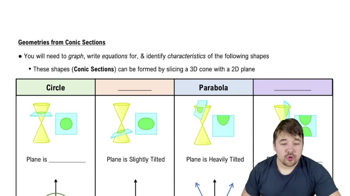
Graphing Conic Sections

Graphing conic sections involves plotting curves defined by quadratic equations in two variables. In this problem, the equations represent a circle and an ellipse, which are types of conic sections. Understanding their standard forms and shapes helps in sketching accurate graphs to find intersection points.
Recommended video:
3:08
Geometries from Conic Sections

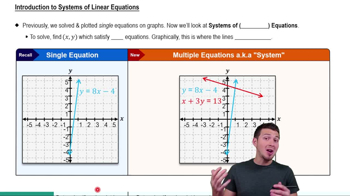
Systems of Equations

A system of equations consists of two or more equations with the same variables. The solution set includes all points that satisfy every equation simultaneously. Graphically, solutions correspond to points where the graphs intersect, making it essential to identify these points accurately.
Recommended video:
Guided course
4:27
Introduction to Systems of Linear Equations

Checking Solutions

After finding potential solutions from the graph, substituting these points back into the original equations verifies their validity. This step ensures that the intersection points truly satisfy both equations, confirming the solution set for the system.
Recommended video:
05:21
Restrictions on Rational Equations
Related Practice
Textbook Question

In Exercises 57–62, use the vertex and the direction in which the parabola opens to determine the relation's domain and range. Is the relation a function?

x=4(y1)2+3x = - 4(y - 1)^2 + 3


736
views
Textbook Question

Find the solution set for each system by graphing both of the system's equations in the same rectangular coordinate system and finding points of intersection. Check all solutions in both equations.

{x225+y29=1y=3\(\begin{cases}\]\frac{x^2}{25}\) + \(\frac{y^2}{9}\) = 1 \(\y\) = 3\(\end{cases}\)

734
views
Textbook Question

Convert each equation to standard form by completing the square on x and y. Then graph the ellipse and give the location of its foci. 36x2 +9y2 - 216x = 0

827
views
Textbook Question

In Exercises 57–62, use the vertex and the direction in which the parabola opens to determine the relation's domain and range. Is the relation a function?

y=x2+4x3y=-x^2+4x-3


732
views
Textbook Question

In Exercises 63–68, find the solution set for each system by graphing both of the system's equations in the same rectangular coordinate system and finding points of intersection. Check all solutions in both equations.

{x=y23x=y23y\(\left\)\{\(\begin{array}{l}\)x=y^2-3\\ x=y^2-3y\(\end{array}\]\right\).

704
views
Textbook Question

In Exercises 63–68, find the solution set for each system by graphing both of the system's equations in the same rectangular coordinate system and finding points of intersection. Check all solutions in both equations.

{(y2)2 =x+4y=(12)x\(\left\)\{\(\begin{array}{l}\]\left\)(y-2\(\right\))^2\(\text{ }\)=x+4\\ y=-\(\text{(}\[\frac\)12\(\text{)}\)x\(\end{array}\]\right\).

650
views