Ch. 8 - Sequences, Induction, and Probability
Blitzer - College Algebra 8th Edition
Blitzer8th EditionCollege AlgebraISBN: 9780136970514Not the one you use?Change textbook
Chapter 9, Problem 90

Exercises 88–90 will help you prepare for the material covered in the next section. Use the formula an = a₁3(n-1) to find the seventh term of the sequence 11, 33, 99, 297,...

Verified step by step guidance
1
Identify the first term of the sequence, which is given as a1=11.
Recognize that the formula for the nth term of the sequence is an = a1 3n - 1, where 3 is the common ratio.
Substitute 7 for n in the formula to find the seventh term: a7 = 11 37 - 1.
Simplify the exponent by calculating 7 - 1 = 6, so the expression becomes a7 = 11 imes 3^{6}.
To find the seventh term, multiply 11 by 3^{6}. (You can calculate 3^{6} first, then multiply by 11.)

Verified video answer for a similar problem:

This video solution was recommended by our tutors as helpful for the problem above.
Video duration:
2m
Was this helpful?

Key Concepts

Here are the essential concepts you must grasp in order to answer the question correctly.

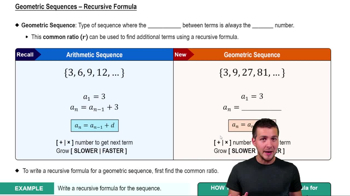
Geometric Sequence

A geometric sequence is a list of numbers where each term after the first is found by multiplying the previous term by a constant called the common ratio. In this problem, the sequence 11, 33, 99, 297,... is geometric with a common ratio of 3.
Recommended video:
Guided course
4:18
Geometric Sequences - Recursive Formula

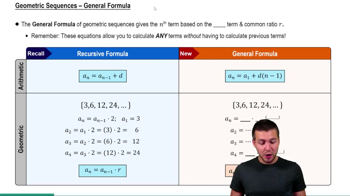
General Term Formula for Geometric Sequences

The nth term of a geometric sequence can be found using the formula an = a₁ * r^(n-1), where a₁ is the first term, r is the common ratio, and n is the term number. This formula allows direct calculation of any term without listing all previous terms.
Recommended video:
Guided course
4:45
Geometric Sequences - General Formula

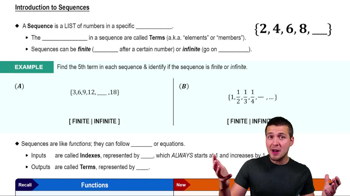
Exponentiation in Sequences

Exponentiation involves raising a number to a power, which in sequences represents repeated multiplication. In the formula an = a₁ * r^(n-1), the exponent (n-1) indicates how many times the common ratio is multiplied, crucial for finding terms like the seventh term.
Recommended video:
Guided course
8:22
Introduction to Sequences