Ch. 8 - Sequences, Induction, and Probability
Blitzer - College Algebra 8th Edition
Blitzer8th EditionCollege AlgebraISBN: 9780136970514Not the one you use?Change textbook
Chapter 9, Problem 91

You are dealt one card from a 52-card deck. Find the probability of getting an ace or a king.

Verified step by step guidance
1
Step 1: Understand the problem. You are tasked with finding the probability of drawing either an ace or a king from a standard 52-card deck. A standard deck has 52 cards divided into 4 suits (hearts, diamonds, clubs, spades), with each suit containing 13 cards.
Step 2: Determine the total number of favorable outcomes. There are 4 aces (one in each suit) and 4 kings (one in each suit) in the deck. Since these events are mutually exclusive (an ace cannot also be a king), the total number of favorable outcomes is 4 (aces) + 4 (kings) = 8.
Step 3: Calculate the total number of possible outcomes. The total number of cards in the deck is 52, so there are 52 possible outcomes when drawing one card.
Step 4: Use the probability formula. The probability of an event is given by the formula: favorable outcomestotal outcomes. Substitute the values: favorable outcomes = 8 and total outcomes = 52.
Step 5: Simplify the fraction to express the probability in its simplest form. Divide the numerator and denominator by their greatest common divisor (GCD), if applicable.

Verified video answer for a similar problem:

This video solution was recommended by our tutors as helpful for the problem above.
Video duration:
2m
Was this helpful?

Key Concepts

Here are the essential concepts you must grasp in order to answer the question correctly.

Probability

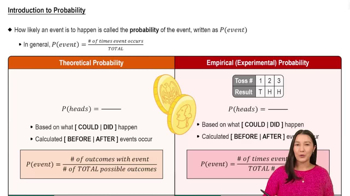
Probability is a measure of the likelihood that a particular event will occur, expressed as a number between 0 and 1. In this context, it quantifies the chance of drawing a specific type of card from a deck. The formula for probability is the number of favorable outcomes divided by the total number of possible outcomes.
Recommended video:
5:37
Introduction to Probability

Favorable Outcomes

Favorable outcomes refer to the specific results that satisfy the conditions of the event we are interested in. In this case, the favorable outcomes are the aces and kings in a standard 52-card deck. There are 4 aces and 4 kings, making a total of 8 favorable outcomes for this probability problem.
Recommended video:
4:23
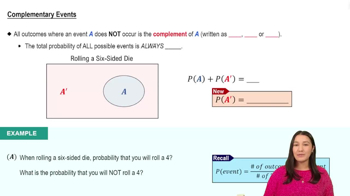
Complementary Events

Total Outcomes

Total outcomes represent the complete set of possible results in a probability scenario. For a standard deck of cards, there are 52 total outcomes since there are 52 cards. Understanding the total number of outcomes is crucial for calculating the probability of drawing an ace or a king.
Recommended video:
4:04
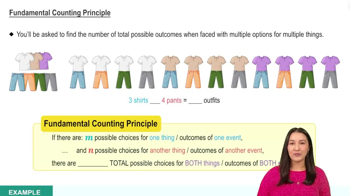
Fundamental Counting Principle