The general term of a sequence is given. Determine whether the sequence is arithmetic, geometric, or neither. If the sequence is arithmetic, find the common difference; if it is geometric, find the common ratio. an = n2 + 5

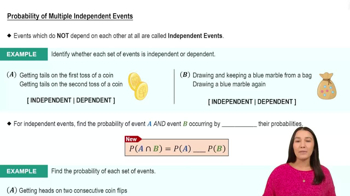
If you toss a fair coin six times, what is the probability of getting all heads?
Verified step by step guidance
Verified video answer for a similar problem:
Key Concepts
Probability of a Single Event
Independent Events
Multiplication Rule for Independent Events
Use the formula for nCr to solve Exercises 49–56. You volunteer to help drive children at a charity event to the zoo, but you can fit only 8 of the 17 children present in your van. How many different groups of 8 children can you drive?
In Exercises 43–54, express each sum using summation notation. Use 1 as the lower limit of summation and i for the index of summation. 1+3+5+⋯+ (2n−1)
In Exercises 51–56, the general term of a sequence is given. Determine whether the sequence is arithmetic, geometric, or neither. If the sequence is arithmetic, find the common difference; if it is geometric, find the common ratio. an = 2n
In Exercises 55–60, express each sum using summation notation. Use a lower limit of summation of your choice and k for the index of summation. 5+7+9+11+⋯+ 31
Find f(x + h) − f(x)/h and simplify. f(x) = x4+7
