Use the graphs of the arithmetic sequences {a} and {b} to solve Exercises 51-58. If {an} is a finite sequence whose last term is -83, how many terms does {an} contain?
Ch. 8 - Sequences, Induction, and Probability

Chapter 9, Problem 53
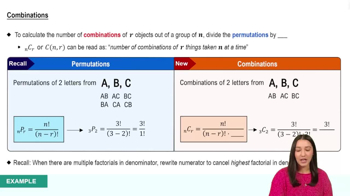
Use the formula for nCr to solve Exercises 49–56. You volunteer to help drive children at a charity event to the zoo, but you can fit only 8 of the 17 children present in your van. How many different groups of 8 children can you drive?
Verified step by step guidance1
Identify the problem as a combination problem because the order in which the children are chosen does not matter. We want to find the number of ways to choose 8 children out of 17.
Recall the formula for combinations, which is given by \(\displaystyle nCr = \frac{n!}{r!(n-r)!}\), where \(n\) is the total number of items, \(r\) is the number of items to choose, and \(!\) denotes factorial.
Substitute the given values into the formula: \(n = 17\) and \(r = 8\), so the expression becomes \(\displaystyle \binom{17}{8} = \frac{17!}{8!(17-8)!} = \frac{17!}{8!9!}\).
Calculate the factorial values or simplify the expression by expanding the factorials partially to make the calculation easier, for example, expand \$17!\( down to \)9!$ to cancel terms.
Evaluate the simplified expression to find the total number of different groups of 8 children that can be formed from 17 children.

Verified video answer for a similar problem:
This video solution was recommended by our tutors as helpful for the problem above.
Video duration:
2mWas this helpful?
Key Concepts
Here are the essential concepts you must grasp in order to answer the question correctly.
Combination Formula (nCr)
The combination formula, denoted as nCr, calculates the number of ways to choose r items from a set of n distinct items without regard to order. It is given by nCr = n! / [r! (n - r)!], where '!' denotes factorial. This formula is essential for counting groups or subsets where order does not matter.
Recommended video:
Combinations
Factorials
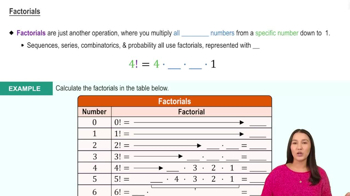
A factorial, represented by n!, is the product of all positive integers from 1 up to n. For example, 5! = 5 × 4 × 3 × 2 × 1 = 120. Factorials are used in permutations and combinations to calculate the total number of arrangements or selections.
Recommended video:
Factorials
Application of Combinations in Real-Life Problems
Combinations are used to determine how many different groups or selections can be made from a larger set when order does not matter. In this problem, selecting 8 children out of 17 to fit in a van is a practical example where combinations help find the number of possible groups.
Recommended video:
Multiplying & Dividing Functions
Related Practice
Textbook Question
939
views
Textbook Question
If you toss a fair coin six times, what is the probability of getting all heads?
617
views
Textbook Question
The general term of a sequence is given. Determine whether the sequence is arithmetic, geometric, or neither. If the sequence is arithmetic, find the common difference; if it is geometric, find the common ratio. an = n + 5
964
views
Textbook Question
In Exercises 43–54, express each sum using summation notation. Use 1 as the lower limit of summation and i for the index of summation. 1+3+5+⋯+ (2n−1)
995
views
Textbook Question
Use the graphs of the arithmetic sequences {a} and {b} to solve Exercises 51-58.
Find a14+b12.
1232
views
Textbook Question
Find f(x + h) − f(x)/h and simplify. f(x) = x4+7
577
views