 Back
BackAccrual Accounting and Income: Chapter 3 Study Notes
Study Guide - Smart Notes
 Tailored notes based on your materials, expanded with key definitions, examples, and context.
Accrual Accounting and Income
Introduction
This chapter explores the principles and practices of accrual accounting, focusing on how income is measured and reported. It covers the differences between accrual and cash-basis accounting, the recognition of revenues and expenses, adjusting entries, the construction of financial statements, and the analysis of a company's debt-paying ability. Data visualization techniques are also introduced to help interpret financial information.
Accrual Accounting vs. Cash-Basis Accounting
Accrual accounting records both cash and noncash transactions, providing a more accurate picture of a company's financial position than cash-basis accounting.
Cash Transactions: Include collecting cash from customers, paying expenses, borrowing money, and issuing stock.
Noncash Transactions: Include sales on account, purchases on account, accrual of expenses, depreciation, usage of prepaid items, and earning revenue when cash is collected in advance.
Example: Sales made on account are recorded as revenue even if cash has not yet been received.
Three Main Concepts/Principles of Accrual Accounting
Time-Period Concept: Ensures accounting information is reported at regular intervals, typically annually or for interim periods.
Revenue Principle: Revenue is recognized when goods or services are delivered, for the amount expected to be received.
Expense Recognition Principle: Expenses are recognized in the same period as the related revenues, ensuring accurate measurement of net income.
Adjusting Entries
Adjusting entries are made at the end of the accounting period to update account balances and ensure proper revenue and expense recognition.
Deferrals: Adjustments for payments or receipts made in advance (e.g., prepaid expenses, unearned revenues).
Depreciation: Allocates the cost of plant assets over their useful lives.
Accruals: Adjustments for expenses incurred or revenues earned but not yet paid or received (e.g., accrued expenses, accrued revenues).
Prepaid Expenses
Prepaid expenses are assets that provide future benefits. Examples include rent, insurance, and supplies.
When prepaid rent is paid, it is recorded as an asset. As time passes, an adjusting entry transfers the appropriate portion to rent expense.
Supplies purchased are recorded as assets; as they are used, the remaining balance is adjusted.
Unearned Service Revenue
Unearned service revenue is a liability created when cash is received before the revenue is earned. As services are performed, the liability is reduced and revenue is recognized.
Depreciation of Plant Assets
Depreciation allocates the cost of long-lived assets (except land) over their useful lives. The straight-line method is commonly used.
Formula:
Example: Equipment costing \frac{24,000}{5} = 4,800\frac{4,800}{12} = 400$ per month.
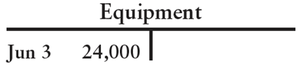
Depreciation is recorded in the Accumulated Depreciation account, a contra asset with a normal credit balance.
Accrued Expenses
Accrued expenses are liabilities for expenses incurred but not yet paid. They are recorded at period-end as adjusting entries.
Example: Salary expense accrued at month-end, to be paid in the following month.
Accrued Revenues
Accrued revenues are revenues earned but not yet collected. They are recognized at period-end to match revenue with the period in which it was earned.
Trial Balance and Adjusted Trial Balance
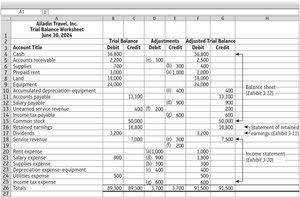
The trial balance lists all accounts and their balances before adjustments. The adjusted trial balance reflects all adjustments and is used to prepare financial statements.
Closing the Books
Closing entries reset temporary accounts (revenues, expenses, dividends) to zero for the next period. Permanent accounts (assets, liabilities, equity) are not closed.
Debit each revenue account for its credit balance; credit Retained Earnings.
Credit each expense account for its debit balance; debit Retained Earnings.
Credit Dividends for its debit balance; debit Retained Earnings.
Classifying Assets and Liabilities
Assets and liabilities are classified as current or long-term based on liquidity.
Current Assets: Most liquid; converted to cash or consumed within a year (e.g., cash, accounts receivable, prepaid expenses).
Long-Term Assets: Not expected to be converted within a year (e.g., land, buildings, equipment).
Current Liabilities: Debts due within a year (e.g., accounts payable, salary payable, unearned revenue).
Long-Term Liabilities: Debts not due within a year (e.g., long-term notes payable).
Analyzing Debt-Paying Ability
Financial ratios help stakeholders assess a company's liquidity and debt-paying ability.
Net Working Capital:
Current Ratio:
Debt Ratio:

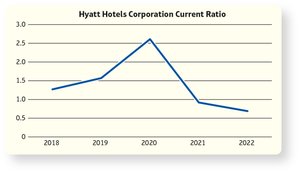
Companies generally prefer a high current ratio and a low debt ratio for financial safety.
Data Visualization in Financial Accounting
Data visualization, such as bar charts and line charts, helps to spot patterns and trends in financial data, making it easier to interpret and analyze information.
Summary of the Adjusting Process
The adjusting process serves two main purposes: measuring income and updating the balance sheet. Every adjusting entry affects both a revenue or expense account and an asset or liability account.
Tables
The trial balance worksheet is a key tool for summarizing account balances and adjustments. Below is a simplified version:
Account Title | Trial Balance (Debit) | Trial Balance (Credit) | Adjustments (Debit) | Adjustments (Credit) | Adjusted Trial Balance (Debit) | Adjusted Trial Balance (Credit) |
|---|---|---|---|---|---|---|
Cash | 36,100 | 36,100 | ||||
Accounts Receivable | 3,200 | 3,200 | ||||
Supplies | 700 | 300 | 400 | |||
Prepaid Rent | 3,000 | 1,000 | 2,000 | |||
Equipment | 24,000 | 24,000 | ||||
Accumulated Depreciation | 400 | 400 | ||||
Service Revenue | 7,000 | 300 | 7,300 | |||
Salary Expense | 1,800 | 900 | 2,700 | |||
Rent Expense | 1,000 | 1,000 | ||||
Supplies Expense | 300 | 300 | ||||
Depreciation Expense | 400 | 400 | ||||
Other accounts... |
Additional info: Table entries are simplified for clarity; actual worksheets may include more accounts and details.
Key Formulas
Conclusion
Accrual accounting provides a comprehensive framework for measuring and reporting income, ensuring that financial statements reflect the true financial position of a company. Understanding adjusting entries, closing the books, and analyzing financial ratios is essential for effective financial accounting.
