 Back
BackAccrual Accounting and Income – Chapter 3 Study Notes
Study Guide - Smart Notes
 Tailored notes based on your materials, expanded with key definitions, examples, and context.
Accrual Accounting and Income
Introduction
This chapter explores the principles and applications of accrual accounting, focusing on how it differs from cash-basis accounting, the recognition of revenues and expenses, the process of adjusting accounts, and the preparation and analysis of financial statements. Understanding these concepts is essential for accurate financial reporting and analysis in financial accounting.
Accrual Accounting vs. Cash-Basis Accounting
Key Differences
Cash-Basis Accounting: Records revenues and expenses only when cash is received or paid.
Accrual Accounting: Records revenues when earned and expenses when incurred, regardless of cash flow.
Accrual accounting provides a more accurate picture of a company's financial position by including noncash transactions such as sales on account, accrued expenses, depreciation, and the use of prepaid assets.
The Time-Period Concept
Ensures accounting information is reported at regular intervals (e.g., annually, quarterly).
Most companies use a calendar year, but some use a fiscal year ending on a different date.
Interim statements may be prepared for periods less than a year.
Revenue and Expense Recognition Principles
The Revenue Principle
Determines when and how much revenue to recognize.
Revenue is recognized when goods or services are delivered, and the company is entitled to receive payment.
The amount recorded is the cash or equivalent value to be received.
The Expense Recognition (Matching) Principle
Expenses are recognized in the same period as the related revenues they help generate.
Ensures accurate measurement of net income:
Involves identifying and measuring all expenses incurred during the period.
Adjusting the Accounts
Purpose of Adjusting Entries
Ensure revenues and expenses are recorded in the correct period (accrual basis).
Made at the end of the accounting period.
Always affect one income statement account and one balance sheet account (never cash).
Categories of Adjusting Entries
Deferrals: Cash is received or paid before revenue is earned or expense is incurred (e.g., prepaid expenses, unearned revenue).
Accruals: Revenue is earned or expense is incurred before cash is received or paid (e.g., accrued expenses, accrued revenues).
Depreciation: Allocates the cost of long-term assets over their useful lives.
Examples of Adjusting Entries
Prepaid Expenses: Initially recorded as assets; as used, they are expensed (e.g., prepaid rent, supplies).
Depreciation: Spreads the cost of plant assets over their useful life, except land.
Unearned Revenue: Cash received before services are performed; recognized as a liability until earned.
Accrued Expenses: Expenses incurred but not yet paid (e.g., salaries, interest).
Accrued Revenues: Revenues earned but not yet received in cash.
Example: Accrued Salary Expense
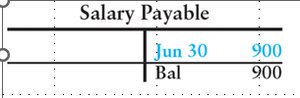
Suppose Alladin Travel, Inc. owes $900 in salary at month-end, which will be paid next period. The adjusting entry records Salary Expense and Salary Payable.
Depreciation of Plant Assets
Straight-Line Depreciation Method
Annual Depreciation = Cost / Useful Life
Monthly Depreciation = Annual Depreciation / 12
Depreciation is recorded in a contra asset account called Accumulated Depreciation, which offsets the asset's book value.
Summary of Adjusting Process
Adjusting entries are necessary to measure income and update the balance sheet.
Every adjusting entry affects both an income statement account and a balance sheet account.
No cash is involved in adjusting entries.
Constructing Financial Statements
Types of Financial Statements
Income Statement: Reports revenues and expenses for a period.
Statement of Retained Earnings: Shows changes in retained earnings.
Balance Sheet: Reports assets, liabilities, and equity at a point in time.
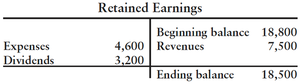
Example: Retained Earnings Account
Retained Earnings | |
|---|---|
Beginning balance | 18,800 |
Expenses | 4,600 |
Dividends | 3,200 |
Revenues | 7,500 |
Ending balance | 18,500 |
Closing the Books
Purpose and Process
Prepares accounts for the next period and updates Retained Earnings.
Temporary accounts (revenues, expenses, dividends) are closed to Retained Earnings.
Permanent accounts (assets, liabilities, equity) are not closed.
Classifying Assets and Liabilities
Current vs. Long-Term
Current Assets: Expected to be converted to cash or used within one year (e.g., cash, accounts receivable, inventory).
Long-Term Assets: Not expected to be converted to cash within one year (e.g., property, plant, equipment).
Current Liabilities: Debts due within one year (e.g., accounts payable, salary payable).
Long-Term Liabilities: Debts due after one year (e.g., long-term notes payable).
Financial Statement Formats
Balance Sheet: Report format and account format.
Income Statement: Single-step (all revenues and expenses together) or multi-step (separates operating and non-operating items).
Analyzing and Evaluating Debt-Paying Ability
Key Ratios
Net Working Capital:
Current Ratio:
Debt Ratio:
Higher current ratios indicate better liquidity; lower debt ratios indicate lower financial risk.
Data Visualization in Accounting
Purpose and Types
Data visualization helps identify patterns and trends in financial data.
Bar Charts: Display categorical data for comparison.
Line Charts: Show changes in data over time.
Additional info: Understanding accrual accounting and the adjusting process is foundational for preparing accurate financial statements and analyzing a company's financial health. Mastery of these concepts is essential for all financial accounting students.
