Back
BackIntroduction to Accounting and the Business Environment
Study Guide - Smart Notes
 Tailored notes based on your materials, expanded with key definitions, examples, and context.
Accounting: The Language of Business
Definition and Purpose
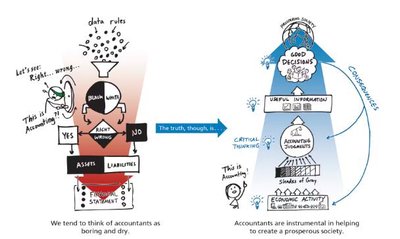
Accounting is an information system that measures, processes, and communicates financial information about business activities. It is often referred to as the "language of business" because it provides essential data for decision-making by various stakeholders.
Measures business financial activities
Processes information into structured reports
Communicates these reports to decision makers
Includes bookkeeping as a foundational element, but extends to analysis and interpretation
Users of Accounting Information
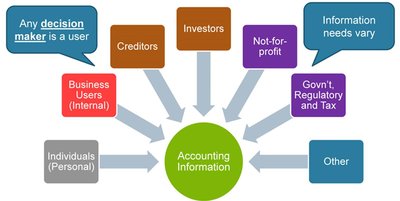
Accounting information is used by a wide range of decision makers, both internal and external to the organization. Each user group has distinct information needs.
Internal users: Managers, business owners, employees
External users: Investors, creditors, government agencies, regulatory bodies, not-for-profit organizations, and individuals
Types of Accounting
There are two primary branches of accounting, each serving different user groups:
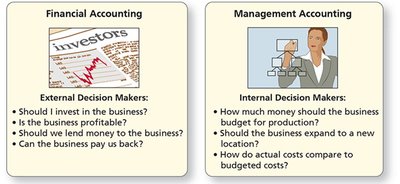
Financial Accounting: Provides information for external decision makers (e.g., investors, creditors). Focuses on historical data and compliance with standards.
Management Accounting: Provides information for internal decision makers (e.g., managers). Focuses on planning, controlling, and decision-making within the organization.
Forms of Business Organizations
Overview and Comparison
Businesses can be organized in several forms, each with unique characteristics regarding ownership, liability, taxation, and legal status.
Proprietorship | Partnership | Corporation | |
|---|---|---|---|
Definition | Unincorporated, single owner | Two or more owners, not a corporation | Organized under law as a separate legal entity |
Number of Owners | One (proprietor) | Two or more (partners) | One or more (shareholders) |
Life of Organization | Ends at owner's choice or death | Ends at partners' choice or death | Indefinite |
Personal Liability | Owner is personally liable | Partners are personally liable* | Shareholders are not personally liable |
Legal Status | Not legally separate | Not legally separate | Legally separate |
Taxation | Owner pays tax on business income | Each partner pays tax on share of income | Corporation pays tax on its income |
Type of Business | Small businesses | Professional organizations | Small to large businesses |
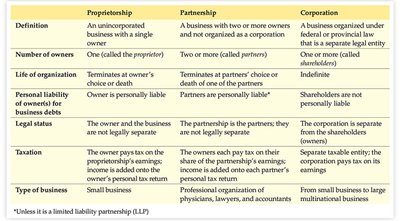
Additional info: In a Limited Liability Partnership (LLP), one partner's actions do not create significant liability for other partners.
Accounting Standards: GAAP vs IFRS
Purpose and Overview
Accounting standards ensure the usefulness, reliability, and comparability of financial information. The two main frameworks are:
GAAP (Generally Accepted Accounting Principles): Country-specific guidelines for measuring, processing, and communicating financial information.
IFRS (International Financial Reporting Standards): Developed by the International Accounting Standards Board (IASB) for global consistency.
Canadian Context: IFRS and ASPE
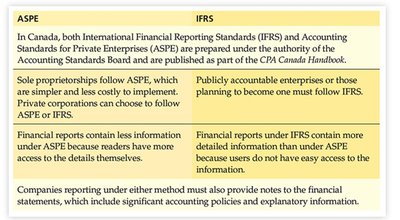
In Canada, the Accounting Standards Board (AcSB) administers standards:
IFRS: Required for publicly accountable enterprises
ASPE (Accounting Standards for Private Enterprises): Used by small to medium-sized businesses; a simplified version of IFRS
Both are principles-based, requiring professional judgment
Framework for Financial Reporting
Hierarchy of the Conceptual Framework
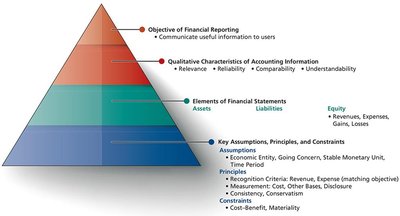
The conceptual framework for financial reporting is structured in levels, each building on the previous to ensure the quality and consistency of financial statements.
Level 1: Objective – Communicate useful information to users
Level 2: Qualitative Characteristics – Relevance, reliability, comparability, understandability
Level 3: Elements – Assets, liabilities, equity, revenues, expenses, gains, losses
Level 4: Key Assumptions, Principles, and Constraints – Economic entity, going concern, stable monetary unit, cost principle, cost-benefit constraint
Qualitative Characteristics
Relevance: Information must be capable of making a difference in decisions
Reliability: Information must be accurate and free from bias
Comparability: Enables users to identify similarities and differences between periods or entities
Understandability: Information must be clear and concise
Key Elements of Financial Statements
Assets: Economic resources controlled by the entity, expected to provide future benefits
Liabilities: Debts or obligations owed to outsiders (creditors)
Equity: Residual interest in the assets after deducting liabilities
Revenues, Expenses, Gains, Losses: Components that affect equity
Key Assumptions, Principles, and Constraints
Economic Entity Assumption: Separate records for each entity
Going Concern Assumption: Business will continue operating
Stable Monetary Unit Assumption: Ignore inflation effects
Cost Principle: Assets recorded at historical cost
Cost-Benefit Constraint: Benefits of information should exceed the cost of providing it
The Accounting Equation
Basic Equation
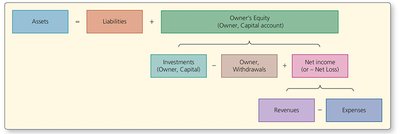
The accounting equation is the foundation of the double-entry accounting system. It shows the relationship between assets, liabilities, and owner's equity:
Formula:

Expanded Accounting Equation
The equation can be expanded to show the components of owner's equity:
Examples of Assets, Liabilities, and Owner's Equity
Assets: Cash, accounts receivable, notes receivable, prepaid expenses, land, buildings, equipment
Liabilities: Accounts payable, accrued liabilities, notes payable, unearned revenue
Owner's Equity: Capital (investments), withdrawals, revenues, expenses
Accounting for Business Transactions
Steps in Transaction Analysis
Each business transaction affects the accounting equation. The steps for analyzing transactions are:
Identify the accounts and account types impacted
Determine if each account increases or decreases
Ensure the accounting equation remains balanced after each transaction
Example: Owner invests cash, business purchases land, earns revenue, incurs expenses, etc.
Financial Statements
Types and Order of Preparation
Financial statements are formal reports that summarize an entity's financial activities. They are prepared in a specific order:
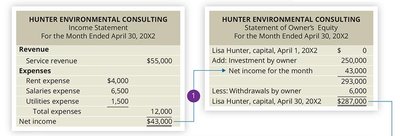
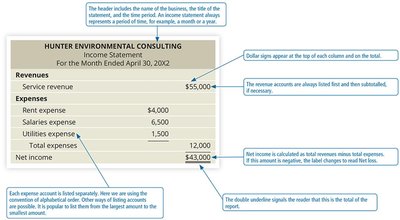
Income Statement: Summarizes revenues and expenses for a period, showing net income or loss
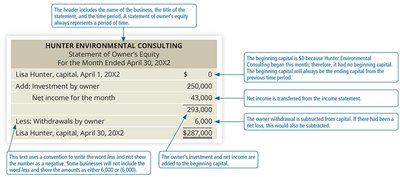
Statement of Owner's Equity: Shows changes in owner's equity during the period
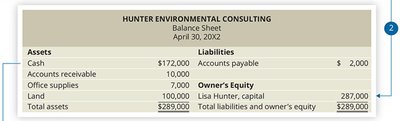
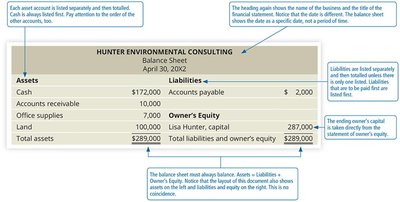
Balance Sheet: Lists assets, liabilities, and owner's equity at a specific date
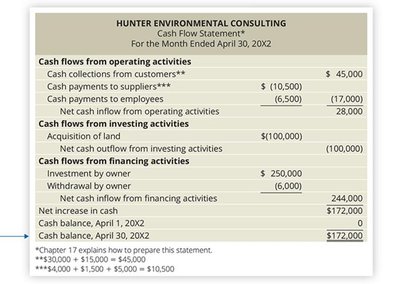
Cash Flow Statement: Reports cash inflows and outflows during the period
Relationships Among Financial Statements
The financial statements are interrelated:
Net income from the income statement is added to owner's equity in the statement of owner's equity
The ending capital balance from the statement of owner's equity appears in the balance sheet
The ending cash balance from the cash flow statement must match the cash reported on the balance sheet