Back
BackPreparation of Financial Statements for Retail Ltd (IAS 1)
Study Guide - Smart Notes
 Tailored notes based on your materials, expanded with key definitions, examples, and context.
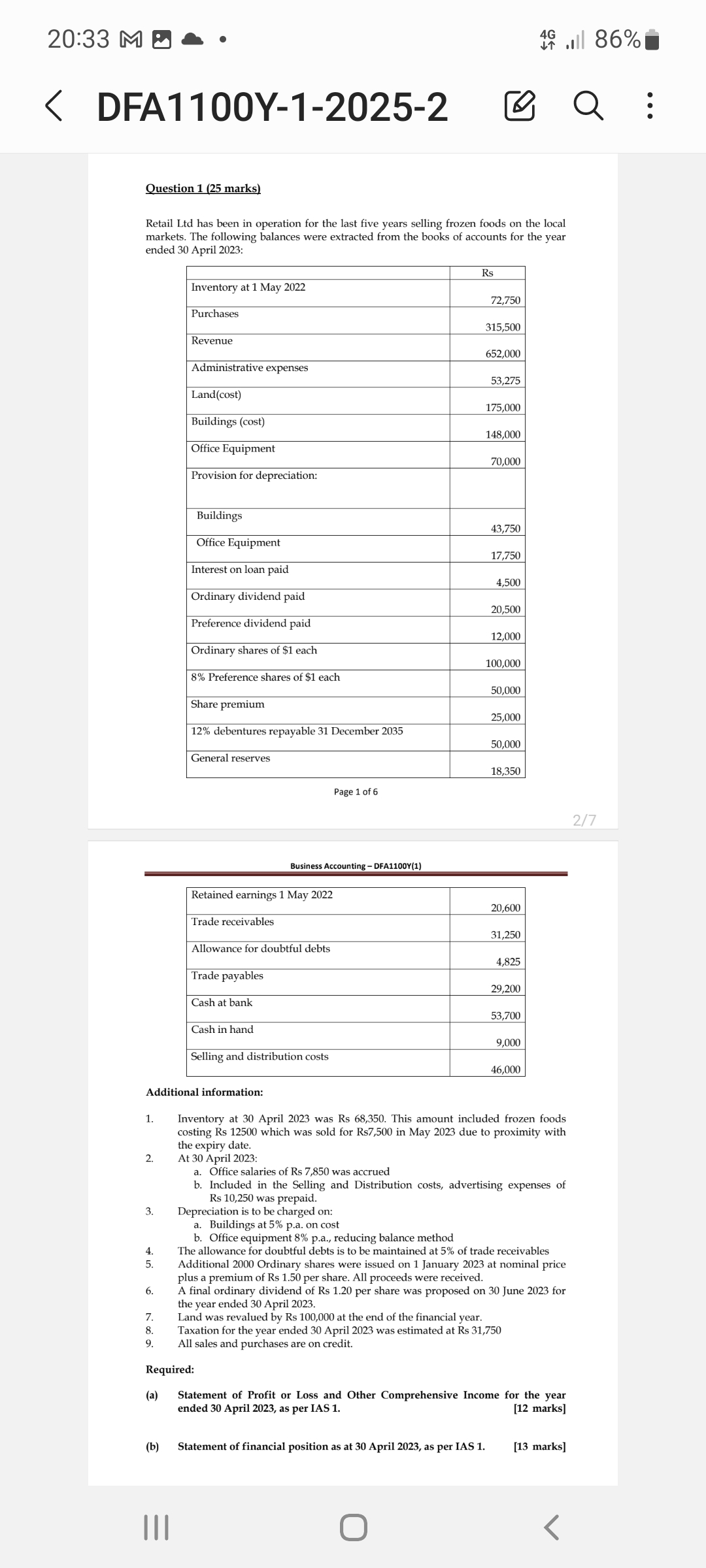
Q1. Prepare the following for Retail Ltd for the year ended 30 April 2023:
(a) Statement of Profit or Loss and Other Comprehensive Income, as per IAS 1.
(b) Statement of Financial Position, as per IAS 1.
Background
Topic: Financial Statement Preparation (IAS 1)
This question tests your ability to prepare the main financial statements for a company: the Statement of Profit or Loss and Other Comprehensive Income, and the Statement of Financial Position. You are required to apply International Accounting Standard 1 (IAS 1), which sets out the overall requirements for financial statements, including their structure and minimum content.
Key Terms and Formulas
Revenue: Total income from sales before any expenses are deducted.
Cost of Sales: Opening Inventory + Purchases - Closing Inventory (adjusted for any obsolete/unsellable stock).
Gross Profit: Revenue - Cost of Sales.
Operating Expenses: Administrative expenses, selling and distribution costs (adjusted for accruals and prepayments), depreciation, and allowance for doubtful debts.
Profit Before Tax: Gross Profit - Operating Expenses - Finance Costs.
Profit for the Year: Profit Before Tax - Tax Expense.
Other Comprehensive Income: Includes items like revaluation surplus (e.g., land revaluation).
Statement of Financial Position: Shows assets, equity, and liabilities at year-end.
Step-by-Step Guidance
Calculate Cost of Sales: Use the formula: Remember to adjust closing inventory for any items that are obsolete or sold below cost (e.g., the frozen foods costing Rs 12,500 but sold for Rs 7,500).
Adjust Operating Expenses: For administrative expenses, add any accrued salaries (not yet paid) and for selling/distribution costs, subtract any prepaid advertising. Also, include depreciation for buildings and office equipment (using the rates and methods provided).
Calculate Allowance for Doubtful Debts: Set the allowance at 5% of the year-end trade receivables. Compare this to the existing allowance and adjust the expense accordingly.
Prepare the Statement of Profit or Loss: Start with revenue, subtract cost of sales to get gross profit, then subtract all operating expenses (including depreciation, doubtful debts, and finance costs) to get profit before tax. Deduct tax expense to get profit for the year. Add any other comprehensive income (e.g., land revaluation surplus).
Prepare the Statement of Financial Position: List assets (current and non-current), equity (including share capital, share premium, reserves, retained earnings, and revaluation surplus), and liabilities (current and non-current). Make sure to adjust for new share issues, dividends, and revaluations as per the additional information.
Try solving on your own before revealing the answer!