 Back
BackRecording Business Transactions: Principles of Financial Accounting
Study Guide - Smart Notes
 Tailored notes based on your materials, expanded with key definitions, examples, and context.
Recording Business Transactions
The Accounting Cycle
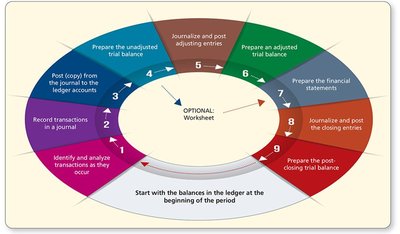
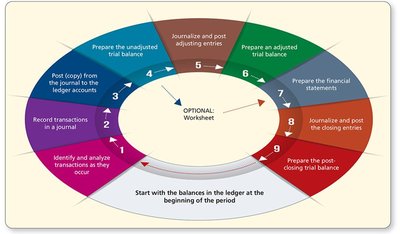
The accounting cycle is a systematic process used to record and summarize business transactions for a specific period. It ensures that all financial events are accurately captured and reported in the financial statements.
Step 1: Identify and analyze transactions as they occur
Step 2: Record transactions in a journal
Step 3: Post from the journal to the ledger accounts
Step 4: Prepare the unadjusted trial balance
Step 5: Journalize and post adjusting entries
Step 6: Prepare an adjusted trial balance
Step 7: Prepare the financial statements
Step 8: Journalize and post the closing entries
Step 9: Prepare the post-closing trial balance
Key Accounting Terms
Understanding the terminology is essential for recording business transactions:
Transaction: An event that affects the financial position of an entity and can be reliably measured.
Journal: A chronological record of all transactions.
Ledger: A collection of accounts showing the changes and balances for each account.
Chart of Accounts: A list of all accounts used by the entity, organized by type and number.
Transaction Analysis
The Accounting Equation
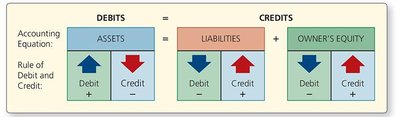
All business transactions are analyzed using the accounting equation:
Assets = Liabilities + Owner’s Equity
Each transaction affects at least two accounts, maintaining the balance of the equation.
Rules of Debit and Credit
The rules of debit and credit determine how increases and decreases are recorded in each account type:
Assets: Increase with debits, decrease with credits
Liabilities: Increase with credits, decrease with debits
Owner’s Equity: Increase with credits, decrease with debits
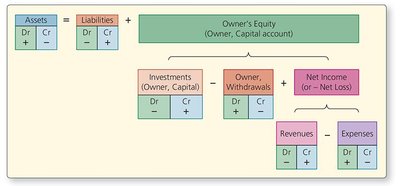
These rules extend to revenues and expenses:
Revenues: Increase with credits
Expenses: Increase with debits
Withdrawals: Increase with debits
Normal Balance of Accounts
The normal balance is the side (debit or credit) where increases are recorded:
Assets, Expenses, Withdrawals: Debit
Liabilities, Revenues, Capital: Credit
Mnemonic: All Elephants Will Love Rowdy Children (Assets, Expenses, Withdrawals = Debit; Liabilities, Revenues, Capital = Credit)
Recording Transactions in the Journal
Journalizing Transactions
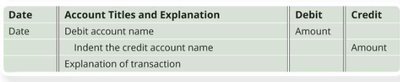
Journalizing is the process of recording transactions in the journal. Each entry includes:
Date of the transaction
Account titles and explanation
Debit and credit amounts
A brief explanation
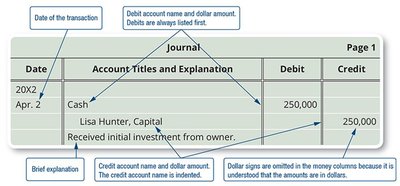
Date | Account Titles and Explanation | Debit | Credit |
|---|---|---|---|
Apr. 2 | Cash Lisa Hunter, Capital Received initial investment from owner. | 250,000 | 250,000 |
Posting to the Ledger
Ledger Accounts and T-Accounts
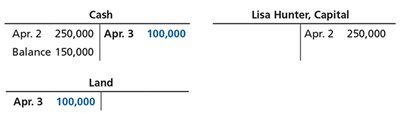
After journalizing, amounts are posted to the ledger, which tracks all transactions for each account. T-Accounts are informal tools to visualize the effect of transactions.
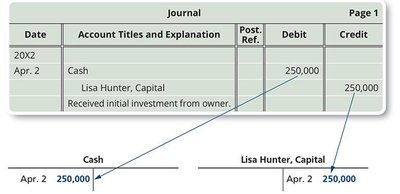
Chart of Accounts
Structure and Numbering
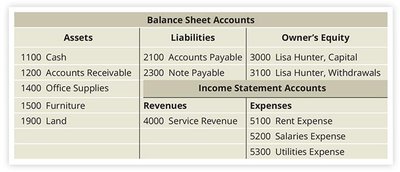
The chart of accounts organizes all accounts used by the entity. Accounts are numbered and grouped by type:
1xxx: Assets
2xxx: Liabilities
3xxx: Owner’s Equity
4xxx: Revenues
5xxx: Expenses
Trial Balance
Preparing the Unadjusted Trial Balance
The trial balance is a summary of all ledger accounts and their balances, used to verify that total debits equal total credits.
Presented in the order: Assets, Liabilities, Owner’s Equity, Revenues, Expenses
Used to detect errors before preparing financial statements
Summary of Recording Business Transactions
Key Points
Transactions are analyzed and recorded using the accounting equation and rules of debit and credit.
Journal entries are posted to the ledger, which tracks account balances.
The trial balance ensures the records are in balance before financial statements are prepared.
Examples and Applications
Sample Journal Entry and Posting
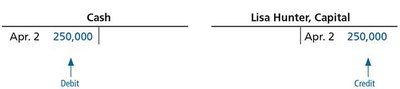
Example: Owner invests $250,000 cash in the business.
Journal Entry: Debit Cash $250,000; Credit Capital $250,000
Ledger Posting: Cash account shows debit; Capital account shows credit
Expanded Accounting Equation
The expanded accounting equation incorporates investments, withdrawals, revenues, and expenses:
Formulas and Equations
Basic Accounting Equation:
Expanded Accounting Equation:
Additional info:
Source documents (e.g., invoices, deposit slips, cheques) provide evidence for transactions and are essential for analysis.
Posting references help trace amounts between the journal and ledger.
Double-entry accounting ensures every transaction affects at least two accounts, maintaining the balance of the accounting equation.
