 Back
BackValuation of Financial Assets: Bonds and Stocks
Study Guide - Smart Notes
 Tailored notes based on your materials, expanded with key definitions, examples, and context.
Valuation of Financial Assets
Financial Markets and Intermediaries
Financial markets and intermediaries play a crucial role in connecting agents with investment needs and those with excess funds. Understanding their structure and functions is essential for financial managers and investors.
Financial Markets: Systems that facilitate the flow of funds between borrowers (households, corporations, governments) and savers/lenders.
Types of Markets:
Primary vs. Secondary: Primary markets involve issuers creating securities; secondary markets involve trading between investors.
Equity vs. Fixed-Income: Equity markets trade shares; fixed-income markets trade debt securities (bonds).
Organized vs. OTC: Organized markets are centralized and regulated; OTC markets lack a central exchange.
Other Markets: Foreign exchange, commodities, derivatives.
Financial Institutions: Organizations that raise money from investors and invest in financial assets. Types include mutual funds, pension funds, hedge funds, insurance companies, commercial banks, investment banks, and public institutions.
Functions of Financial Markets
Transfer Resources Across Time: Enable borrowing and lending, allowing agents to shift resources between present and future.
Risk Transfer and Diversification: Investors can reduce risk by holding diversified portfolios or using insurance and derivatives.
Liquidity: Ability to convert investments to cash quickly and at low cost.
Payment Mechanism: Facilitate fund transfers via checks, credit cards, electronic systems.
Provision of Information: Markets provide price signals and rates of return, aiding investment decisions.
Financing Instruments: Debt vs. Equity
Corporations and other entities issue financial claims to raise funds, primarily in the form of debt and equity.
Equity: Entitles stockholders to perpetual ownership, voting rights, and dividends.
Debt: Entitles lenders to fixed payments for a set period, with priority in repayment.
Key Differences:
Cash Flow Rights: Debtholders have priority and fixed payments; shareholders have residual claims and variable payoffs.
Control Rights: Shareholders control the firm; debtholders gain control only in default/liquidation.
Valuing Bonds
The Bond Market
Bonds are debt securities issued by corporations and governments to raise funds. Bondholders receive periodic coupon payments and the principal at maturity.
Bond Characteristics:
Face value (principal/par value)
Coupon rate (periodic payment)
Maturity (repayment date)
Bond Types: Bills, notes, debentures, zero-coupon bonds
Interest Rates and Bond Prices
The value of a bond is the present value of its future cash flows, discounted by the market interest rate.
Bond Price Formula:
Bond Price Example:
Interest Rate Impact:
When market rate > coupon rate: bond trades at discount
When market rate = coupon rate: bond trades at par
When market rate < coupon rate: bond trades at premium
Interest Rate Risk
Bond prices are sensitive to changes in interest rates, especially for long-term bonds.
Price changes are more pronounced for bonds with longer maturities.
Yield to Maturity and Bond Rates of Return
Yield to maturity (YTM) is the discount rate that equates the present value of a bond’s payments to its price.
Yield to Maturity Formula:
Bond Rate of Return:
The Yield Curve
The yield curve plots bond yields against maturity, often upward-sloping, reflecting higher yields for longer-term bonds due to greater price volatility.
The slope of the yield curve indicates market expectations about the economy.
Corporate Bonds and Default Risk
Corporate bonds carry default risk, compensated by higher coupon rates and default premiums.
Bond Ratings: Provided by agencies (e.g., Moody’s), ranging from Aaa (highest) to Ba (speculative/junk).
Protections: Seniority, security (collateral), protective covenants.
Valuing Stocks
Stocks and Stock Markets
Corporations raise capital by issuing shares, which represent ownership. Shares are traded in primary and secondary markets.
Primary Offering: Sale of new shares to investors.
Secondary Market: Trading of existing shares among investors.
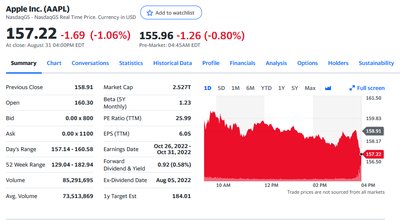
Stock Market Listings: Provide trading data, dividend yield, PE ratio, and other metrics.
Stock Rate of Return
Formula:
For longer holding periods:
Valuing Common Stocks
Stock valuation can be approached via book value, liquidation value, or market value. Market value reflects investor expectations and intangible assets.
Valuation by Comparables: Uses ratios like market-to-book and price-earnings to estimate value based on similar firms.
Example Table:
Company
Industry Market-to-Book
Company PE Ratio
Industry PE Ratio
Apple
26.3
27.04
14.97
Levi Strauss
3.83
11.96
36.12
Walmart
5.89
26.5
32.64
Johnson & Johnson
5.43
23.91
45.69
Netflix
5.13
19.85
765.06
The Dividend Discount Model
The dividend discount model (DDM) values a stock as the present value of expected future dividends.
Constant-Growth DDM (Gordon-Shapiro Model): Where is next year's dividend, is required rate of return, is dividend growth rate.
Required Rate of Return:
Growth Rate Estimation:
Example:
Book value per share: $10$
ROE:
Payout ratio:
Dividend:
Growth rate:
Required return:
Stock price:
Non-Constant Growth DDM: Where
The Sources of Value
Stock value can be decomposed into assets in place and growth opportunities.
Reinvesting earnings can increase future dividends and stock value if ROE > required return.
Summary Table: Key Formulas
Concept | Formula (LaTeX) |
|---|---|
Bond Price | |
Yield to Maturity | |
Bond Rate of Return | |
Stock Rate of Return | |
Dividend Discount Model | |
Required Rate of Return | |
Growth Rate |
Conclusion
Understanding the valuation of financial assets, including bonds and stocks, is fundamental for financial-accounting students. The concepts of present value, yield, risk, and market mechanisms underpin the pricing and analysis of these assets in financial markets.
